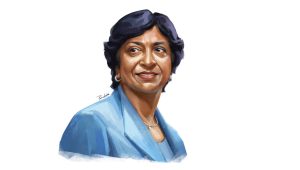
At a time when women’s voices rarely travelled beyond the walls of their homes, Nurjahan Begum chose to place them firmly on printed pages. She did not merely edit a magazine; she built a platform, a movement, and a legacy. As a pioneer of women’s journalism in Bangladesh and the long-serving editor of Begum, the first women’s weekly magazine of the Indian subcontinent, she reshaped how women engaged with media, literature and public life.
Born on June 4, 1925, in a village in Chandpur, Nurjahan grew up in an environment where ideas mattered. Her father, Mohammad Nasiruddin, was the editor of the influential newspaper Saugat, and her mother, Fatema Khatun, quietly nurtured her curiosity. In 1929, the family moved to Kolkata, exposing Nurjahan early to the world of journalism and intellectual debate.
She studied at Sakhawat Memorial School, a progressive institution for girls, completing her secondary education in 1942. Later, she earned a BA degree from Lady Brabourne College after studying Philosophy, History and Geography, an education that sharpened her critical thinking and social awareness.

The Saugat office became her informal classroom. Literary gatherings there brought together figures like Kazi Nazrul Islam, Begum Sufia Kamal and Kazi Motahar Hossain. Nurjahan listened, observed and learned. These conversations convinced her that the written word could be a powerful tool for change.
Begum magazine began publication in 1947. Though Begum Sufia Kamal was its first editor, Nurjahan was involved from the start as acting editor, balancing editorial work with university life. Over time, she would serve as editor for nearly six decades, an extraordinary commitment that defined her life.




After marrying Roknuzzaman Khan in 1950, she moved to Dhaka and expanded the magazine’s reach. She encouraged women to write, draw and express themselves, often visiting homes to collect submissions. Gradually, Begum became a publication written entirely by women, a quiet yet revolutionary statement in a male-dominated media landscape.
Under her leadership, the magazine gained international recognition. In 1954, the Begum Club was formed, creating a space for women’s cultural and intellectual engagement. Nurjahan also remained active in organisations dedicated to women’s rights, child welfare and literature, including Bangladesh Mahila Parishad and Bangladesh Lekhika Sangha.
Her work earned widespread recognition, including the prestigious Rokeya Padak in 1997. But her greatest achievement lay beyond awards. Nurjahan showed women that their stories mattered and that they could claim space in public discourse.
Nurjahan Begum passed away on May 23, 2016, but her legacy remains deeply woven into Bangladesh’s cultural and journalistic landscape. She showed generations of women that it is possible to create space where none existed before. Her life stands as a reminder that empowerment often begins with belief, persistence and the courage to tell one’s own story and to help others tell theirs.