


A song ends. You put down your phone, return to work, and carry on with your day. Then, perhaps an hour later, the chorus is back.
You did not play it. You were not thinking about it. Yet there it is, repeating inside your head: sometimes just a few words or notes over and over again. The more you try to stop it, the more stubbornly it seems to stay.
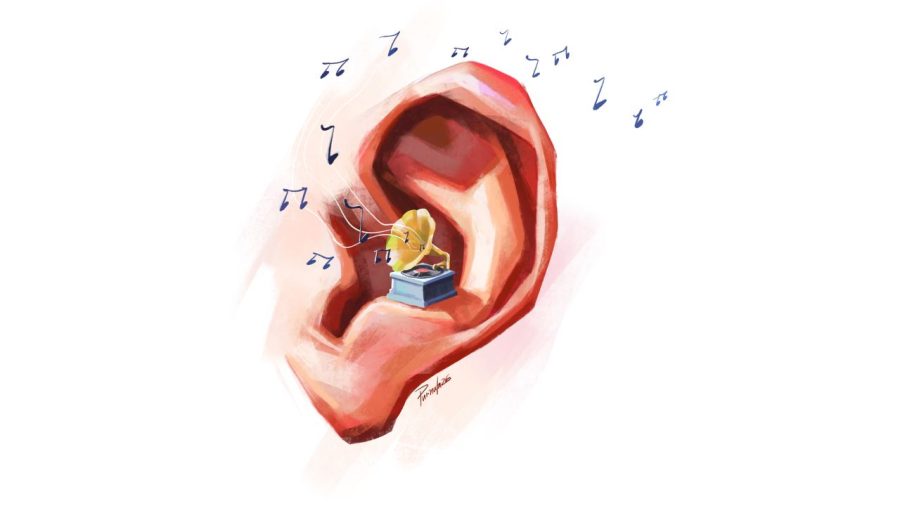
Scientists call this phenomenon involuntary musical imagery, or INMI. More commonly, it is known as an “earworm”: a short piece of music that appears in the mind without deliberate effort and repeats itself. Research suggests it is remarkably common, with more than 90 per cent of people reporting the experience at least once a week.
So why does the brain do this?

One reason is familiarity. Songs we know well are particularly likely to become earworms. Repeated exposure gives the brain a stronger memory of a melody, making it easier to retrieve later. In an experiment, researchers found that repeated exposure to unfamiliar songs increased their familiarity and desire to sing along, and influenced how strongly they interfered with later memory tasks.
But familiarity alone cannot explain everything. Some songs seem almost designed to get stuck. Research has found that frequently reported earworms often have melodies that are familiar enough to be easy to follow but contain distinctive twists in their melodic patterns. Faster tempos also appear to play a role. In other words, a song may be memorable because it gives the brain something predictable to grasp while offering something unusual enough to stand out.




The chorus is another likely culprit. Lyrics often drive earworms, and researchers have found that vocal music produces them more often than instrumental music. A familiar chorus, repeated several times in a song, gives the memory plenty of material to work with.
Then there is the curious matter of timing. Earworms often appear when the mind is not fully occupied. Commuting, exercising, working on repetitive tasks, or simply sitting idle can leave enough mental space for spontaneous thoughts to surface. Studies have linked earworms with mind wandering, boredom, tiredness, and activities requiring relatively little cognitive effort.
Sometimes the trigger is not even music. A word, a person’s name, a place, a sound, or a visual scene can remind the brain of a song. Suddenly, a melody associated with that memory starts playing again.
Remarkably, mental performance may be more accurate than we realise. In a 2024 study, participants were asked to sing songs they were experiencing in their heads. Nearly 45 per cent of their recordings matched the original song’s pitch exactly, while almost 69 per cent were within one semitone. The finding suggests the brain can preserve surprisingly precise musical information even when no sound reaches the ears.
That internal music can even follow us into bed. People who frequently listen to music report more persistent nighttime earworms, which are associated with poorer sleep quality. In a laboratory experiment, listening to music before bed increased nighttime earworms, with instrumental music also producing an increase in some measures of sleep disruption.
Fortunately, an earworm is usually harmless. Most episodes are neutral or even pleasant. When a melody becomes irritating, researchers have found that deliberately listening to the song or distracting yourself with another musical or verbal activity can sometimes help break the loop.
So the next time an unwanted chorus suddenly appears in your head, your brain is not necessarily malfunctioning. It is doing something much more ordinary. It is remembering.