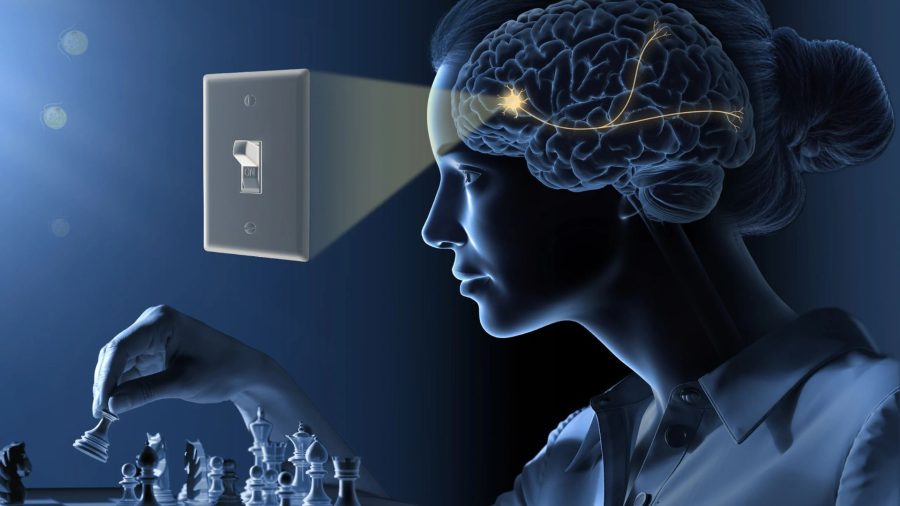



Imagine being able to turn individual brain cells on or off with a flash of light. It may sound like science fiction, but scientists can already do it in laboratories.
This breakthrough, known as optogenetics, has earned the 2026 Nobel Prize in Physiology or Medicine. The technique has given scientists a powerful new way to understand how the brain works.

The prize was awarded to Karl Deisseroth, Peter Hegemann and Georg Nagel for their discoveries about light-sensitive proteins and their role in optogenetics. Their work has helped scientists study how individual brain cells are involved in memory, emotions, movement and behaviour.
The story begins with a tiny organism: a single-celled alga. In the early 2000s, German scientists Peter Hegemann and Georg Nagel were studying how algae respond to light. Their research led to the discovery of channelrhodopsin, a protein that reacts to light.
When the protein is exposed to certain types of light, it opens a tiny passage in the cell. This allows electrically charged particles to move through the cell and create an electrical signal.
At first, this discovery seemed to have little connection with the human brain. But scientists soon realised that the same light-sensitive protein could be put into other types of cells. That changed everything.

Karl Deisseroth and his colleagues placed the gene responsible for making channelrhodopsin into nerve cells. In 2005, they showed that these nerve cells could be controlled with light. Later, they used the technique in the brains of living mice. The method became known as optogenetics, a combination of genetics and light.
So, how does it work? The brain contains billions of nerve cells, called neurons. These cells constantly send signals to one another. Scientists have long been able to see which parts of the brain become active during different activities. But it was much harder to know exactly which cells were responsible.
Optogenetics gave researchers a much more precise tool. Scientists can make a selected group of neurons sensitive to light. They can then use a tiny light source to turn those cells on or off and observe what happens.




This allows them to ask a simple but important question: What happens when these particular brain cells become active?
That has opened a new window into memory and behaviour. Researchers have used optogenetics to study brain circuits involved in memory, fear, sleep and wakefulness, movement, attention, pleasure, pain and other behaviours.
For example, scientists have used the technique in mice to activate groups of brain cells linked to particular memories. This has helped show that specific groups of neurons can play a role in storing and recalling memories.
Optogenetics has also become an important research tool for studying brain disorders. Diseases and conditions such as Parkinson’s disease, Alzheimer’s disease, epilepsy, depression and addiction involve complicated changes in the brain. By studying the exact nerve cells and connections involved, scientists hope to better understand these conditions and eventually develop more targeted treatments.
But optogenetics is not yet a routine treatment for people. Using light to reach deep parts of the human brain is difficult. Most optogenetics research is still being carried out in laboratories and animals. Scientists also need to find safe and practical ways to introduce light-sensitive proteins into the right cells.
One area where the technique has shown particular promise is vision restoration.
The eye is easier to reach with light than most parts of the brain. Researchers have therefore explored whether light-sensitive proteins could help remaining cells in damaged retinas respond to light in people with certain forms of blindness.
Early clinical research has shown encouraging results, although these treatments are still specialised and experimental. Perhaps the most remarkable part of the Nobel-winning work is the journey from algae to the human brain.
A basic question about how a tiny organism responds to light eventually led to a technology that can help scientists study one of the most complicated organs in the human body.
It is a reminder that scientific discoveries do not always have an obvious purpose when they are first made. A finding that begins as basic research can later become the foundation for something completely unexpected.
For years, scientists were able to create something like a map of the brain, showing which areas were linked to particular functions. Optogenetics has added a new level of detail. It allows researchers to study specific groups of nerve cells and see what happens when they are switched on or off.
The 2026 Nobel Prize in Physiology or Medicine is therefore about more than a clever laboratory technique. It recognises a major change in neuroscience: scientists can now use light to explore questions about the brain that were once extremely difficult to answer.
With every carefully controlled flash of light, scientists are getting a little closer to understanding one of humanity’s greatest mysteries: how the brain turns electrical signals into memory, emotion, movement and thought.