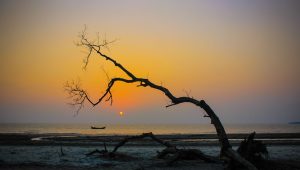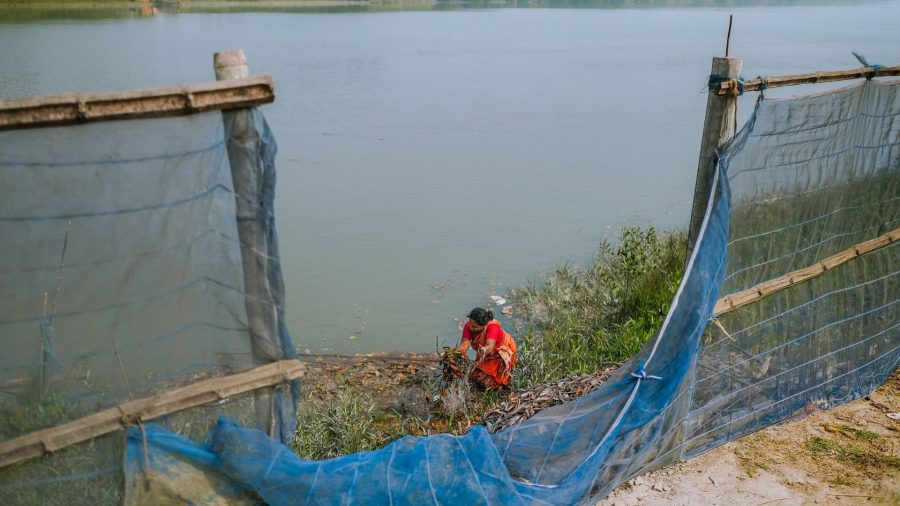



A familiar figure walks in a small village in Sundarban, across firming mudflats as the afternoon feels a little colder than usual and the air smells faintly of salt. She carries a pot on her hip, and she walks a little farther each year. Generations back, her mother and grandmother drew water nearby from village ponds and tube wells; she must now trek two to three kilometres across drying ground just to find a source that hasn’t turned brackish.
Later, when the tide is out and the mudflats are firm enough to cross, she will go to check the crab lines her husband tended. She does all this and still rises first to light the stove.
She is simply trying to get water home, keep the family fed, and be ready if the sky turns. But somewhere in between the tasks, she is renegotiating without ever using the word for what it means to be a good woman.
We have grown used to asking, and subsequently witnessing, how climate change affects women. The statistics on displacement, disaster mortality, and unpaid labour paint a grim picture. According to the Bangladesh Bureau of Statistics, women in Bangladesh spend nearly 6.8 hours a day on unpaid work against 1.2 hours for men; a gap of five and a half hours that repeats itself, unpaid and largely unseen, in millions of households every single day.
Other studies place the ratio even higher: a woman’s unpaid workload rises by over 151 per cent after marriage, more than double the increase recorded for men. A quieter question waits beneath, not how climate change harms women, but how it is quietly rewriting the very definition of feminine virtue?

The ‘good’ woman
To understand what is breaking down, one must look at the traditional script that was handed down to her. The good woman kept the household running. This ideal was never universal, and women have always laboured in fields and on embankments. For the vast majority of women, the labour was identical to what the social ideal pretended did not exist. The dividing line was never the absence of hard work, but the absence of its recognition. But it held as an aspiration, a horizon families measured themselves against, precisely because it signalled that a man could provide.
It is this aspiration that climate stress is quietly dismantling, season by season, tide by tide. When the paddy will not grow in soil gone saline, when the boat is lost to a cyclone or the harvest to a flood that arrives out of its old calendar, the husband’s ability to earn collapses, and the script that once defined a decent household becomes, simply, unplayable; someone must fill the gap it leaves, and it is she who fills it. She begins to earn.




Some might call this a form of liberation or resilience, and it would not be entirely unreasonable to do so. Development literature reaches for such portrayals often, with its case studies of “empowered” women and “resilient” communities.
But such reading is almost embarrassingly small; the water pot she used to carry, she still does. She may now earn a wage, but she still walks for water, cooks every meal, still nurses her children back to health, still wakes at the break of dawn, long before the rest of her family does. What has changed is not the weight of her old obligations, but the additional burden of new ones piled on top. She has inherited the man’s work without any reduction of her own, and inheritance, we should remember, is not the same thing as emancipation.
Call it not the weakening of patriarchy but its adaptation. The system absorbs the shock by extracting more from women while conceding as little as possible in return. What she earns falls under the category of “helping out”.
Performative femininity
There is a way of thinking about gender that might help explain what is happening here. Femininity, in this view, is not something a woman simply is, fixed and unchanging inside her. It is something she does, a set of actions repeated so many times, by so many women, over so many generations, that the repetition itself starts to look like nature.
What the coast reveals is a strange, unplanned test of this idea. The script is not being challenged on purpose; it is being bent by something far less deliberate, by salt, by cyclone, by rain that no longer falls when it should. When speaking to an NGO representative, breaking the rules of femininity was not a choice she made, but a reaction to circumstances pushed upon her. And yet the performance does not end; it only changes its facade. She is still being watched, still being judged.
Institutions present at the scene responsible for relief distribution, adaptation programmes, and even gender-sensitive initiatives frequently treat women as boxes to be ticked or mere tools of household resilience rather than as individuals with rights of their own. These women are trained, counted as beneficiaries, but rarely consulted on how the embankment should be routed, how the relief should be distributed, or what concerns they might have in aid implementation. Her reliability is prized because it is inexpensive.
Still, it would be its own kind of dishonesty to say that nothing is changing. The question worth sitting with is whether these temporary expansions of female “authority” will solidify their rights, or whether they will simply dissolve once the waters recede.
That depends on what we do with the moment. If climate policy continues to treat women’s expanded labour merely as a resource to be drawn upon, patriarchy’s adaptation to the changing climate will be complete, and the system that feeds it will persist unchanged.
If, instead, that labour is read as evidence, proof of capacity, competence, judgement under pressure, and answered accordingly, with land titled in her name, wages that are named as wages and kept in her own hand, and a seat on the committees that make decisions which directly affect her material experiences, then necessity might yet be turned into something more lasting than survival.
The pot on her hip is heavy, and it grows heavier with every kilometre the saltwater reaches further inland. But the true weight she carries is not the water itself; it is the accumulation of unacknowledged labour, uncounted hours, and the silent expectations. Perhaps it is time we stopped admiring her endurance, and began asking, more seriously, why endurance has been the only thing we ever thought to ask from her.