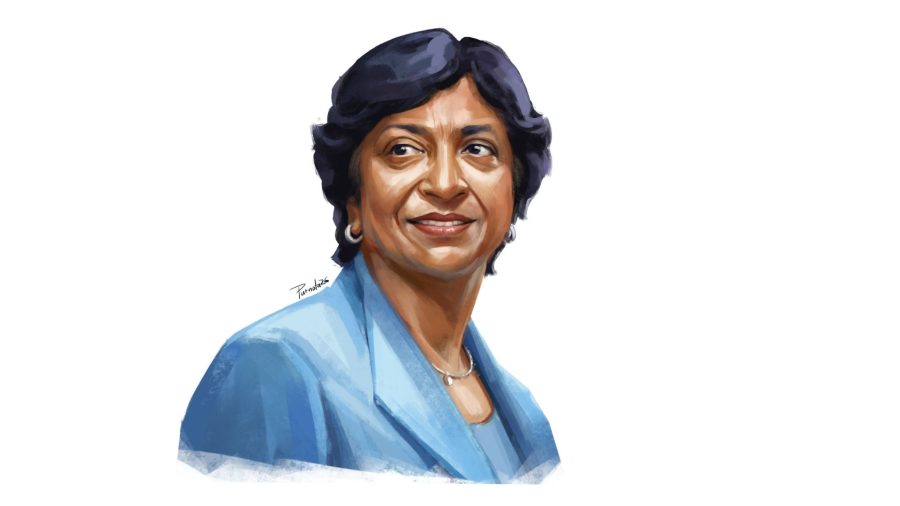



For Navi Pillay, justice has never been confined to a courtroom. Throughout her career, she has challenged discrimination, defended human rights and helped shape the legal frameworks used to hold perpetrators of serious crimes accountable. From apartheid-era South Africa to international courts and investigations into Israel-Palestine, her journey reflects a lifelong commitment to human dignity and international justice.
Navanethem “Navi” Pillay, a South African jurist of Indian Tamil origin, was awarded the 2026 Nobel Peace Prize on 9 October for her efforts to promote peace and international law. The recognition marked decades of work addressing injustice and strengthening international accountability.
Born in Durban, South Africa, in 1941, Pillay grew up under apartheid, a system that enforced racial segregation and denied basic rights to the black majority. Her experiences during this period helped shape her commitment to challenging discrimination through the law. In 1967, she became the first woman to establish a law practice in Natal Province. As a lawyer, she defended anti-apartheid activists and challenged the treatment of political prisoners. Her career reached another milestone in 1995, when she became the first Black woman appointed to South Africa’s High Court.

Pillay later took her work to the international stage. She served as a judge at the International Criminal Tribunal for Rwanda and became its president in 1999. The tribunal investigated and prosecuted those responsible for the 1994 genocide. One of its landmark decisions came in 1998, in the case of Jean-Paul Akayesu, when the judgment recognised that rape and sexual violence could constitute acts of genocide under specific circumstances. The ruling became an important precedent in international criminal law, reinforcing the need to recognise and prosecute sexual violence committed during conflict.
From 2003 to 2008, Pillay served as a judge at the International Criminal Court in The Hague. She subsequently became the United Nations High Commissioner for Human Rights, serving from 2008 to 2014. In that position, she advocated the protection of fundamental freedoms and greater accountability for human rights violations around the world.




Pillay’s work on Israel-Palestine has become a particularly prominent part of her international human rights record. Her engagement with the issue reflects her broader emphasis on international humanitarian law, the protection of civilians and the need to hold those responsible for violations accountable, regardless of their political or military standing.
She chaired a United Nations commission of inquiry on the Occupied Palestinian Territory, contributing to international scrutiny of alleged violations and the wider human rights situation affecting Palestinians. The work placed her at the centre of contentious debates over Israel’s conduct, the treatment of Palestinians in the occupied territories and the application of international law to the conflict.
Investigations into Israel-Palestine have frequently become flashpoints in international diplomacy, with disputes over accountability, the conduct of military operations and the obligations of parties under international law. Pillay’s involvement has kept these questions in focus, underscoring the principle that allegations of serious violations must be examined through independent legal processes rather than political considerations alone.
Beyond her work on Israel-Palestine, Pillay has continued to contribute to international legal proceedings. She is serving as an ad hoc judge at the International Court of Justice in a case concerning Myanmar, extending a career that has taken her from domestic courts to some of the world’s most consequential institutions of international justice.
The 2026 Nobel Peace Prize recognises Pillay’s contribution to international justice and the protection of human rights. Her career demonstrates how the law can serve as a means of challenging discrimination, confronting abuses of power and defending people whose rights are threatened.
For women entering law and public service, her journey also offers a reminder that breaking barriers can help transform institutions. From confronting apartheid to engaging with some of the most contentious human rights questions of the present day, Pillay’s work has been shaped by the conviction that justice must apply across borders and to everyone.