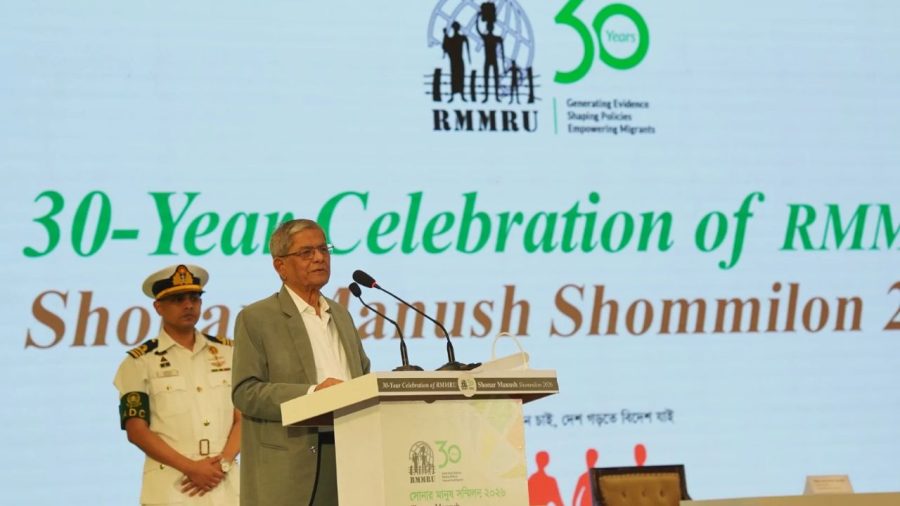



President Mirza Fakhrul Islam Alamgir has stressed the importance of protecting migrant workers’ interests, saying remittances from expatriate Bangladeshis are strengthening the economy and improving the living standards of millions of families.
The state has a responsibility to recognise the contributions and sacrifices of migrant workers, he said, calling for lower migration costs, tougher action against fraud and broker networks, and more worker-friendly Bangladesh missions abroad.
The president made the remarks as the chief guest on Wednesday at the second day of the “Sonar Manush Sammilon 2026”, organised to mark the 30th anniversary of the Refugee and Migratory Movements Research Unit (RMMRU). The event was held at the Ruposhi Bangla Hall of Hotel InterContinental Dhaka.

Mirza Fakhrul said expatriate Bangladeshis had played an unprecedented role in the movement against fascism.
Their participation in the July mass uprising demonstrated that migrant workers were an integral part of the country’s economic and national life, he added.




He said the current situation in the Middle East had created new challenges for Bangladesh. To address them, the country must diversify its overseas labour markets and expand employment opportunities in Europe and other Asian countries.
The president also called for lessons to be drawn from past policy mistakes in sending female workers to the Middle East for domestic work. He stressed the need for a long-term, coordinated national strategy to improve migration management.
Speaking at the event, Prime Minister’s Political Adviser Zahir Uddin Swapon alleged that a deep-rooted conspiracy over the past 17 years had kept Bangladesh dependent on imports.
He claimed the objective was not only to facilitate looting but also to weaken the country. He urged the relevant ministries and officials to move beyond past policies and take effective measures to protect the welfare of expatriate Bangladeshis.
Thanking RMMRU for its longstanding work on migration issues, Zahir Uddin Swapon expressed hope that the organisation would continue to share its experience and recommendations to help shape government policies.