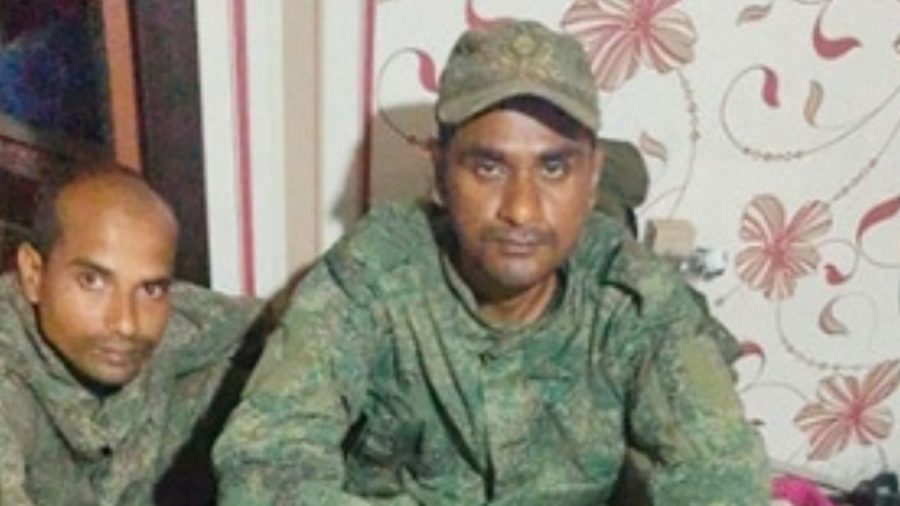



Driven by the desire to support their families, 30 young men from across Bangladesh embarked on what they believed to be legitimate overseas employment in Russia.
Instead, an illegal trafficking syndicate operating with forged documents trapped them into serving on the front lines of a devastating war.
Today, only two have managed to return home – wounded, traumatised, and saddled with crushing debt – while the fates of the remaining 28 youths remain unknown.
Escaping the frontline horrors
For Adnan Hossain, a resident of the Painadi area in Siddhirganj, Narayanganj, the journey began in full compliance with government regulations.
Having completed training and obtained official certification from the Bureau of Manpower, Employment and Training, he travelled to Russia expecting peaceful work rather than military conflict.
“We went to work, not to fight a war,” he recalled, describing horrors beyond words as Russia sent him to the frontlines.
Wounded in a Ukrainian drone attack, Adnan underwent multiple surgeries at a hospital in Moscow, where he learned that at least 20 of his companions had died in combat.

On 15 September, while still recovering, he escaped from the hospital and returned home with assistance from the embassy, purchasing his flight ticket using his family’s own funds.
Back home, Adnan and his family find themselves in deeper peril, burdened by immense loans taken out to send him abroad and additional debts incurred to bring him back.
His mother, Papiya Akter, expressed profound distress over their financial ruin, explaining that despite following all official procedures, they have received no government compensation or relief.
Adnan appealed for the arrest of the owners of the accused recruiting agencies and urged the authorities to step in with financial redress for the affected families.
Licences revoked after scandal
In response to the scandal, the government has revoked the licences and confiscated the security deposits of three recruiting agencies – RS International, Jabal-e-Noor, and TS Overseas Ltd.




Kartik Chandra Debnath, assistant director of the Narayanganj District Employment and Manpower Office, explained that official action is taken whenever victimised families submit formal complaints.
He highlighted that the authorities consistently encourage legal migration with proper manpower clearance, which ensures genuine employment, regular monthly wages, and legal remittance channels, alongside low-interest loan facilities from the Probashi Kallyan Bank.
In contrast, those who travel through illegal channels are forced into constant hiding.
Regarding the 30 victimised youths, the assistant director noted that the cancellation of the three recruiting agencies’ licences demonstrates government action, expressing hope that the affected families will ultimately receive remedy and justice.
Exploiting economic despair
The tragic ordeal reflects a wider economic vulnerability.
With the domestic labour market small relative to the number of job seekers, young people from industrial hubs like Narayanganj are easily lured abroad by promises of high wages, safe living conditions, and civic benefits.
However, rogue brokers and fraudulent syndicates exploit these aspirations by deploying fake documentation.
Experienced workers and officials advise job seekers to conduct all financial transactions with recruiting agencies strictly through banking channels and to avoid illegal sea routes arranged by brokers, which endanger lives and plunge entire families into ruin.
Anguish of left-behind families
A similar tragedy hangs over the households of two other young men from Painadi – Robin Miah and Kazi Rezaul Karim – who likewise went to Russia through formal channels with BMET clearance.
Robin’s wife, Peyara Begum, shared her anguish, noting that she does not know whether her husband is alive or dead. Stranded with two small children and a debt of Tk10 lakh, she begged the Government to bring back her family’s sole provider.
Meanwhile, Kazi Rezaul Karim’s wife, Munni Begum, explained that her husband’s elderly parents are growing increasingly ill from relentless grief, with their household trapped under debts they see no way of repaying.
The heartbreak stretches across Bangladesh, where families of the missing youths endure agonizing uncertainty alongside the households of Adnan and Rajan from Jhenaidah, the only two survivors who managed to flee after being injured in Ukrainian drone strikes.
The missing youths whose whereabouts remain unknown include Md Al Mamun, from Kharua area of Nandail in Mymensingh, and Tariqul Islam Mintu, from Lauri area of Manirampur in Jashore.
Also among the missing are Md Sayeed Molla, from Hasnabad in Nawabganj, Dhaka; Md Sohel, from Khalpar in Nawabganj; and Md Nazrul Islam, from Bironlohara under Gopalpur Police Station in Tangail.
From the same region are Md Aminur Islam, from Dakshin Pathalia under Gopalpur Police Station, and Shree Pabitra Chandra, from Majidpur under Gopalpur Police Station.
The list continues with Md Abu Hanif, from Kishoreganj Sadar; Md Roni, from Fakirbari in Gopalganj Sadar; Md Sourav Molla, from Balakair in Gopalganj; and Palash Sheikh, from Ghosherchar under Udaypara Police Station in Gopalganj.
Other untraced youths are Mainuddin, from Faridganj in Chandpur; Arif Hossain Patwary, from Chandpur Sadar; Md Mofiz, from Madarganj in Jamalpur; Md Arif Hossain, from Madarganj in Jamalpur; and Md Arman Ali, from Jamalpur Sadar.
Further missing youths include Md Sabbir Hossain, from Boimari area of Satkhira Sadar; Md Wasim Akram, from Laskarpur under Shibganj Police Station in Chapainawabganj; Md Al Amin Islam, from Prankrishna area of Patgram in Lalmonirhat; and Abdullah Al Mamun, from Prankrishna Kuyamari area of Patgram.
Completing the list are Helal Sheikh, from Atrabhamra under Bhanga Police Station in Faridpur; Md Kamal Hossain, from Madaripur Sadar; Ripon Hossain, from Kudabor area of Gazipur Sadar; and Ali Hossain, from Goalanda in Rajbari.