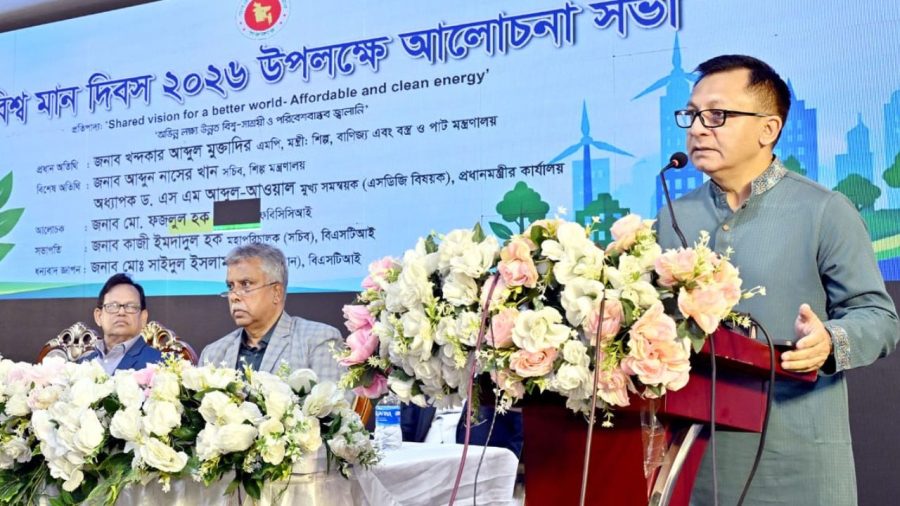



Commerce Minister Khandaker Abdul Muktadir has said the capacity, manpower, and operational scope of the Bangladesh Standards and Testing Institution (BSTI) will be expanded phase by phase to maintain product quality, protect consumer rights, and ensure a safe life for the public.
He made the remarks on Wednesday at the Officers’ Club, Dhaka, to mark World Standards Day 2026.
He highlighted the critical role of quality control in improving people’s living standards.
“Quality is not merely a technical feature of a product; it is directly related to human dignity and safe living,” the minister said, noting that ensuring the quality of every item—from building construction materials to food products, fuel, and daily consumer goods—is the responsibility of the state.

He emphasised that consumers spend their money on products and must have confidence and a sense of security regarding their quality.
Underlining food safety as a top priority, Muktadir stated that BSTI’s activities will be further strengthened to protect public health and food security.
He urged BSTI to take greater initiative in aligning with international standards, enhancing the global acceptance of Halal certification, and achieving mutual recognition with relevant institutions in various countries.




Outlining BSTI’s infrastructure development, the minister announced three major ongoing projects, including a plan to construct a 13-storey new building at the BSTI complex costing nearly Tk850 crore, which will house around 63 new laboratories.
In addition, initiatives are underway to establish testing laboratories in 10 new districts and set up a metrology laboratory at a cost of approximately Tk450 crore.
He added that following Bangladesh’s graduation from the Least Developed Countries (LDC) status, establishing a world-class testing and quality control system is essential to increase the international acceptance of Bangladeshi goods.
To achieve this, BSTI’s workforce and institutional capacity will be augmented alongside expanding its activities nationwide.
Addressing recent media reports regarding the alleged presence of heavy metals and lead in soybean oil, the minister clarified that 193 samples of various soybean oil brands in the market were tested, and no harmful metals or lead were detected.
Terming the reports complete propaganda, he assured the public that all soybean oil brands available in Bangladesh are pure and free from harmful adulterations, adding that reliable testing and information disclosure are vital to clear confusion.
Muktadir reaffirmed the government’s resolve to strengthen quality control measures to gain public trust and sought the cooperation and support of all stakeholders to achieve this goal.
The discussion meeting was presided over by BSTI Director General Kazi Imdadul Haque. Other speakers included Secretary to the Ministry of Industries Abdun Naser Khan, Principal SDG Coordinator at the Prime Minister’s Office Professor SM Abdul-Awal, FBCCI Administrator Md Fazlul Hoque, Bangladesh Accreditation Board (BAB) Director General Md Aminul Islam, and BSTI Director Md Saidul Islam.