


A battered woman turns up at two brothers’ doorstep, and one sees someone to save while the other senses trouble. That single encounter sets the stage for a family saga fuelled by desire, deception and a chilling struggle for control.
In Netflix’s East of Eden, Florence Pugh plays Cathy Ames, whose arrival unsettles the Trask family and raises a bigger question: are people born evil, or do they choose to become it?
Adapted by Zoe Kazan from John Steinbeck’s celebrated 1952 novel, the seven-episode series explores family rivalry, inherited conflict and human choices across generations.
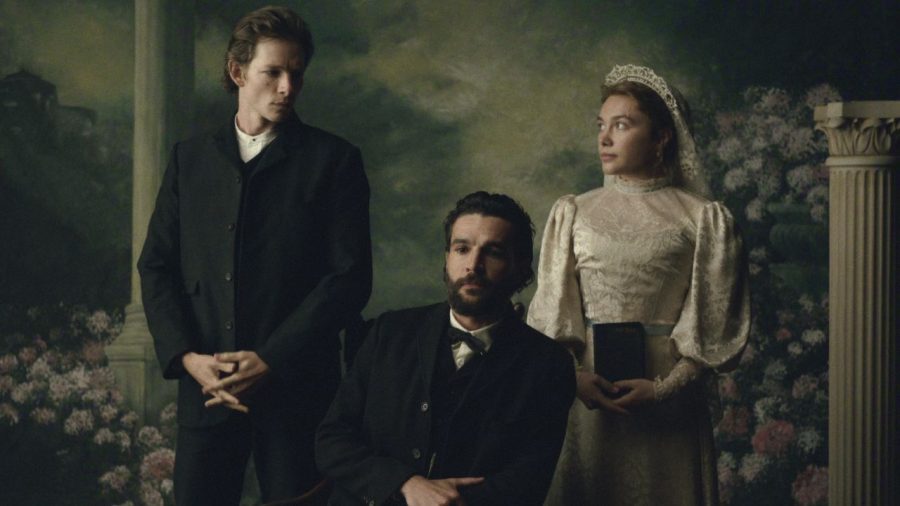
The story begins with half-brothers Adam (Christopher Abbott) and Charles Trask (Mike Faist), raised under their demanding father, Cyrus (Tracy Letts), a one-legged Civil War veteran who expects his sons to embody his ideas of strength. Gentle Adam contrasts with brooding, forceful Charles, and their shared hunger for paternal approval fuels years of resentment.
When Cathy arrives at their doorstep, battered and apparently unable to explain her past, Adam falls for her vulnerability. Charles suspects something far more dangerous beneath her appearance.
The story later moves to California’s Salinas Valley, where Adam’s twin sons, Cal (Joseph Zada) and Aron (Joe Anders), inherit the family’s tangled rivalries. Neighbour Samuel Hamilton (Ciarán Hinds) and loyal servant Lee (Hoon Lee) bring warmth and moral perspective to the increasingly troubled family.
Kazan’s adaptation covers more of Steinbeck’s novel than Elia Kazan’s 1955 film, which focused largely on the book’s final third and starred James Dean.

Elia’s granddaughter has seven episodes to explore the story’s biblical parallels and philosophical questions, but the sprawling narrative remains difficult to contain.
The screenplay largely follows Steinbeck’s plot and dialogue, while Kazan and Alexander Chee give Lee greater prominence. However, cutting much of the Hamilton family’s storyline leaves gaps, and abrupt transitions sometimes undermine the pacing.
Cathy remains the series’ most divisive figure. Rather than turn her into a heroine or excuse her destructive choices, Kazan adds psychological depth to a character long debated as either the embodiment of evil or a woman resisting society’s expectations.
Pugh makes her fascinating through calculated silences, fleeting expressions and sudden flashes of rage. Cathy seeks freedom from male control but repeatedly manipulates others to secure it.




The series explores the experiences that shaped her, though its explanations occasionally feel too explicit. Pugh’s performance, however, keeps her compelling and unsettling.
Her commanding presence exposes weaknesses elsewhere. Abbott gives Adam a gentle, melancholy quality but sometimes makes him emotionally limited, leaving his relationship with Cathy uneven.
Faist brings simmering resentment and intensity to Charles. Zada and Anders give the younger generation emotional weight, with Zada particularly effective as Cal struggles with his darker instincts. Hinds provides welcome warmth as Samuel, although his reduced role limits his impact.
Lee is a standout. Hoon Lee transforms the seemingly conventional servant into the story’s moral and emotional centre, bringing intelligence, compassion and humanity to the role.
His conversations with Samuel explore faith, morality and free will, providing some of the series’ most affecting moments.
Martha Plimpton also impresses as Faye, a brothel madam whose unexpected kindness adds complexity to Cathy’s world.
Directors Garth Davis and Laure de Clermont-Tonnerre give the period drama a striking visual identity.
Sweeping New Zealand landscapes, carefully framed doorways, detailed architecture and contrasts between open countryside and tense domestic spaces create cinematic scale.
The cinematography uses light and shadow to reflect the characters’ emotional distance, while Laura Karpman’s rich, sweeping score deepens the tragic atmosphere.
Yet beautiful imagery and music cannot always rescue uneven pacing or underdeveloped characters.
At its heart, East of Eden explores “timshel”, translated in Steinbeck’s novel as “thou mayest”. The idea suggests that people need not remain prisoners of family history or inherited tendencies; they can choose their paths.
Biblical echoes of Cain and Abel give the Trasks’ rivalries wider significance, although the series does not always match the novel’s philosophical depth.
Its focus on Cathy also leaves less room for other characters’ moral dilemmas, while some of the book’s humour and quieter passages disappear.
The result is an ambitious but imperfect adaptation. Pugh’s gripping performance, Lee’s humanity, the supporting cast and the lavish visuals make it worth watching for fans of sweeping family dramas and morally complicated characters.
Those seeking a tightly paced thriller, a balanced ensemble or a complete exploration of Steinbeck’s ideas may find it less satisfying.
Still, the series makes the struggle between inherited darkness and personal choice compelling again.
East of Eden is streaming on Netflix.