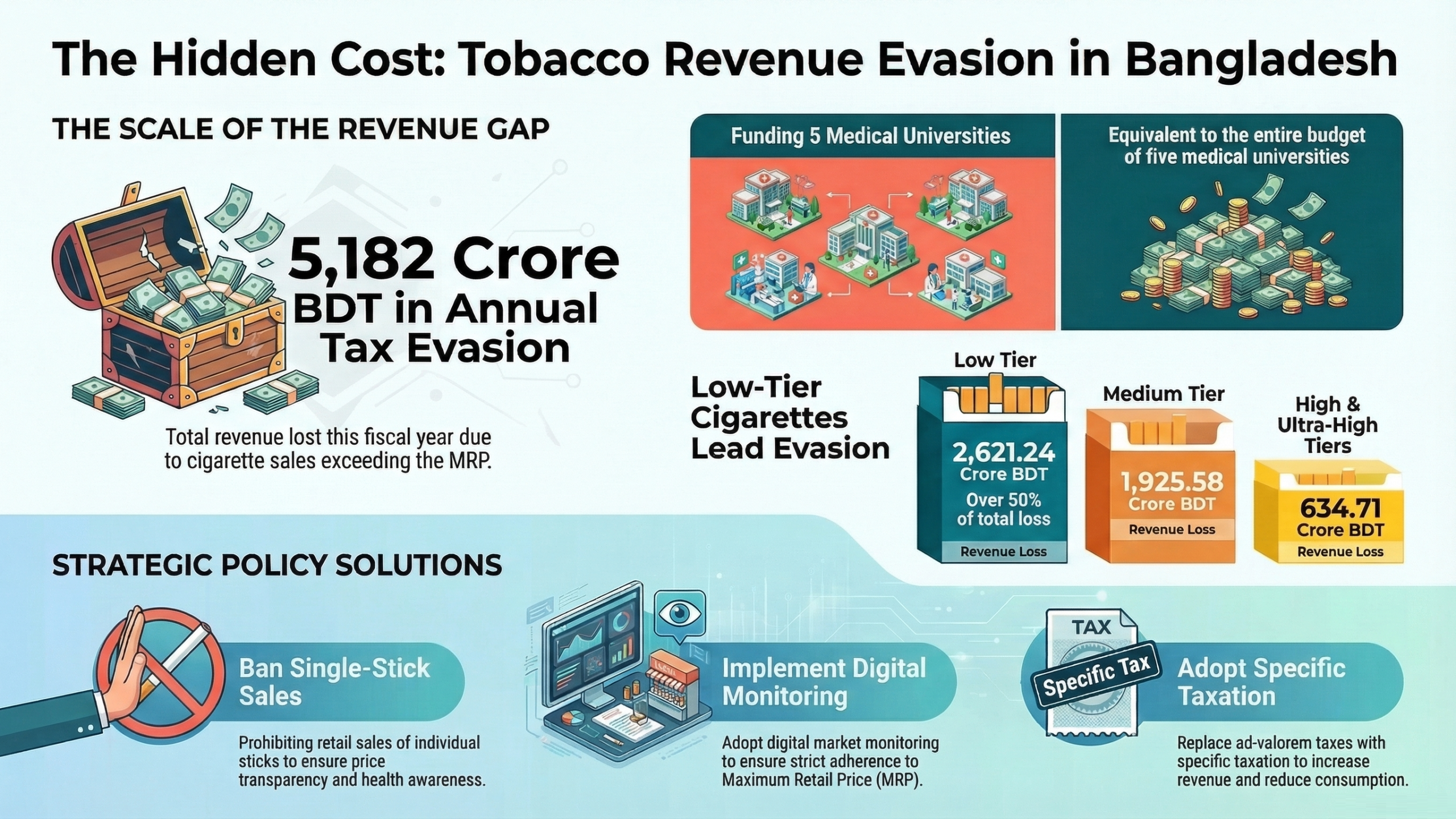

Cigarette and bidi manufacturers in Bangladesh are causing a massive revenue loss of Tk5,182 crore in the current fiscal year by failing to adhere to the maximum retail price (MRP).
While all other products in the country are sold at MRP, tobacco companies are selling cigarettes to vendors at the retail price, who then charge consumers significantly higher amounts than the prices mentioned on the packets.
These findings were revealed in a study titled “Company strategies in controlling the cigarette market and its impact on revenue collection: A survey,” presented on Thursday during a discussion meeting at the Dhaka Reporters Unity.
The event was jointly organised by the Bureau of Economic Research (BER) of the University of Dhaka and the Bangladesh Network for Tobacco Tax Policy (BNTTP).
Revenue loss across cigarette tiers

Presenting the keynote paper, Ishrat Jahan Oyshee, Research Assistant at BNTTP, stated that field-level data indicates revenue evasion of Tk510.31 crore in the ultra-high tier.
Furthermore, evasion amounted to Tk124.40 crore in the high tier, Tk1,925.58 crore in the medium tier, and Tk2,621.24 crore in the low tier.
The research collected data from 48 retail outlets across 12 cities, including divisional centres such as Dhaka, Barishal, Khulna, and Mymensingh, as well as two additional district towns in each division.



Discussants at the event noted that the evaded revenue is equivalent to the combined budgets of five medical universities, including Bangladesh Medical University, and highlighted that this money could fund free cardiac treatment across the entire country.
Economic impact, health risks
Experts warned that selling cigarettes above MRP attracts young people to smoking through single stick sales.
They pointed out that the government has not yet addressed the demand to ban single stick sales, which not only facilitates tax evasion but also prevents smokers from seeing health warnings on the packaging.
The speakers included Professor Dr Rumana Huq, convener of BNTTP; Hossain Ali Khondoker, consultant for the Tobacco-free Railway Project; and Advocate Syed Mahbubul Alam, a public health and policy analyst.
The session was chaired by Dr Syed Mahfuzul Huq, National Professional Officer of the World Health Organisation (WHO), while Hamidul Islam, Project Manager of BNTTP, delivered the welcome address.
Recommendations for policy reform
The study proposed several recommendations, including ensuring cigarettes are sold at MRP and punishing violators, as well as implementing digital methods for tax collection and market monitoring.
It further suggested banning the sale of single cigarette sticks and reducing the multiple price tiers of cigarettes to a single tier. To increase revenue and reduce consumption, the researchers recommended shifting from an ad valorem tax system to a specific tax system.
Finally, the experts urged the withdrawal of government shares from tobacco companies and the pursuit of alternative revenue sources. The event concluded with a Q&A session involving journalists and officials from various anti-tobacco organisations.