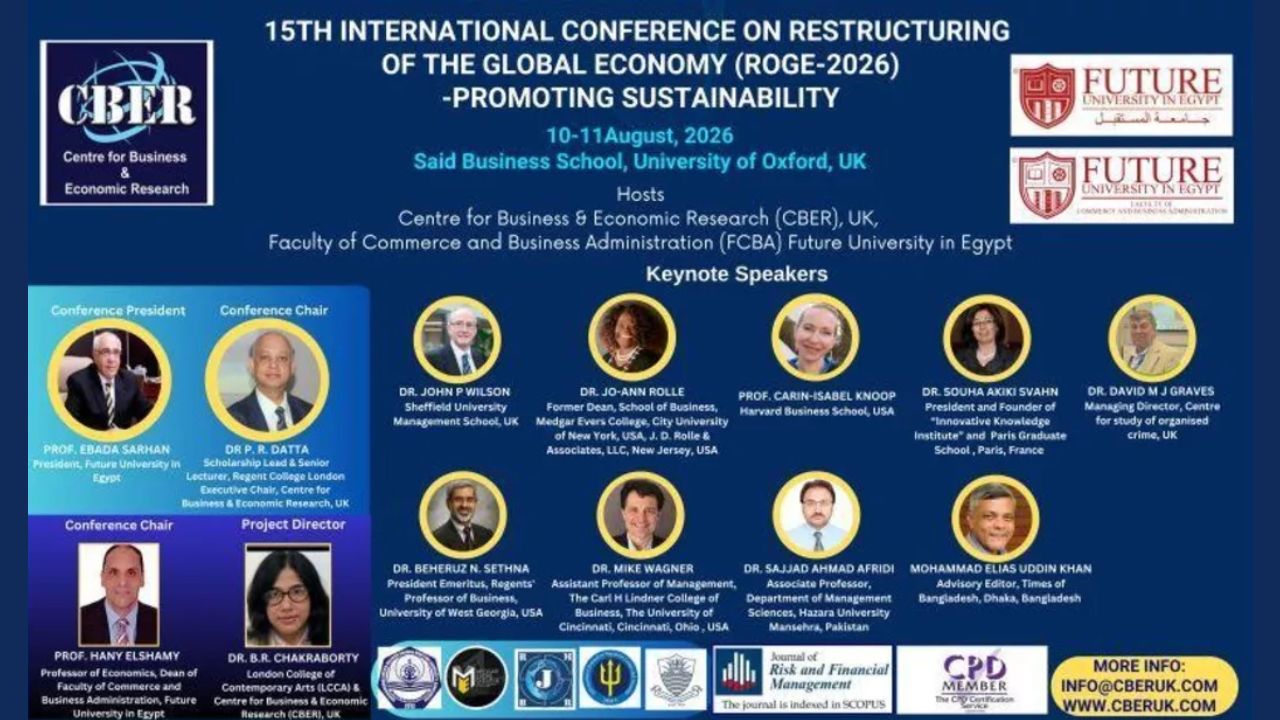



Academics, researchers, business leaders and professionals from across the world will gather at the University of Oxford for the 15th International Conference on Restructuring of the Global Economy (ROGE-2026).
This major international academic event, scheduled for 10–11 August 2026, coincides with the 20th anniversary of Centre for Business & Economic Research (CBER), UK.
Jointly organised by CBER, UK, in association with the Faculty of Commerce and Business Administration, Future University in Egypt (FUE), the two-day conference is held under the theme “Restructuring of the Global Economy – Promoting Sustainability”, read a press release.
The conference will take place at the Saïd Business School, University of Oxford, in both in-person and virtual modes to enable global participation.
ROGE-2026 has drawn an exceptionally broad international response, featuring more than 111 presentations representing 28 countries and 99 institutions.
The multidisciplinary programme will address defining economic, technological and managerial challenges of the present era.

Topics of focus encompass sustainable development, finance, banking and accounting, artificial intelligence and big data, globalisation and international trade, marketing and branding, logistics and supply-chain management, human resource management, tourism, education and lifelong learning, and economic growth and development.
The conference serves as an international meeting place where scholars, practitioners and researchers from developed and developing economies can exchange ideas and build enduring collaborations.
The gathering particularly encourages research examining how management thinking must evolve and be re-imagined in response to a rapidly changing global environment.




The event brings together a distinguished group of academics, university leaders and international experts.
Among those featured in the programme are Dr John P Wilson of Sheffield University Management School; Prof Alan Parkinson of UCL School of Management; Dr Jo-Ann Rolle, former Dean of the School of Business at Medgar Evers College, City University of New York; Carin-Isabel Knoop of Harvard Business School; Golestan Sally Radwan, Chief Digital Officer of the UN Environment Programme; Dr Beheruz N Sethna, President Emeritus and Regents’ Professor of Business at the University of West Georgia; Prof (Dr) Padmakali Banerjee of KIIT University; Dr Michael Richard Wagner of the University of Cincinnati; and Prof (Dr) David Graves of the Centre for the Study of Organised Crime and University of Buckinghamshire.
The inaugural programme includes an address from Prof Ebada Sarhan, President of Future University in Egypt and Honorary President of the Conference, followed by remarks from Conference Co-Chair Dr Palto Datta.
Dr Beheruz N Sethna will deliver a keynote on leadership, while Prof Alan Parkinson will contribute special inaugural keynote remarks on carbon accounting.
Additionally, a special feature of the first day will be the Book Launching and Fellowship Award Ceremony, providing an opportunity to recognise academic contribution and celebrate scholarship alongside the research programme.
This year’s conference carries particular significance as 2026 marks the 20th anniversary of CBER, which was founded in London in 2006.
Over two decades, the Centre has worked to advance education, research, innovation and international collaboration, creating opportunities for scholars, researchers, practitioners, policymakers and industry leaders to exchange knowledge and establish partnerships across national and disciplinary boundaries.
Reflecting on this journey in his conference message, Dr Datta recalled that CBER began with a simple ambition: to create a place where ideas could travel freely across borders.
The initiative has since developed into a global academic community connecting scholars from more than 100 countries, organising more than 100 international conferences and publishing thousands of research papers.
Looking ahead, the anniversary message identifies responsible artificial intelligence, sustainable leadership, ethical innovation and global partnerships among the priorities likely to shape the next phase of academic and professional inquiry.
Indeed, CBER enters its next chapter with a renewed emphasis on these areas, alongside research capable of responding to the rapidly changing challenges facing business, society and the global economy.
For Dr Datta, however, the significance of ROGE extends beyond statistics and research presentations.
He argues that the enduring value of an international conference often emerges from the relationships created between people, such as a discussion over lunch or coffee that later develops into an international research collaboration.
This philosophy captures the broader ambition behind ROGE-2026: bringing together people from different nations, institutions, cultures and disciplines through a shared commitment to intellectual curiosity and the belief that research can contribute to a more sustainable and better-connected world.