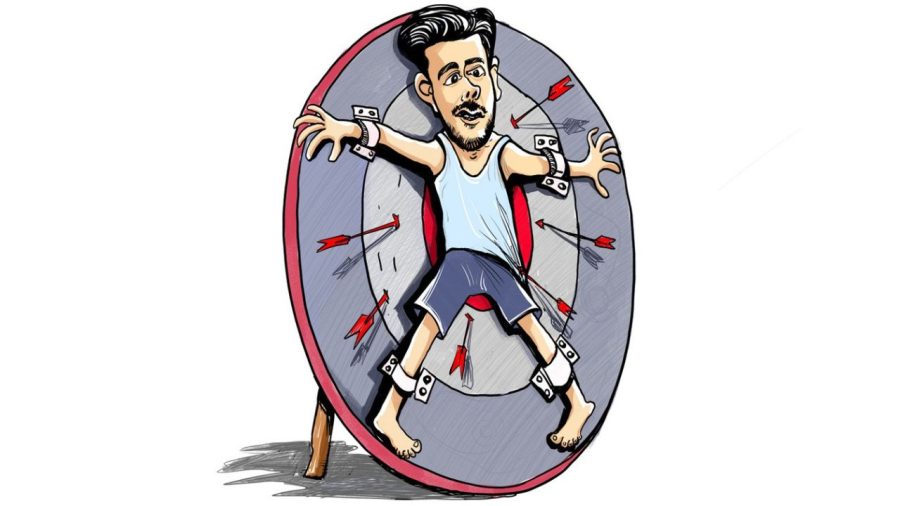



A week after content creator Salman Muqtadir’s Brownfish studio was attacked and looted in Dhaka’s ECB Chattar area, a flurry of moves by state agencies has raised a new question: is the victim now being targeted?
The concern intensified after Salman publicly criticised Home Minister Salahuddin Ahmed over the handling of the attack.
Soon afterwards, Bangladesh Financial Intelligence Unit (BFIU) sought information on Salman’s bank accounts on an urgent basis. Raids were also carried out at businesses linked in media reports to his father-in-law Sheikh Nurul Islam.
Salman has called the developments an attempt to silence him.
“In future, others will also be afraid to speak against the government or against injustice,” he said.
Opposition politicians, lawyers, academics and journalists have also questioned the timing of the state action, warning that it could create the impression that criticism of the government carries consequences.
Jamaat-e-Islami Assistant Secretary General AHM Hamidur Rahman Azad accused the government of using state machineries to harass Salman.
“What the fascist government used to do, the current government is following the same path. This is wrong and unjust,” he told TIMES.
Political scientist Professor Dilara Choudhury said Salman appeared to be facing harassment after speaking against the home minister.
“Such treatment of a citizen is in no way desirable. This is not democratic behaviour,” she said.
Journalist Masud Kamal said the timing was bound to raise suspicion.

“The government could have taken these steps earlier or later. Why now? That is where people become suspicious,” he said.
Supreme Court lawyer Manzill Murshid warned that the sequence of events could undermine confidence in state institutions and narrow the space for criticism.
State agencies move in
On 30 September, reports emerged that BFIU had sought Salman’s bank account information.
An email sent to banks at 10:38am that day instructed them to provide the information urgently. The request was marked high priority and asked that the information be submitted within an hour through the goAML message board.
Banks were also told to maintain confidentiality.
It remains unclear what information was eventually provided.
Salman later questioned the timing.
“Why are my bank accounts being sought when I am the victim?” he said.




A day later, the Customs Intelligence and Investigation Directorate, Department of Narcotics Control and Special Response Battalion raided Tos Bond (Private) Limited, a bonded liquor warehouse in Gulshan.
National Board of Revenue later said four warehouses belonging to the company had been sealed over allegations that duty-free liquor imported under bonded facilities had been stored in unauthorised warehouses.
Media reports said two of the warehouses belonged to Salman’s father-in-law Nurul Islam.
Islam, however, told TIMES that he had sold his ownership in Tos Bond before 2018. He said he had lived in Canada for 46 years and had invested earnings from his businesses there in Bangladesh.
Mohammad Faizul Karim, head of operations at Fu-Wang Bowling Services Limited, also denied that Islam had any link with Tos Bond.
He said Islam had opposed his daughter Disha Islam’s marriage to Salman and had no contact with him since.
“If this was done while trying to target Salman’s family, then perhaps they do not know that Nurul Islam has no relationship with Salman,” Faizul said.
He added that Fu-Wang Club had also been raided twice over the past week.
“This has never happened before. It is unfortunate,” he said.
According to media reports, NBR’s Central Intelligence Cell and income tax intelligence unit have also sought information from Canada.
‘Why now?’
Critics say the legality of any investigation is one issue. The timing is another.
Manzill Murshid said that if any warehouse or business had been operating illegally, the obvious question was why action had not been taken earlier.
“Why was action taken only after he (Salman) made the statement?” he asked.
He said public confidence would suffer if people came to believe that bodies such as BFIU or Anti-Corruption Commission were being used to target individuals after politically sensitive remarks.
Tawohidul Haque, associate professor at the Institute of Social Welfare and Research at the University of Dhaka, made a similar point.
“If an action is illegal, it is illegal both before and after a statement,” he said. “If action is suddenly taken after someone criticises another person, suspicion and distrust will naturally arise.”
Masud Kamal also questioned the sequence.
“When we see bank account information being sought after his (Salman) statement, questions naturally arise,” he said.
He added that financial information should be sought through a clear legal process.
“If action was taken because of personal anger or abuse of power, that would be deeply worrying,” he said.
It began with the minister-Salman exchange
On the night of 26 September, more than 100 people attacked an under-construction New Gini Properties project at ECB Chattar, where Salman’s Brownfish studio is located.
The studio was vandalised and looted.
Salman later alleged in a video that BNP men had attacked the site after failing to obtain extortion money, although he subsequently withdrew that allegation.
What followed was a public exchange between Salman and the home minister.
Addressing Salahuddin Ahmed in a video after the attack, Salman said, “Please don’t take any tension. This is normal in Bangladesh.”
At a press conference on 27 September, the home minister rejected what he described as a sweeping allegation against BNP and said Salman had not filed a case.
Salman responded in another live video, saying he had gone to Cantonment Police Station on the night of the attack and remained there until dawn, but police had not registered a case.
He then sharply criticised the minister.
“Do you feel even a little ashamed?” he said.
The home minister made no further public comment on the matter.