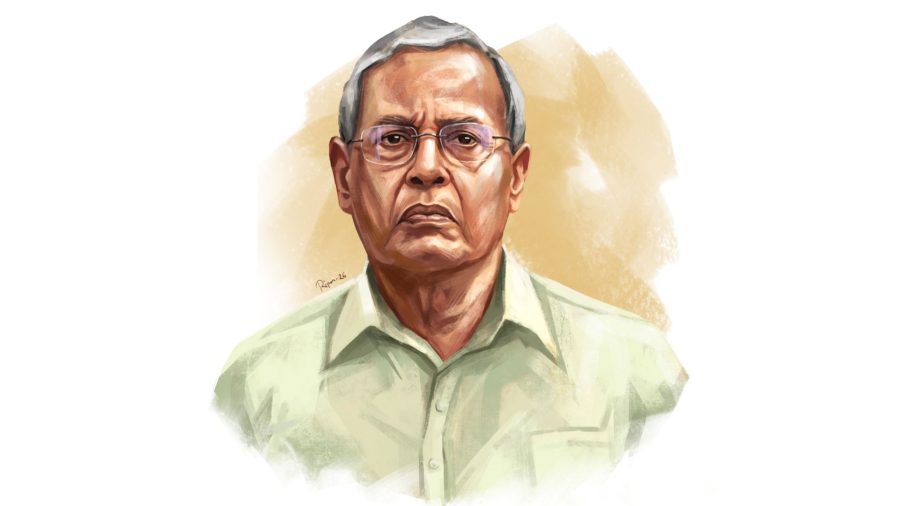

Dr Abdul Khaleque, one of Bangladesh’s most prominent independent scientists and inventors, began his journey more than five decades ago during the Six-Point Movement and the 1971 Liberation War. From publishing groundbreaking research in top UK laboratories to working alongside 1,100 farmers in the fields of Rangpur, Khaleque’s story reflects the evolution of Bangladesh’s quest for scientific self-reliance.
He sat down with TIMES of Bangladesh’s Shamim Shopno about his decision to return home in 1984, his battle against institutional politics, and his vision for a thriving research environment for the next generation.
TIMES: You had a successful academic career in the UK and opportunities to stay. What was the specific moment or realisation that made you decide to return to Bangladesh for good in 1984, despite knowing the challenges that awaited you?
Dr Khaleque: While working in the UK, I had published over 20 papers and developed a major patent on fertility control in collaboration with the University of London. I had spent three years as a Research Associate, two years with the Royal Institute of Chemistry, and two years as a Research Professor. But when it came time to file the patent, the British professor’s name was listed ahead of mine. When I asked about it, he explained that under foreign law, because the university provided the laboratory, equipment, and funding, the lead credit had to go to the UK professor. That left a deep sense of frustration in me.
I realised that no matter how much breakthrough work I did abroad, the credit would never truly belong to me or my homeland. I told myself, “If I am going to pour my life into research, I will do it in my own country. Whether I succeed or fail, at least the work and the name will remain mine.”
You turned down a job at Dhaka University because of “teacher politics.” What exactly did you see that made you choose the difficult path of independent research over institutional support, and how did you sustain yourself financially in those early years?
I actually joined the Biochemistry department at Dhaka University, but I stayed for only about four months. What I witnessed was an environment so toxic and consumed by factional politics that people were practically ready to hold knives to each other’s throats. Real scientific inquiry cannot survive in a place where political patronage matters more than truth.
So, I walked away and never sought an institutional job again. As for survival, I was fortunate. The patents I had secured during my time in London and with the Royal Institute continued to generate steady foreign royalties. That income was sent directly to me, allowing my family and me to live comfortably without depending on university salaries or government handouts.

Your research was conducted not in a lab, but in the fields of Rangpur with 1,100 farmers. How did you convince poor farmers to participate in your experiments, and what did you learn from them that you couldn’t have learned in a laboratory?
Before going to Rangpur, I had done preliminary testing on my family’s land in Tangail, but I needed real-world field verification across different soil conditions. When I approached 1,100 farmers across Bangladesh, I knew they couldn’t afford to take risks with their livelihoods. So, I divided their fields into three segments: one using chemical fertiliser, one using my organic fertiliser “Swarna,” and one with no fertiliser at all.
I gave them a strict personal guarantee: if the experimental plot yielded less than their usual seven to twelve maunds per bigha, I would personally pay them the full market value out of my own pocket. When I distributed those compensation payments after bad weather, I saw farmers weeping tears onto my feet. That experience taught me the sheer vulnerability of rural agriculture, something no sterile laboratory or textbook could ever convey.
You have 16 patented inventions, yet you claim to have never sought to profit monetarily from them. Why did you choose not to commercialise your inventions, and do you ever regret that decision?
My patents include Swarna, Rupali, hydroponic nutrient formulas, an organic chemical treatment for potato preservation and many more.




The potato preservation chemical, for instance, allowed farmers to store potatoes safely at room temperature for ten months using a simple washable solution, completely bypassing expensive cold storage facilities. When word of this innovation spread, established cold storage business owners raised strong objections, concerned that such a low-cost alternative would directly disrupt their traditional business models.
Entrenched cartels and corrupt interests constantly block innovations that help the poor. I chose not to battle these commercial forces for personal financial gain because my goal was public service, not to build a private empire. I have zero regrets; seeing the science proven is reward enough.
You have been very critical of the bureaucratic hurdles and lack of research culture in Bangladeshi universities. What is the single most important change the government could make today to create a thriving research environment for the next generation?
The government must dismantle the toxic “building blocks” that currently choke our institutions: corruption, extortion, political violence, and administrative interference. We have brilliant minds in Bangladesh, but they are suppressed by corrupt patronage networks.
The single most important action any government can take is to step back, eliminate bureaucratic red tape, and create an autonomous, merit-based ecosystem where genuine researchers are selected and supported without political intimidation.
Your patents span classical mechanics and biology, from fertilisers to a kinematic engine. How do you move between such different fields, and what do you think it takes for a scientist to make that kind of leap?
All basic sciences are fundamentally interconnected. You cannot truly understand environmental science or biological systems without a firm grasp of general physics, the structural mechanics of energy, matter, and the universe. I have always been an unrepentant bookworm.
Moving between disciplines doesn’t require a miracle; it requires first-principles thinking, a foundational understanding of physics, and a relentless desire to read broadly outside your narrow specialisation.
You invented an engine that can provide electricity on demand without additional fuel and without polluting the environment. Where does this technology stand today, and what would it take for it to be adopted widely in a country like Bangladesh?
The technology uses kinetic motion energy, capacitors, and AC alternators to generate and self-replenish power continuously without needing heavy, toxic chemical batteries, fuel combustion, or generating residual heat or carbon footprints. It can be applied to electric vehicles, ships, and power generation.
I once even offered a proposal to produce 20,000 megawatts of electricity for the nation. However, adopting it requires political vision, which our leadership has consistently lacked. For wide adoption, Bangladesh needs a government with the strategic foresight to build pilot industrial manufacturing facilities rather than relying on imported fuel and conventional power systems.
You described your inventions as “your babies.” Which one was the most difficult to bring to life, and what did you learn from that struggle?
The kinematic engine was by far the most gruelling. When I submitted the patent application to the International Bureau in Geneva, they rejected and returned it ten separate times, demanding complete engineering measurements for every single component: down to the exact dimensions of every bolt, nut, and screw.
Compiling those specifications independently was an exhausting ordeal, but it taught me absolute precision and unyielding resilience. Nature and science do not yield breakthroughs easily; you must be willing to endure relentless refinement.
What is your message to young Bangladeshis who have the talent and ambition to become researchers but feel they must leave the country to succeed? What would you say to encourage them to stay or return?
My advice to the younger generation is simple: read books and cultivate genuine ideas. Technology and superficial digital trends are eroding the discipline of deep reading. My father was the principal of a college, and during the 1971 war, Pakistani forces dragged our family library of 14,000 books into the field and burned them to bake bread. I know the irreplaceable value of written knowledge. Go abroad to learn if you must but immerse yourselves in rigorous reading and bring that intellectual foundation back to serve your own people.
You have had a remarkable journey. As you look back, what do you consider your most important contribution to Bangladesh, and what do you hope will be your legacy?
Systemic bureaucracy in Bangladesh gave me displacement, suspicion, and obstacles, but I gave Bangladesh my life’s work and sixteen patents. As for my legacy, it will remain dormant until the state and society actually begin utilising these innovations for the public good.
But the day these technologies are implemented, it will prove that a scientist can succeed independently right here in Bangladesh, and that proof will inspire at least 2,000 brilliant Bangladeshi scholars currently abroad to return home and transform our nation.