
Bangladesh needs a stronger legal and institutional framework to address intellectual property rights (IPR) challenges after its graduation from the least developed country (LDC) category, experts and policymakers said at a discussion on Monday.
They said the changing intellectual property landscape would create challenges for key sectors including pharmaceuticals, readymade garments, information technology and agriculture, while also creating opportunities for innovation, technological advancement, branding and value addition.
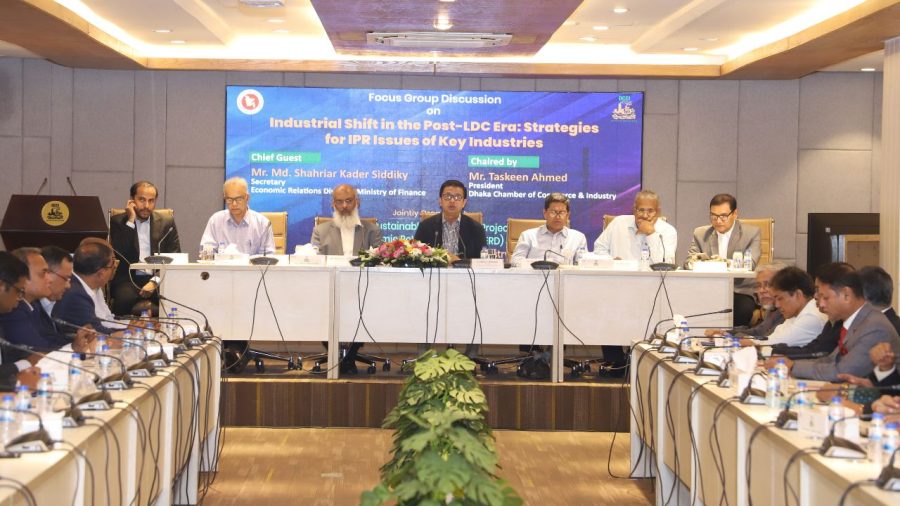
The remarks came at a focus group discussion titled “Industrial Shift in the Post-LDC Era: Strategies for IPR Issues of Key Industries” jointly organised by the Dhaka Chamber of Commerce & Industry (DCCI), Support to Sustainable Graduation Project (SSGP) and Economic Relations Division (ERD) at the DCCI Auditorium on 21 September 2026.
Md Shahriar Kader Siddiky, Secretary of the Economic Relations Division under the Ministry of Finance, attended the event as chief guest, said a press release.
A H M Jahangir, Additional Secretary and Project Director of SSGP, ERD, said Bangladesh’s private sector would face significant challenges in the post-LDC era. He stressed the need for effective enforcement of intellectual property laws, industry preparedness and necessary policy formulation.
DCCI President Taskeen Ahmed said the importance of intellectual property rights for products is increasing in the global economy. He said Bangladesh must focus not only on expanding production in sectors such as pharmaceuticals and readymade garments but also on innovation, branding, technology transfer and value addition.

Taskeen identified structural delays in the existing IPR system, weak institutional coordination, inadequate policies, limited institutional capacity and low awareness among private sector stakeholders as major challenges.
He proposed establishing a modern intellectual property rights office, setting up IP tribunals in Dhaka and Chattogram for faster dispute resolution, introducing an automated digital trademark registration system, recruiting trained manpower and increasing awareness among entrepreneurs, particularly SME entrepreneurs.
Shahriar Kader Siddiky said locally produced goods have strong demand in the domestic market and could gain export potential if their designs and quality improve further.
He said research allocations are available but are not always properly utilised, while there are also concerns over inadequate funding for research, indicating a lack of coordination that needs to be addressed.




The ERD secretary said the government is preparing a special fund for SMEs but stressed the importance of improving entrepreneurs’ capacity and ensuring sustainable development for effective utilisation of such allocations.
He said the government is providing sector-specific technical assistance through the SSGP project and will make necessary policy amendments and reforms. He also said initiatives have been taken to bring all government services under digital operations.
Mohammad Ataul Karim, Faculty of Law at the University of Oxford and former consultant at WIPO Academy, presented the keynote paper.
He said Bangladesh’s industries need to make strategic use of intellectual property rights to adapt to post-LDC realities. He noted that TRIPS and potential TRIPS-plus obligations could create challenges for pharmaceuticals, software and IT, agriculture and industrial design sectors, while also opening opportunities for innovation and industrial transformation.
He stressed the importance of using existing legal flexibilities on IPR, strengthening research and development, promoting industry-academia collaboration and creating incentives for innovation.
During the panel discussion, speakers included Md Jahangir Hossain, Director General of the Department of Patents, Industrial Designs and Trademarks (DPDT); S M Arshad Imam, Copyright Registrar (Additional Secretary), Copyright Office Bangladesh; Abdul Baki, Project Adviser of SSGP and former secretary to the government; Dr Saif Uddin Ahammad, Joint Secretary of the Trade Support Measures Wing under the Ministry of Commerce; Dr Abureza M Muzareba, Professor of Marketing at the University of Dhaka; KSM Mostafizur Rahman, President of Bangladesh Agrochemical Manufacturers Association (BAMA); Major General Dr Md Shahedul Islam (Retd), Secretary General of BGMEA; Md Azizur Rahman FCS, Director General of Intellectual Property Association of Bangladesh (IPAB); Raisul Kabir, Founder and CEO of Brain Station 23 Limited; and Faez Ahmed, Deputy General Manager of Incepta Pharmaceuticals Ltd.
Jahangir Hossain said each industrial sector should prepare its own action plan and ensure appropriate support from relevant government agencies to address post-LDC challenges.
Abdul Baki said the extended timeframe for LDC graduation should be used effectively through greater coordination among government agencies and closer cooperation with the private sector.
Shahedul Islam said effective enforcement of Bangladesh’s intellectual property laws, along with incentives and support for entrepreneurs, would be essential after graduation. He said BGMEA has established a Centre of Excellence to work on new product designs and intellectual property issues in the readymade garment sector.
KSM Mostafizur Rahman called for the agrochemical sector to be recognised as a priority sector and urged the formulation of updated policies.
Raisul Kabir said Bangladesh cannot achieve future success by relying only on outsourcing without prioritising technology innovation. He stressed stronger academia-industry collaboration and improved IP security and enforcement in the IT sector.
Faez Ahmed said strict enforcement of international intellectual property rights in the domestic pharmaceutical market after LDC graduation could significantly increase medicine prices and put additional pressure on consumers. He stressed the need to strengthen technological capabilities in the sector.
Md Azizur Rahman FCS highlighted the importance of creative engineering, branding locally developed products, improving human resource skills and adopting new technologies.
Dr Abureza M Muzareba called for stronger public-private collaboration in developing new products and technologies and stressed the need to obtain Geographical Indication (GI) status and commercialise local products.