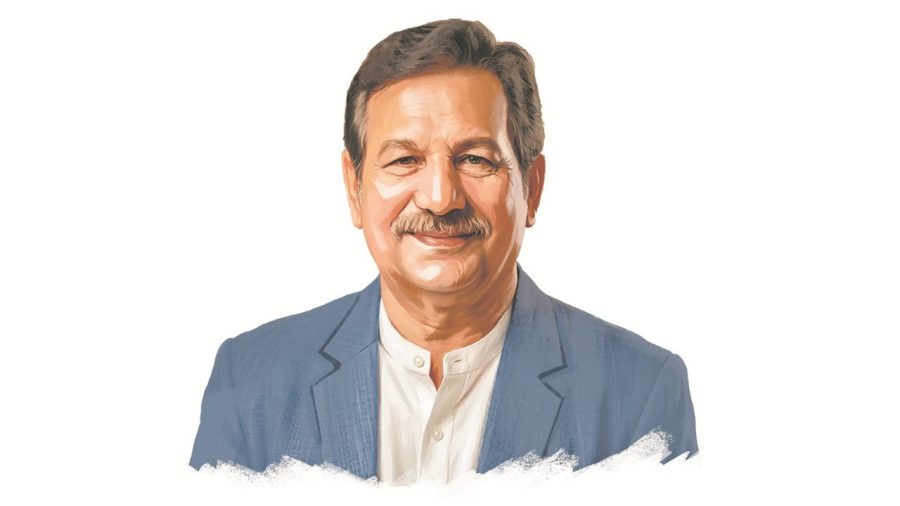



As global civilisation undergoes sweeping changes, some continue to keep the doors of cultural education open even in an increasingly challenging world. Among them is Professor Mostafizul Haque, Chairman of the Board of Trustees of Shanto-Mariam University of Creative Technology, former Professor at the Faculty of Fine Arts, University of Dhaka, and a renowned artist.
In a recent conversation with TIMES of Bangladesh reporter Aleem Haider, Professor Haque spoke about the changing landscape of education in Bangladesh, the management of private higher education, industry-academia collaboration, the importance of civic education and the future of skills-based learning.
When plans to establish the institution began in 2002, its founder, Bir Muktijoddha Mohammad Imam ul Kabir Shanto, had no children. The idea behind the university, however, was to create a legacy that would outlive him.
Professor Mostafizul Haque, now Chairman of the Board of Trustees of Shanto-Mariam University of Creative Technology, had suggested that Shanto build something through which he could continue to live on through good deeds even after his death. That vision eventually gave rise to Shanto-Mariam University of Creative Technology in 2003, named after Shanto and his life partner.
From the outset, the university was conceived as something different from a conventional institution of higher education. It positioned itself as an art and design institution — a ‘cultural university’ — with an emphasis on creative disciplines that were largely unfamiliar in Bangladesh at the time. Its first programmes included music, dance, fine arts, fashion design, apparel manufacturing management, computer graphics and multimedia, interior architecture and other creative fields.
The university’s early years were marked by experimentation. Teachers were brought in from the United Kingdom, Germany, Sri Lanka and India to teach the first batches. Eventually, graduates of the university themselves began taking over the departments. The subjects were new not only to Bangladesh’s higher education landscape but also to many students and their parents, who had little idea about the career opportunities they could offer.
His thinking was closely linked to the country’s economic future. Bangladesh’s garment industry was already emerging as a major source of foreign currency, but the question remained: who would provide the skilled workforce needed to run and expand the sector? The university sought to answer that question by giving students practical, hands-on training.
Over time, its graduates entered the garment industry in growing numbers, reducing the sector’s dependence on foreign professionals. Some went on to become factory owners themselves, while others joined with friends to create their own brands and businesses.

After 2010, the university faced a practical challenge. Sustaining an institution entirely around creative subjects required considerable space, specialised facilities and numerous laboratories. As a result, it gradually introduced engineering, BBA and other conventional disciplines. Today, around 8,000 students study across 17 departments under five faculties.
Yet the university’s emphasis on practical skills has remained central to its identity. Industry-academia collaboration has become an important part of that approach. The university has signed memorandums of understanding with various industries, while companies regularly approach the institution to discuss recruitment and internship opportunities. Demand for certain skills, particularly graphic design, has become so strong that some students begin working even before completing their degrees. In some cases, students are effectively booked for employment in advance.
The change is particularly visible in Bangladesh’s garment sector. Positions that were once frequently filled by professionals from India and Sri Lanka are now increasingly occupied by graduates of Bangladeshi institutions such as Shanto-Mariam University and BGMEA University.
For Professor Mostafizul Haque, however, education cannot be reduced to employability. He frequently reminds students that becoming a doctor, engineer or scientist is not enough. Before pursuing a profession, he believes, young people must learn how to become good human beings. From the reception of each new batch, he speaks about ethics, honesty and the development of humane qualities. These themes recur throughout his addresses to teachers, students and staff.
His philosophy has been shaped by more than five decades of working with children and providing counselling. He believes that anyone entering the teaching profession must understand child psychology. His experience studying in Japan reinforced that conviction. A teacher who enters a classroom without understanding the psychology of children, he believes, is likely to make mistakes. He has trained teachers in every district of Bangladesh and personally counsels new teachers joining the university on the importance of understanding students’ psychology and behaviour.



The university is also preparing for changes in the global economy and education system. Chinese language courses were introduced soon after its establishment, and the university now has 10 Chinese-language teachers serving around 700 to 800 students. Some former students have gone on to teach Chinese at institutions elsewhere in the country. Plans are also being considered for a separate institute offering Japanese, Chinese, German and other languages.
The university is placing increasing emphasis on artificial intelligence and machine learning as well. A curriculum in AI and machine learning has already been developed and is expected to be submitted to the University Grants Commission for approval. The institution is also considering establishing a new faculty combining computer science, AI and other emerging disciplines.
For Haque, these changes reflect a broader transformation in education itself. The future, he believes, may not necessarily revolve around traditional four-year degrees. Instead, people may increasingly acquire specific skills through shorter programmes lasting anywhere from three months to two years before entering the workforce. Education, in other words, is becoming increasingly skills-based.
The same transformation can be seen in the growth of online commerce and digital services. The world is changing rapidly, and educational institutions must change with it.
Despite its expansion, the university’s original mission remains central to its leadership. When Shanto established the university in 2003, his primary objective was to create opportunities for lower-middle-income students and young people with creative potential. The university has therefore sought to support students whose academic results may not be exceptional but who demonstrate a willingness to learn practical skills and build careers around them.
Some former students have told Haque that their lives might have taken a very different path had the university not been established. The relatively low cost of studying there allowed them to acquire professional skills and establish themselves. Some became entrepreneurs. Others built careers through outsourcing and, in certain cases, began earning more independently than they might have through conventional salaried employment. This, according to Haque, is what distinguishes the university’s approach.
The institution was never intended to operate primarily as a business. After launching the university with unconventional and creative subjects, Shanto used profits from his other businesses to support it rather than seeking financial returns from the university. His objective was to create an ‘education hub’ that would serve the public.
Shanto died during the Covid-19 pandemic. But those who remain on the Board of Trustees say they continue to uphold his principles. Haque stresses that none of them came to the institution to take anything from it.
The university was established as a non-profit organisation, with no provision for distributing dividends. Its leadership considers it public property and says it remains committed to that founding principle.
The institution provides scholarships worth around Tk12–13 crore every year. Students with strong academic results can receive scholarships covering between 50 and 80 per cent of tuition fees. Even students receiving smaller scholarships may face financial difficulties during their studies. In such cases, if their parents submit an application, the university can waive their tuition fees.
The aim is to ensure that financial hardship does not necessarily force a student to abandon higher education. For Haque, this is not simply an institutional policy. It is a reflection of his own identity.
“I am a teacher myself. I am not a businessman,” he says.
For him, helping a student stand on their own feet carries greater value than making money from a business.
The members of the Board of Trustees, he notes, have never taken payment for attending meetings. He himself is not the owner of the university but the Chairman of its Board of Trustees. The founder never sought dividends from the institution.
The university’s specialised character also allows people to return to education at different stages of their careers. Unlike public universities, private universities do not generally impose the same age restrictions. As a result, professionals already working in various industries but lacking formal qualifications in their fields can return to study. Some enrol in two-year master’s programmes to formalise and deepen their expertise.
The university has also attracted established figures from the creative world who lacked formal academic qualifications in their disciplines. Musicians such as Yakub Ali Khan and dancers such as Munmun Ahmed, for example, did not initially hold formal degrees in their respective fields. Some developed their skills through training in India before later completing undergraduate or master’s degrees at Shanto-Mariam University and, in some cases, returning to teach.
The university recognises that its regular students may not always enter with the same level of artistic preparation as students admitted to Fine Arts programmes at public universities. But those who arrive with genuine interest receive extensive practical training.
The objective is to ensure that they leave with skills that can help them establish themselves professionally. To support that goal, the university has developed laboratories and other facilities and plans to expand them further when its new campus is completed. It is also placing greater emphasis on sports, including special opportunities and facilities for students admitted under sports quotas. Meanwhile, students in fields such as graphic design and multimedia are already earning while they study.
For Haque, these outcomes represent the true measure of the institution’s success.
The university may have expanded from a pioneering creative institution into a broader university with thousands of students and numerous academic disciplines. But beneath that growth remains the same founding idea: education should create opportunities, develop human potential and help people build independent lives. And that, ultimately, is the legacy its founders set out to create.