
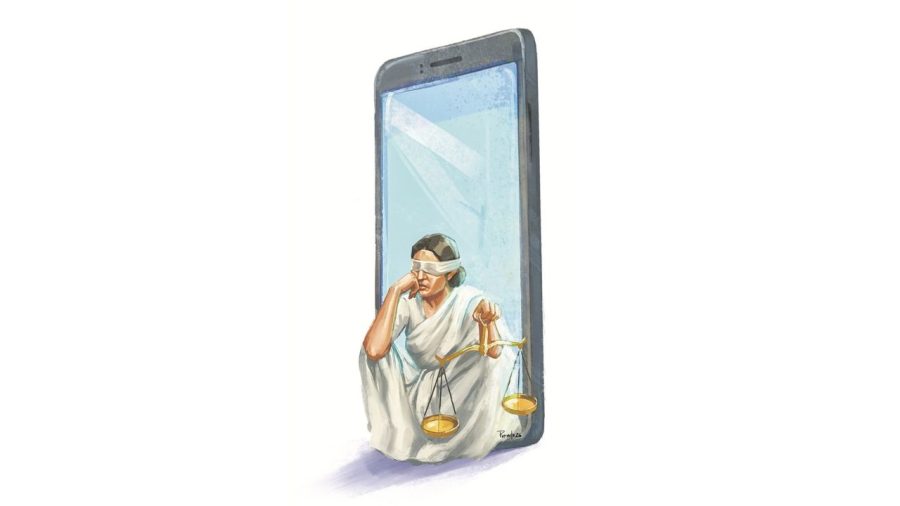



A few weeks ago, a young woman at a private university in Dhaka posted her account of harassment on social media. Screenshots, timestamps and a narrative of what she said happened to her spread across the internet within hours. The accused responded in kind, posting his own version, his own screenshots and his own testimony. This created a scenario where the common sections were filled with verdicts of the case.
Furthermore, different users shared different perspectives on the matter. By the time, either party might have considered walking into a police station, or a university proctor the case had already been tried, deliberated and settled through social media sites like Facebook and Instagram. The whole process was done by an anonymous jury of strangers without deep investigation of the case, only judging through each social media posts’ narrative.
In this opinion piece, neither party is directly named deliberately. This is the whole point I want to make. This is because if we look closely at the above case example, a serious allegation such harassment (at worst something closer to an abuse) was adjudicated entirely outside any process capable of protecting anyone. Neither the accuser if her account is true and not the accused if his account is true. Nobody was cross examined and no evidence was properly tested.
No one was afforded due process and yet a verdict was reached. Based on this verdict, a punishment which was a social exile was carried out within days. The case alone is not an isolated case; it is a pattern which is accelerating.
Across Bangladeshi campuses more specifically among teenagers and young adults; a certain type of post has become a default response to harm, which is the expose post. This is how an expose post normally goes, a victim posts an account of harassment, gaslighting, abuse or in worse case sexual exploitation of minors. The post is drafted in a way that it goes viral and within hours the accused is named, screenshotted and shared across pages with tens of thousands of followers.
Then comes the verdict delivered not by a court but by a comment section and in almost all cases the accused is ‘cancelled’. A social exile and a state of complete isolation given as a moral punishment by the society. They are eventually dropped from friend groups, uninvited from events, sometimes withdrawn from classes and in some cases contacted by their own families before any formal complaint is even filed.
The posts get results in a narrow sense because they do generate the necessary outrage, they do generate visibility and often they do generate real consequences for the accused. But the process is not done under the laws of the land or through a legal channel. If a person is indeed guilty of such crimes like harassment and abuse, they should be held liable before a court of law rather than just being socially cancelled. This is precisely why the pattern deserves scrutiny rather than either blanket celebration or blanket dismissal.
The honest answer to this issue is that for many young people, the legal system does not feel like a real option. Many call it slow, intimidating, which requires patience, resources and for a survivor of harassment or abuse a willingness to retell the story of their trauma in front of unfamiliar authorities who at times do not treat the complaint with equal sensitivity. Reporting can also mean exposure to family shame, institutional retaliation or simply being disbelieved.

A social media post by contrast is instant, free of financial burden (unlike a legal pathway) and puts control of the narrative directly in the survivor’s hands.
However, speed and control are not true mechanisms of justice. Hence, this is where the conversation needs to get a little uncomfortable rather than comfortable. We need to understand that awareness about a certain individual’s action is important but, cancellation is not a substitute of law in either direction. If someone has genuinely committed harassment, gaslighting or exploitation of minors, just an informal social exile is a widely inadequate response to what is in many cases a criminal offense under the laws of Bangladesh.
This may leave the accused free to repeat the behaviour elsewhere, with no record, no restriction and no rehabilitation. And if the allegation turns out to be false, exaggerated or product of a personal dispute framed as an abuse then the accused is in a situation where they are permanently and publicly punished with no mechanism to clear their name Both outcomes are therefore a failure as neither serves the person who was actually harmed.
Therefore, it is worth stepping back to define what we are actually talking about. Cybersecurity is commonly defined as the protection of internet connected systems which is built around the connection of devices, networks and data from unauthorised access, misuse and harm. But cybersecurity is not limited to firewalls and hacked accounts, it also concerns the safety of people’s identity reputations, images and personal information as they move through digital spaces.
In such a space, when for example a minor’s photo is circulated maybe on the basis of a cancelled post without consent there can be far greater consequences which we are not yet to take accountability of. It also creates other issues such as AI generated deep fakes, private messages leaked as ‘evidence’ in an expose post or when a teenager’s identity is exposed to a hostile public before any investigation has occurred. All of this falls squarely within the domain of cyber safety, not just social conduct.




In Bangladesh, the primary users of this digital space are precisely the demographic most involved in expose culture. In particular teenagers and young adults are overwhelmingly active on social media sites such as Facebook, Instagram and TikTok. For this generation often called ‘Gen-Z’ social media is not a supplementary space but it is often the primary venue where disputes, grievances and even criminal complaints are first posted.
News aggregators have amplified the wide spread of such news. This may be the reason that social justice for many young Bangladeshis has effectively migrated online because the offline institutions meant to deliver it have not kept pace with how young people actually communicate, organise and seek redress.
The risks this creates includes unverified allegations, spreading faster than any correction can follow, minors being named, shamed or doxxed in the process of ‘exposing’ someone-else, AI generated deepfakes being weaponised in harassment campaigns with almost no existing enforcement mechanism and a chilling effect where genuine victims either overexpose themselves seeking validation or under report because they have seen how brutal the public process can be.
The current law of Bangladesh offers some remedies for such criminal acts. Harassment, sexual exploitation of minors and cyber offenses can be pursued under a combination of the Penal Code, the Children Act 2013, the Digital Security Act framework (now under review and partial reform as the Cyber-Security Act), and Bangladesh’s evolving jurisprudence on sexual harassment in educational institutions, most notably the High Court’s 2009 directive requiring universities to establish complaint committees.
Many universities do have internal proctor bodies which have been created to handle exactly these complaints confidentially and with due process.
It should also be noted that absence of proper legal mechanism may be one aspect of this. Other aspects include absence of awareness, trust and accessible pathways to it. However, most target groups are not well informed or there exists a lack of awareness or maybe lack of trust to approach these bodies with their concerned issues.
But in Bangladesh there needs to be a new law which covers issues such as AI generated deep fake images of individuals, online bullying and harassment, widespread social justice through online expose posts. A well-established enforcement capacity with trained cybercrime units, fast response takes down mechanisms, victim support infrastructure still remains thin in comparison to the scale of the problem.
Closing this legal gap will require more than litigation. The possible legal pathways may include a writ petition or public interest litigation (PIL). This can compel specific institutional action or fill an interpretive gap where the Constitution’s protections are engaged, and Bangladesh’s courts have used PIL effectively before including on the 2009 harassment directive itself. But a durable fix particularly for AI-enabled abuse and minor’s digital protection is more likely to come from sustained policy advocacy.
A white paper which is grounded in evidence and youth testimony, built into a draft bill and pushed through Parliament with the backing of legal, education and technology stakeholders. Litigation can open a door but only legislation and funded institutions can walk through it and stay there.
It’s also worth naming a parallel current making all of this worse. A wave of online ‘sigma male’ and similarly branded content creators who explicitly frame misogyny, emotional manipulation and disregard for women’s boundaries as markers of markers of masculine success. Contents such as this lies at the core of such posts and problems associated with. These misogynist content creators actively promote such lifestyles which results in gaslighting, coercion, contempt for consent amongst others.
The expose posts are in most cases nothing but a desperate reaction against it. Therefore, any serious response to expose culture has to reckon with the fact that both harmful behaviour and the harmful response to it are shaped by the same unregulated content ecosystem.
It has to be said that none of this is an argument for telling survivors to simply ‘trust the process’ and stay silent and for many, the process has never earned their trust. It, hence, an argument for building a better process, one that is as fast and accessible as a social media post but that actually protects people instead of just performing justice for an audience.
Some of the possible solutions could include a legal awareness focused ai-chatbot, a dedicated cyber social justice focused helpline, confidential legal clinics embedded in schools and universities and a network to tackle cybercrime.
If we focus on the first solution of creating a legal awareness focused ai chatbot then we need to create a trained ai-chatbot on Bangladeshi law specifically. This would let a young person privately ask the ai-chatbot questions such as “What legal actions can I take under the Laws of Bangladesh against the incident which happened to me?”. They can do it first, without first having to post it publicly or confront an institution. Maybe then they can focus on the second step of calling the helpline to seek help through the solution they just got to know.
Therefore, through a dedicated cyber-social justice helpline equipped to handle emerging harms like AI deepfakes, non-consensual image sharing and coordinated campaigns against such issues not just generic complaint intake. Immediate actions regarding such issues can also be enabled through confidential legal clinics embedded in schools and universities working alongside existing bodies like displenary committees, proctoral bodies so that cases are investigated internally, professionally and privately before or instead of becoming a public spectacle.
Lastly it is highly important to create A Network on Cyber Policy which advocates for a change in law and supports platforms such as helpline, legal clinics or even ai-chatbot’s backend support. Such a network can be mobilised quickly to advise, investigate and where warranted escalate a case into a formal legal system with proper evidence handling.
In Bangladesh such complex social issues are legible to people through storytelling. One of the primary examples of this is ‘MEENA’, the UNICEF animated character which taught a generation about girl’s rights and safety in a way (amongst other social issues) that classroom lectures never could. We likely may need a modern equivalent platform. This fictional storytelling should focus on characters which are relatable and emotionally honest in regards to character development and storytelling.
This may help the youth understand that how legal mechanisms should be the primary route to address issues such as harassment, gaslighting and exploitation amongst other such issues.
But awareness alone will not fix this. Meena worked because she was paired, eventually with policy, programmes and institutional change. The expose post is a symptom of a generation that feels unheard and unprotected by the systems meant to serve it. Hence, we need to build a mechanism, through a network of experts who can advocate to create a legal focused solution that can give instant remedy to the youth in such cases.
Author is the Corporate communications manager, Banglalink