


A disastrous combination of administrative inertia, chemical shortages, and phantom fogging drives has crippled Dhaka’s response to a surging dengue crisis, leaving the capital’s two city corporations completely outmatched by the deadly mosquito-borne disease.
As infection rates and fatalities soar across the metropolis, a damning picture of institutional breakdown has emerged. Dhaka South City Corporation (DSCC) was recently forced to go cap in hand to Dhaka North City Corporation (DNCC) to borrow 16,000 litres of malathion adulticide after failing to secure its own supply, all while field-level monitoring and inter-agency coordination have effectively dissolved.
Borrowed poison and failed tests
The supply breakdown in the South occurred after health officials decided to abandon deltamethrin, an adulticide that Japanese researchers proved last year had become practically useless against local mosquito populations.
However, DSCC’s planned transition to malathion collapsed when chemical samples delivered by a commercial contractor failed crucial laboratory quality tests.
Desperate to avoid a total cessation of fogging operations, DSCC Chief Executive Officer Khaibar Rahman dispatched an urgent request to his DNCC counterpart on 24 August seeking a loan of 70,000 litres of insecticide. The DNCC eventually handed over 16,000 litres on 1 September.

Although DSCC officials claim the crisis was resolved by 8 September after fresh batches passed testing, the procurement delay cost precious weeks during the peak transmission season.
Empty smoke and fractured ward oversight
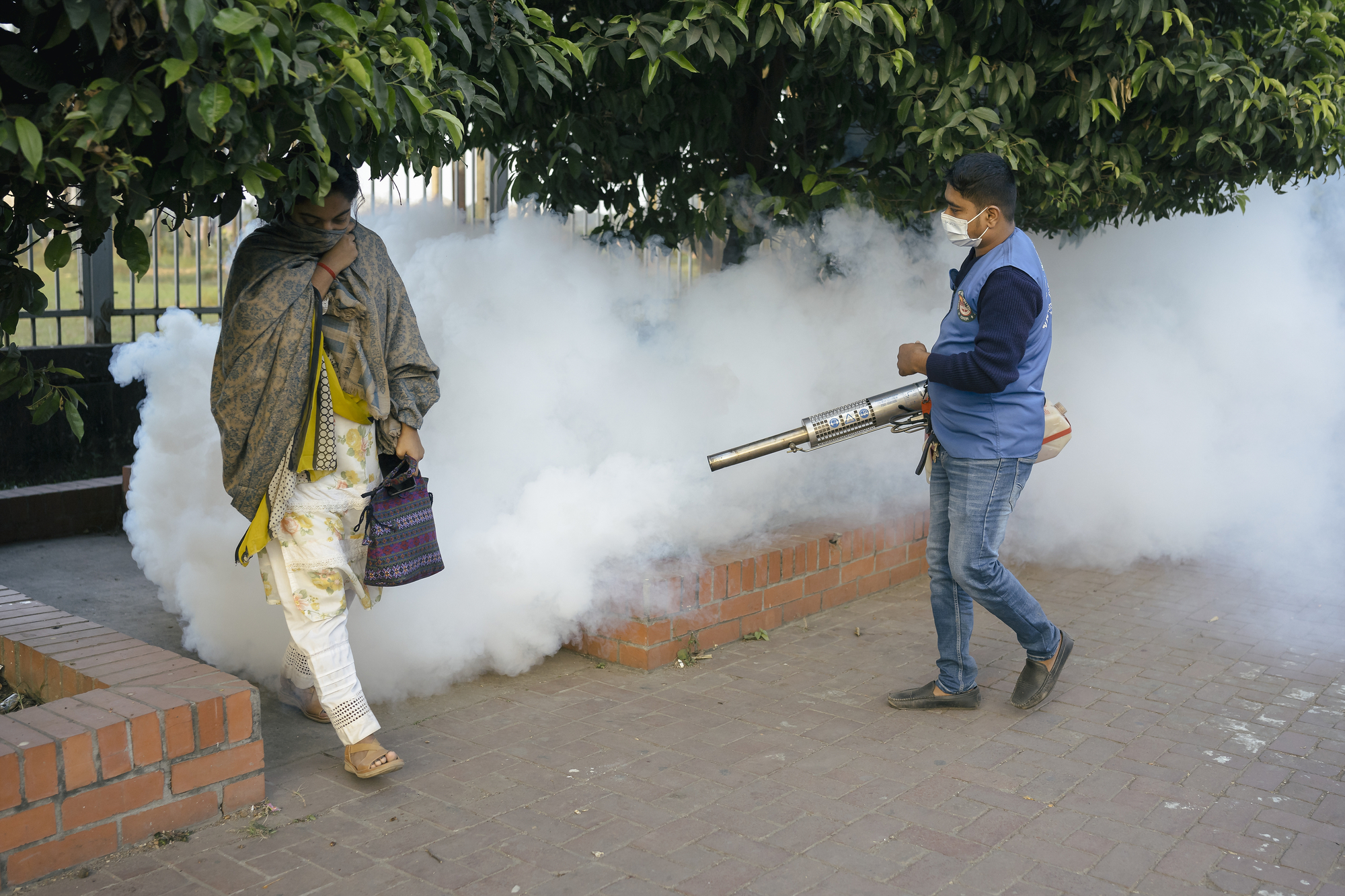
On the ground, local residents and ward officials describe an operation rife with negligence and zero accountability. Across several neighbourhoods visited by reporters, spray teams operate with total independence from local ward offices, appearing erratically and applying chemicals without oversight.
Rabeya Akter, ward secretary of DNCC Ward 21, revealed that local administrators have been completely frozen out of mosquito-control operations for over a year.




“There is no connection whatsoever between the ward secretary and what insecticides workers are collecting, what they are applying, or where they are applying it,” Akter admitted, noting that ward offices are routinely kept in the dark about daily fogging schedules.
An identical disconnect plagues DSCC Ward 91, where office assistant Md Tarikul Islam confirmed that spray teams operate out of a separate facility near Kadam Ali Jheel. “They do not interact with us at all, they only pop into the office when they need a secretary’s signature on paper,” Islam said.
As a result, resident complaints lodged at local ward offices disappear into a bureaucratic black hole. Meanwhile, residents in high-risk zones like Badda report that afternoon fogging yields little more than theatrics.
“There is plenty of noise and foul-smelling smoke, but no mosquitoes actually die,” said local businessman Asad Molla.
A deadly toll mounts
The administrative paralysis comes as figures highlight the catastrophic scale of the outbreak. In September 2026 alone, a harrowing 43,774 people were admitted to hospital with dengue, resulting in 148 deaths. From January through September, the official national death toll stood at 245.
The latest surge follows years of severe casualties, with government data recording 1,705 dengue deaths in 2023, 575 in 2024, and 413 in 2025, alongside over 525,000 hospitalisations across the three-year period.
The national dengue management guidelines now officially classify the infection as a year-round threat rather than a seasonal menace.
DSCC Administrator Md Abdus Salam insisted that citywide surveys are underway to identify hotspots for targeted “special drives,” adding that a board of entomologists is now screening all imported chemicals.
Experts slam bureaucratic delays
Leading experts warn that sluggish surveys and superficial drives will do nothing to stem the tide. While city workers currently apply larvicide (temephos) in the morning and malathion fogging in the afternoon, Jahangirnagar University entomologist Professor Kabirul Bashar warned that timing and accurate dosing are everything.
“If a survey takes 12 days to conduct and another 12 days to process into a report, dengue will have already ripped through the population,” Professor Bashar warned. “Interventions must be immediate.”
Urban planner Iqbal Habib added that public health cannot be safeguarded through empty PR exercises.
“A city cannot achieve public health progress through populist and unaccountable activities,” Habib cautioned. “Much like waste management, controlling vector-borne diseases demands an integrated, accountable, and flawlessly coordinated system—not fragmented, panic-driven gestures.”