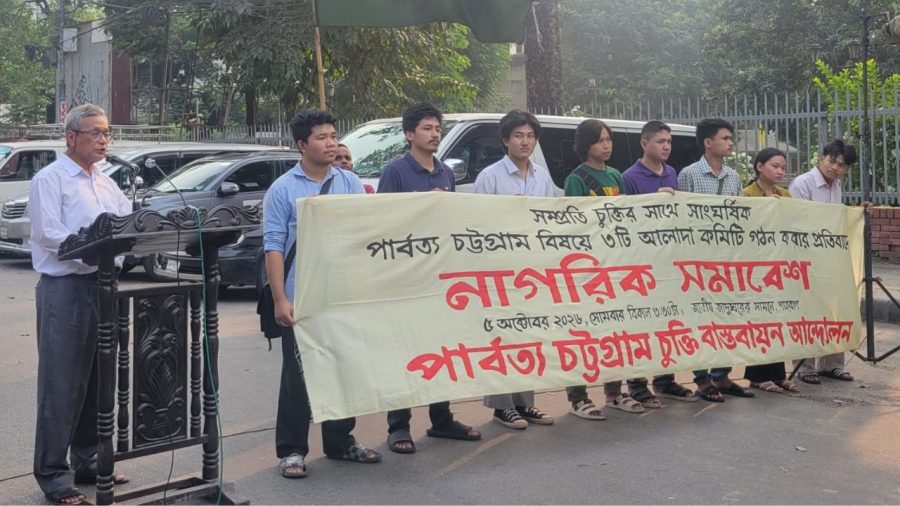



Speakers at a citizens’ rally organised by “Parbatya Chattogram Chukti Bastobayon Andolon” have demanded immediate cancellation of three separate national committees formed “in conflict with” the Chittagong Hill Tracts (CHT) Accord, alongside the fulfillment of an eight-point demand.
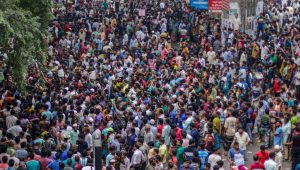
The protest gathering was held at 3:30pm on Monday in front of the National Museum in Shahbagh.
‘State commitments cannot be denied’
Zakir Hossain, joint coordinator of Parbatya Chattogram Chukti Bastobayon Andolon and human rights activist, said, claiming an accord was signed with another party or individual, rather than the State, displays extreme political unawareness and immaturity.
He stressed that when a prime minister or head of government signs an accord, it is executed directly with the State, not with a person or specific political party.
Dismissing the trend of repudiating international or state treaties following a change in government as completely irrational, he cited international commitments such as the United Nations Sustainable Development Goals (SDGs), noting that believing a subsequent government will not abide by an agreement signed by a previous prime minister is pure political foolishness.
He added that while constructive discussions can take place to review and strengthen Accord terms, completely evading responsibility demonstrates a lack of political sincerity, calling instead for a strengthened movement and mutual empathy.

Echoing these views, former CPB General Secretary Ruhin Hossain Prince noted that the 1997 Accord was signed with the State of Bangladesh, not a single political party.
He stated that if the State considers the Accord unacceptable, the government must present a clear position, adding that if a review is desired, it should be done comprehensively to pave the way for full implementation.
He urged the government to recognise all resident ethnic communities if it genuinely prioritises “Bangladesh first.”
Historical continuity, administrative concerns
Critiquing recent administrative actions in the Hill Tracts, Bangladesh JaSaD General Secretary Nazmul Huq Pradhan pointed out that a Hill representative was initially appointed as a minister and subsequently removed, followed by the formation of multiple new committees.




Demanding an immediate halt to political manoeuvring and experimentation involving Hill communities, he warned that failing to implement fundamental Accord provisions pushes the region towards conflict.
He strongly advocated for guaranteeing the rights of Hill populations, demanding that communities with distinct lifestyles and cultures be recognised as ‘indigenous’ or equal citizens of Bangladesh, with their grievances addressed without delay.
ALRD Executive Director Shamsul Huda highlighted that extensive discussions were conducted with Hill representatives during the tenure of Begum Khaleda Zia, laying the groundwork for the final Accord signed under the Awami League government.
He revealed that upon returning to power in 2001, then prime minister Begum Khaleda Zia directed Law Minister Barrister Moudud Ahmed to scrutinise the Accord. Following a thorough review, Barrister Moudud Ahmed concluded that the document contained nothing harmful or anti-state.
Consequently, the BNP government preserved the Accord throughout its 2001–2006 term, proving that the administration did not view it as detrimental to the State.
Senior journalist and freedom fighter Abu Sayeed Khan observed that the core issue surrounding the CHT stems from misconceptions within the national political and administrative mindset.
He noted that bureaucrats, police, military officers, and politicians posted in the region often erroneously believe “too much has been given” to the CHT, a misconception that must be overcome for overall national progress.
Comparing local governance, he noted that powers devolved to CHT local bodies do not exceed those of London counties, and granting equivalent powers to all district councils across Bangladesh would cause no harm to the State.
Eight-point demand for lasting peace
Addressing national integration, Abu Sayeed Khan stated that Bangladesh comprises diverse ethnic, linguistic, and gender groups, warning that national advancement stalls if any community remains alienated.
He asserted that for Bangladesh to flourish in its unique character, Bengalis, Chakmas, Marmas, Tripuras, Santals, Garos, and all other ethnic groups must be united and their pressing problems solved.
He further called for a positive psychological transformation among Bengalis and Bengali Muslims to accord equal acceptance and rights to minority groups, contrasting Bangladesh’s current stance with global practices of granting special privileges to minorities.
To establish permanent peace in the region, Abu Sayeed Khan presented an eight-point demand to the government and policy-makers on behalf of the organisation. The core demands include the immediate cancellation of conflicting committees and the formation of a “CHT Accord Implementation Monitoring Committee.”
Furthermore, the organisation urged the withdrawal of the non-Hill State Minister for CHT Affairs and the reconstitution of the Advisory Council in line with the Accord.
They also called for a clear, time-bound roadmap for Accord implementation, the rapid framing of rules to render the “CHT Land Dispute Resolution Commission” fully functional, direct policy-level meetings with the CHT Regional Council, and the initiation of government-led multilateral dialogue to resolve land disputes.
Presided over by Zakir Hossain, joint coordinator of Parbatya Chattogram Chukti Bastobayon Andolon and human rights activist, the meeting was attended by prominent civic and political leaders. Guest speakers included senior journalist and freedom fighter Abu Sayeed Khan, ALRD Executive Director Shamsul Huda, Gono Forum President Advocate Subrata Chowdhury, Bangladesh JaSaD General Secretary Nazmul Huq Pradhan, BaSaD General Secretary Bazlul Rashid Firoz, former CPB General Secretary Ruhin Hossain Prince, and writer-researcher Ishita Dostidar.
Representatives from various social organisations, together with national-level student and youth leaders, attended to express solidarity with the movement for full Accord implementation.