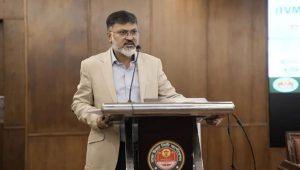



Deputy Speaker Barrister Kayser Kamal on Monday said there was no room for reconciliation with the ousted Awami League regime, arguing that its actions against citizens had permanently disqualified it from taking part in Bangladesh’s political future.
“There is no room for reconciliation with the ousted regime. Their criminal, inhuman, and ruthless actions against their own citizens have permanently disqualified them from participating in our political future,” he said.
He made the remarks at a session titled “Justice, Accountability and National Reconciliation” on the concluding day of the three-day Bay of Bengal Conversation 2026 in Dhaka. The event was held at Pan Pacific Sonargaon from 3 to 5 October, reports UNB.
The session was moderated by Pramod Jaiswal, research director at the Nepal Institute for International Cooperation and Engagement.
Kayser said transitions from autocracy to democracy are often threatened by institutional remnants of former regimes.
“True transitional justice requires far more than symbolic gestures or premature calls for unity; it demands forensic, systematic dismantling of impunity,” he said.

He argued that reconciliation efforts around the world often fail when they are used as a political shield to protect perpetrators of state violence from legal consequences.
“National reconciliation without justice is not peace – it is simply a pause between conflicts,” he said.
Kayser said 5 August 2024 was not merely a change of administration but a fundamental shift in Bangladesh’s political order.




“The citizens decisively rejected a regime built on fear, patronage, and the suppression of civil liberties,” he said.
He alleged that the previous regime had disregarded the rule of law and institutionalised a system in which killing people was treated as legitimate to keep an autocrat in power.
Citing UN fact-finding reports, Kayser said 1,600 people were killed during the July-August uprising, with children accounting for 12 to 13 per cent of the victims.
He said the generation that took part in the uprising fought to restore democratic dignity and fundamental rights and to build a Bangladesh where citizens are treated equally and perpetrators are held accountable.
“This justice is not only for punishment, but to establish a definitive precedent so that no one will ever dare to construct another authoritarian regime in Bangladesh in the future,” he said.
Kayser also alleged that those responsible were now trying to regain political relevance through sporadic acts of terrorism.
He said some groups at home and abroad were advocating for them under the banner of reconciliation, warning that such an approach could push the country towards further conflict.
“One cannot reconcile with the apparatus that systematically weaponised the state against the very people it was meant to protect,” he said.
The deputy speaker said Bangladesh was working to restore economic stability and reclaim its dignity abroad as an independent and sovereign nation.
He said people in the post-5 August period expected absolute accountability from the government.
“We must not act as yes-men, but as custodians of the people’s will,” he said.
“We are committed to a future where government is structurally bound to accountability, ensuring that the dark chapter of autocracy remains permanently closed,” he added.
Executive Director of the Centre for Peace and Conflict Studies, Cambodia, Nikki Singer, New Age Editor Nurul Kabir, University of Rajasthan Professor Karori Singh and Wits University researcher Madalitso Zililo Phiri also addressed the session.