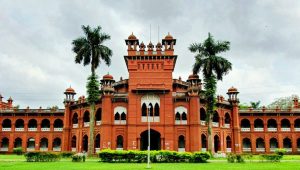



The National University was established in 1992 to improve the quality of higher education. By affiliating with the country’s general colleges and institutions providing professional education, it conducts undergraduate and postgraduate education, formulates curricula, organises examinations, and awards degrees. Currently, about 40 lakh students are studying in 2,318 colleges under this university.
The current Vice-Chancellor of the university is Professor ASM Amanullah. In an exclusive interview with TIMES, he spoke about his plans for the future of National University.
Around 76,000 seats remain vacant in the first year of undergraduate (honours) under the National University. Why is this happening?
This depends on the pass rate in HSC. We have introduced an admission test for the first year. Only those who pass will be admitted. There is no issue of seats remaining vacant or applications being lost here.
But seats are not filled 100 per cent in any university, even at Dhaka University some remain vacant.
Which colleges have more vacant seats and why?
In government colleges, about 98 per cent of seats are filled. In private colleges, more remain vacant. Private colleges in remote areas cannot attract students. The reason for this is the failure to ensure quality education, the lack of good teachers, and the absence of an environment conducive to study.
There are also questions about the skills of National University students. Their demand in the job market is low.
The outdated curriculum is responsible for this. Over the past 30 to 35 years, we could not provide quality education or specific skills. However, we have conscious and intelligent. If we can prepare them and give them opportunities, a lot is possible through them. The financial market, banks, insurance companies, and large first-tier corporate companies continue to operate by relying on National University students.
More than 80 per cent of the country’s jobs are in the private sector. Of this sector, 82 to 83 per cent of graduates are from the National University. We are creating industry-academia linkages to expand the job market for students, which will help increase the quality of education at the National University and the employability of students.
It has been two years since you took charge as Vice-Chancellor. What new initiatives have you taken during this time?
Of the boys and girls pursuing higher education, 70 per cent are National University students. Preparing them to be suitable for the global market is extremely challenging. Despite many obstacles, we have taken up that task.

Over the past two years, through various ups and downs, the university is now on the right track, and its pace is increasing. We are moving toward quality and skills-based, job-oriented education.
What kind of changes are being brought to the curriculum to increase students’ skills?
A plan for fundamental reform has been undertaken. First, we are emphasising outcome-based education. Plans to make basic digital skills – data analytics, coding, digital marketing, and basic and advanced AI courses – compulsory are being implemented.
There are about 4,000 courses across 50 subjects. Of these, the syllabi of about 400 courses have already been reformed. Work on the rest is ongoing. We have also made English and ICT compulsory. If anyone wants a National University degree, they must pass these two courses.
Modern subjects such as artificial intelligence, cyber security, programming, semiconductors, digital communication, leadership, cognitive empowerment, and financial literacy are also being included in the curriculum. Various micro-credential programmes are also about to be launched. A master plan for creating skilled teachers is also underway.
What is your view on politics in educational institutions?
Politics will exist in educational institutions. But that politics must be constructive. When teachers enter a college, they will work in the interest of the institution. Students will also work in their own interest. This is what campus politics should be. The teacher-student relationship must remain above all kinds of politics.
You have spoken of a ‘paradigm shift’ in education. What is this change actually?
Until now, the main goal of our higher education was to give students a degree. Now a degree alone is not enough; students must be given such knowledge and skills that will prepare them for their careers and the changing world of the future. This is the essence of our “paradigm shift”.




The biggest change will come in the curriculum and teaching methods. We are changing old content that is inconsistent with the job market and formulating up-to-date syllabi. Alongside soft skills, we are emphasising hard skills and technological skills for students.
The world is now moving toward artificial intelligence, data analytics, cyber security, and other technology-driven skills. So that our students do not fall behind in this change, they must be made familiar with and skilled in these subjects during their student life.
The National University has a large number of affiliated colleges. How difficult is it to implement this change in such a large system?
This is, of course, a big challenge. But this also provides a big opportunity. The quality of teachers and teaching in affiliated colleges must be increased. Already, teachers of various departments are being given ICT training. If teachers are skilled, new knowledge and technology can be effectively delivered to students.
What were the main challenges when you took charge?
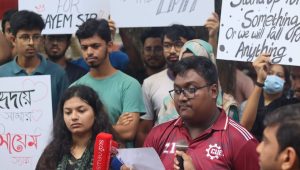
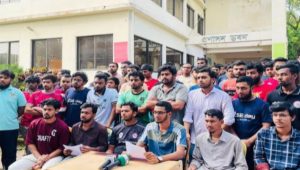
After the 2024 mass uprising, the entire education system collapsed. The hardest part was bringing teachers and students back to the classroom. For this, measures were taken to overcome the situation by involving guardians, the teachers’ community, and education-related local individuals. Governing bodies have been reconstructed in about two thousand colleges with the coordination of renowned educationists and professionals. Counselling arrangements have been made for teachers and students.
To ensure students’ attendance in class, in-course exams have been introduced and made mandatory to be sent to the university’s central office.
There was also stagnation in the university’s central administration. Many strict measures have been taken to bring administrative dynamism by reconstituting all policy-making boards and ensuring maximum transparency and accountability. As a result, overall improvement in the university’s activities is already visible.
What steps are being taken to address the teacher shortage?
To reduce the teacher shortage in colleges, an initiative has been taken to form a part-time “teacher pool.” Retired qualified and experienced teachers and experts skilled in relevant subjects will be included in this pool.
Alongside, subject-based teacher pools are being formed to create opportunities for students to learn from the practical experience of experts skilled in various subjects.
One of the big problems of the National University is session jam. How do you plan to address this issue?
Session jam was not created by any single cause. Examination conduct, answer script evaluation, result publication, academic calendar, and administrative management – all of this is connected to it. Our goal is to reduce the unnecessary gap between the examination schedule and result publication and to make the academic calendar more realistic. I hope session jam will be completely over by 2027.
We are now following a specific academic calendar. Recently, we published the results of the Degree Pass and Certificate Course second-year examinations within 42 working days, which is a record for the National University.
Master’s final year results were published within 50 working days, and Honours final year examination results were also published within 47 working days. We have also started working with UK’s Oxford AQA and Edexcel. If we can do this, it will be possible to publish examination results in the shortest possible time.
You have also taken various initiatives regarding third language education.
If we can teach a third language besides English, expatriate income could double. For this, a Multi-Language Learning Institute has been established.
Under the supervision of this institute, we have started the work of establishing language clubs in colleges affiliated with the National University. Several colleges in Dhaka have already launched them. Gradually, it will expand across the country.
Students are interested in learning Mandarin, Japanese, Arabic, and French. For this reason, we are taking initiatives for industry-academia linkages. An agreement has been signed with IDP Bangladesh. As a result, students will be able to develop language skills. Additionally, we are forming cyber security clubs and career clubs.
What initiatives have you taken regarding industry-academia?
An initiative has been taken to build industry-academia connections by overhauling the dilapidated curriculum. Opportunities are being created for industrial entrepreneurs to connect with graduates as well.
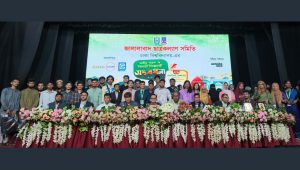
We have signed MoUs with more than 150 domestic and foreign universities, research organisations, and industrial institutions. Through this, opportunities for internships, employment, and skill development are being expanded.
Agreements have been made with Dhaka Sheraton and the Westin. Our graduates will get internship opportunities at these establishments.
Memorandums of understanding have been signed with BRAC University and North South University. Through this, our students will exchange research and skills. Very soon, we are going to launch a Master’s of Public Health (MPH) programme in collaboration with a foreign university.
Are there any initiatives for dropout students?
Micro-learning and micro-credential courses of 10-12 credits are being launched for both current and dropout students. Through these three-month courses, the rate of trained students succeeding in the workplace is 97.5 per cent. The process of establishing an “Institute of Skills Based Education” is underway to properly manage these courses and post-graduate diploma programmes.
Are there any initiatives for students from families of martyrs of the mass uprising?
In the July mass uprising, 26 students from 25 colleges affiliated with the National University were martyred. The July Foundation and the National University jointly provided Tk8 lakh in assistance to each of their families.
Tuition fees have been waived for students from martyrs’ families. The “July Shaheed Smriti Education Scholarship 2025” has been launched. We have also taken steps for mental health development under the supervision of experts so that students can overcome trauma.
Are there any special initiatives for women’s empowerment at the National University?
About 47 per cent of National University graduates are women, many of whom remain outside employment. Next year, there are plans to bring 50,000 women under online marketing skills and freelancing opportunities through a women’s freelancing and gig economy programme.
In some colleges, campus-based job and internship centres are being run with the support of domestic and foreign organisations. In this regard, the National University has undertaken a project called “She Skills.”
Where do you want to see the National University in the future?
My dream is very clear: to transform the National University into such a modern university where a student finishes their education on time, receives quality education, acquires necessary skills, and emerges with the capability to build their own future.
We want every student to feel that they are a graduate of the country’s largest higher education institution and that international-standard opportunities can be created for them as well.