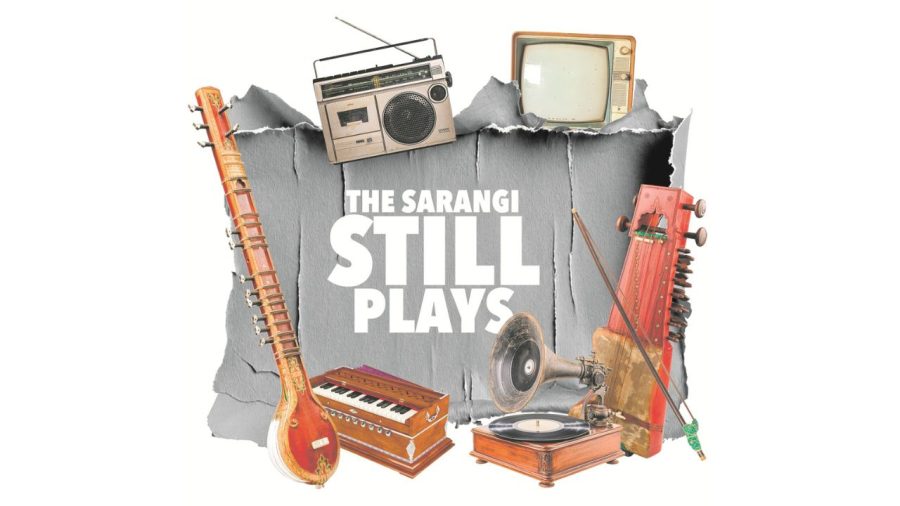



During our childhood in the 1980s, we listened to music mainly on the radio. Those who were a little more affluent and fonder of modern conveniences had televisions at home. Those with still more refined tastes had gramophone record players. Before that, the gramophone or koler gaan, as it was popularly known, had occupied this place in people’s lives.
As technology has advanced, the means by which people listen to music have continued to change. The gramophone, radio, television, gramophone record player, cassette, CD and, now, the internet and its various platforms have successively shaped our listening habits. Needless to say, the rapid advancement of technology has had a profound impact on every sphere of artistic practice, and music is no exception.
In recording, the magic of new technology has brought us to a point where a person can sing a song without ever knowing or meeting anyone involved in its creation. The song may even become popular. Someone creates a framework for a song – a track – with precisely calculated spaces in which different artists will play or sing. Everything is done according to mathematical precision and computer programming. Whether this is ultimately good or bad is a matter for a much longer debate.
Yet many of the timeless songs we continue to listen to are more than 70 years old. Those songs were created through extraordinary teamwork. The lyricist, composer, instrumentalists, vocalist and recording technicians – all were part of that team. The relatively uncomplicated social structure of those days, combined with a correspondingly simple and honest outlook on life, created an exceptionally fertile ground for music. Much of that world has now been lost.
Let me mention a few Bengali modern songs that have broken virtually every record of popularity and continue to hold their place with dignity:
Ami Bonful Go (1942), sung by Kanan Devi;
Tumi Aaj Kato Dure (Chithi) (1948), sung by Jagmohan Mitra;
Enhechhi Amar Shata Janamer Prem (1949), sung by Gaurikedar Bhattacharya;

Ganyer Bodhu (1949), sung by Hemanta Mukhopadhyay;
Gane Mor Kon Indradhanu (1954), sung by Sandhya Mukhopadhyay;
Tumi Ar Nei Se Tumi (1956), sung by Sachin Dev Burman;
Tir Bhanga Dheu Aar (1956), sung by Manna Dey;
O Palash, O Shimul (1958), sung by Lata Mangeshkar;
Ekta Gaan Likh Amar Jonno (1961), sung by Pratima Banerjee; and



Tomar Samadhi Phule Phule Dhaka (1964), sung by Shyamal Mitra.
Countless songs of this standard were composed in those days. Several decades have passed, yet neither their appeal nor their relevance has diminished.
Many celebrated vocalists have subsequently re-recorded these songs. Some of those versions have been warmly received by listeners. Among them, I consider Srikanta Acharya the most successful. In my view, he has been the most capable of preserving the spirit, emotion and dignity of the original songs. We have also heard re-recordings of golden-era songs in the voices of Sriradha Banerjee, Sadi Mohammad and Srikumar Chattopadhyay.
In those days, the music director or composer played an extremely important role. They would create a song and then decide which singer’s voice would suit it best. Only then would the chosen singer be called in.
Here is a true story. On one occasion, music director and composer Nachiketa Ghosh went to Star Theatre to hear Ravi Shankar play the sitar at a music conference. It was three o’clock in the morning. Ravi Shankar was about to move from the slow vilambit section to a faster tempo. Nachiketa Ghosh put his fingers in his ears and hurried home from Star Theatre, determined not to let any other melody enter his ears.
As soon as he arrived, he sat down with his harmonium and began composing. He telephoned the lyricist Gauriprasanna Majumdar. Gauriprasanna apologetically said, “How can I come? The buses haven’t even started running yet!” Nachiketa replied, “Come as soon as the buses start. Otherwise, I’ll give the song to someone else.”
Thus, was born Bone Noy, Mone Mor Pakhi Aaj Gaan Gaye. He then called Manabendra Mukhopadhyay and said, “Come, will you sing a hit song?” The rest, as they say, is history. In Manabendra’s voice, the song became an invaluable part of Bengali music. There are many such little stories that reveal just how closely people involved in music were connected with one another in those days.
It was not always the case that the lyrics came first. Sometimes a melody came first, and words were subsequently written to fit it. Singer Jagmohan Mitra first met Kazi Nazrul Islam in HMV’s rehearsal room. For Jagmohan, that first encounter was an intensely moving experience. In the presence of such a towering musical personality as Nazrul, the young singer was almost overwhelmed with nervousness.
But Nazrul, true to his characteristic manner, immediately put him at ease by addressing him informally as tui. Nazrul asked the young man what he wished to sing. With considerable hesitation, Jagmohan replied that he had written a few songs himself and set them to music. Nazrul asked him to sing one. Jagmohan sang:
Jodi bashona mone, dibe dohon Jwala, tobe moner kone, keno bashile bhalo.
Nazrul praised the melody, while reminding him of the conventions and requirements of commercial songs. He then wrote lyrics to that very melody, right there in the room, producing his own distinctive song:
Shawon rate jodi smorone ashe more, bahire jhor bohe noyone bari jhore.
Jagmohan later described what happened next:
“When I set the song to the melody and sang it to Kazi-da, he laughed in such a way that I cannot possibly convey it in writing. Seeing his open-hearted, uproarious laughter, I felt as though we had conquered the world. Without mentioning even once that his lyrics had enhanced the value of my melody, Kazi-da kept saying, “Your melody is so beautiful – your melody is so beautiful.” How can one put into words how generous and noble Kazi-da was?”
Nazrul’s song, sung by Jagmohan Mitra, was released in 1940.
Yet somehow the situation has been reversed. Listeners tend to remember a song by the voice in which they hear it. Most people do not even know the names of the lyricist or composer. Many have never heard the names Nachiketa Ghosh, Anupam Ghatak, Subal Das, Kamal Dasgupta, Sudhin Dasgupta, Pulak Banerjee, Shyamal Gupta or Gauriprasanna Majumdar. Or, even if they have heard the names, they have never stopped to consider the importance of these people, the roles they played, or the recognition and remuneration they deserved.
If, while playing football, every member of a team thought only of himself, the team would certainly lose. The vast field of music is much the same. It contains artists and technicians of many kinds, each of whom is important in his or her own field. If everyone is not given due recognition for the work they do, the quality of the team is bound to suffer.
In the early days of music, cinema and the gramophone in the Indian subcontinent, matters of attribution and documentation were often chaotic and inconsistent. As a result, much information has been lost. Many old records did not mention the names of the lyricist or composer. In many cases, songs became known simply by the name of the actress. Consequently, historians, researchers and writers have encountered considerable difficulties when attempting to investigate this period.
Much has inevitably remained unknown. Things have progressed considerably since then. The preservation of information is now taken much more seriously. It is therefore essential that every recording of a quality song clearly acknowledge its lyricist, composer, vocalist and other contributors. Otherwise, even a worthwhile work can end up looking like an inferior production.
These days, an astonishing number of factual errors can be found on virtual platforms. People post whatever they please, without feeling any obligation to verify whether the information is true. Everyone needs to become more conscious of this. Freedom, after all, entails responsibility. If one fails to fulfil that responsibility, can freedom truly have any meaning?
The title of this article, “The Sarangi Still Plays”, is taken from the opening line of a popular song sung by Haimanti Shukla. The lyricist was Bishwanath Das and the composer Abhijit Banerjee. The song was released in 1979.
Author is a Musician and writer