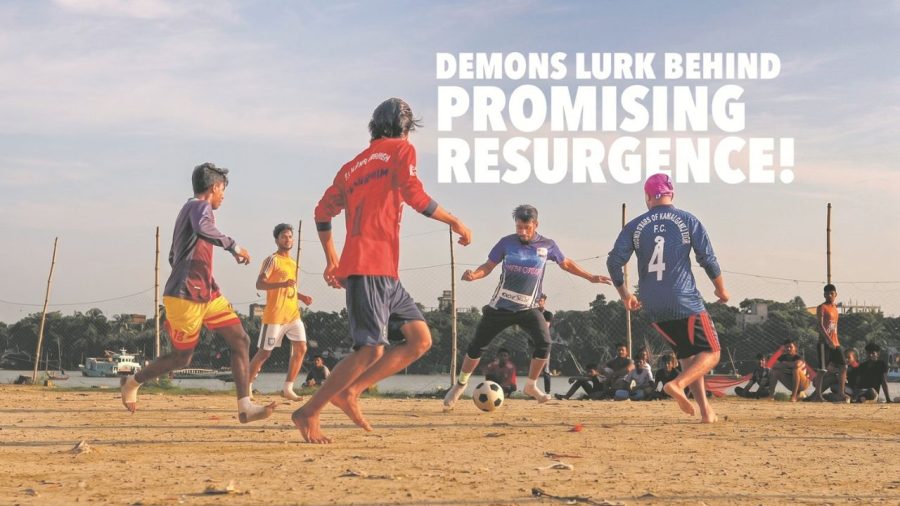



If one wants to find out where Bangladesh football stands, then just a tour of the jersey market will be enough to provide a reliable picture. Once avoided by football lovers, the highest-selling jerseys in the market are not of foreign clubs or other national teams but of Bangladesh. Even during the World Cup frenzy, the national team jersey was also on sale and, with the SAFF football a few months away, the buzz is picking up at a steady pace.
At football’s highest tournament, we may be screaming our hearts out for other sides and often getting into verbal duels, sometimes turning to fisticuffs over Argentina and Brazil, but when the regional championship arrives, the focus is fervently on Bangladesh. This time, the attention is bolstered by a revitalised national side, featuring British Bangladeshi talisman, Hamza Choudhury, Canada-based striker Shomit Shome, Italian gusto and Bangla fervour exuding Fahamedul and others.
Hamza Choudhury alone has triggered the resurgence of the nation’s football frenzy, and although Bangladesh could not go to the next stage of the Asian Cup qualifiers, they finished the campaign with five points – a creditable feat indeed, because five years ago, the national side struggled to secure a win.
There’s a lot of talk about football madness making a comeback catalysed by the hope that after a gap of about two decades, Bangladesh has a chance of winning the SAFF trophy on home ground. Such a line is easier said than done. Not to pour cold water on the rising enthusiasm, but before we begin to dream big, a reality check is needed.
Standing in late August at the heel of former Argentina World Cup team star Caniggia’s visit to Bangladesh, one needs to go back to the year when Maradona’s pass was neatly converted by Caniggia to give the Albiceleste a one-nil win over Brazil. Since Caniggia brings back memories of the 1990 World Cup, let’s dive back to the year when Bangladesh football lovers hoped, with some reason, to someday see the national side at the World Cup.
If the 1980s is deemed the golden age of football in Bangladesh, then the crescendo of that era came in 1989 when, at the Mirpur stadium, Bangladesh Red beat a fast-paced South Korean University team to win the President Cup Football trophy for the first time. The tournament began under the patronage of late President Ziaur Rahman in 1981, and in the first edition, the Bangladesh team, which had played in the Asian Cup football in 1980, went to the final beating a North Korean side in the semis to lose to South Korean Seoul City Hall in the final. The signs of improvement were there.
In 1980, Bangladesh lost all their matches at the Asian Cup, but they also showed flair in several games, notably in the one against North Korea in which they lost 3-2. Ashish Bhadra, Chunnu, Salahuddin, Anawar Ilias were the stars of the early 80s side soon to be bolstered by Tutul, Gaffar, Wasim, Kaiser Hamid, Aslam, Johnny and others. By 1985, the national side was feared/revered by any other South Asian and East Asian side.

However, the saddest part is that this outstanding line-up failed to win the gold at the SAFF Games. At that time, the SAFF tournament did not exist, and the regional showpiece meet was the football event at the SAFF Games, eclipsing all other disciplines. In the 1984 Nepal SAFF Games, without India competing in football, Bangladesh went to the final as favourites, brushing aside Nepal in the group stage but then lost the plot and came back with silver. The hoodoo had begun.
In 1985, the SAFF Games were held in Dhaka, and all eyes were on football. As expected, Bangladesh and India, the two regional giants, went to the final, with both sides featuring legendary players.
Bangladesh had Kaiser, Mamun Babu, Aslam, Ranjit, Ashish, Tutul, Babul and others while India had their star selection: Babu Mani, Atanu Bhatyacharya, Shishir Ghiosh, Krishanu De, Sudeep Chatterjee etc. In a clash of Titans, India went forward to see it cancelled by a spectacular volley by Aslam from midfield, bamboozling the Indian keeper Atanu. Moving to tie-breakers, Bangladesh again had to settle for second best.
The same year, Bangladesh played their first World Cup qualifiers and dazzled on home soil as they beat both Indonesia and Thailand, 2-1 and 1-0 respectively in back-to-back matches. However, the side failed to win against India home and away, which irked football lovers.
Weekly Bichitra magazine ran a cover story on Bangladesh’s two straight wins, commending the players for bringing us pride, conceding that they triumphed in the face of a lot of financial and other limitations.




In 1989, with yet another superb set, Bangladesh went to the SAFF Games in Pakistan but had to come back with silver. The silver spectre had become our curse!
However, in 1989 Bangladesh also won the President’s Gold Cup for the first time, sparking hopes of success beyond the region. When the under-14 side beat Brazil in the Dana and Gothia Cup in 1989, politicians in parliament enthused about playing the World Cup in eight years.
In 1995, under legendary coach Otto Pfister, Bangladesh, led by late defender Monem Munna, won the four-nation trophy in Myanmar and then, finally, in 1999, under former Iraqi player turned coach Samir Shaker, the gold in the Nepal SAFF Games.
The momentum led to the famous 2003 SAFF trophy win in Dhaka, thanks to a team of gems: Alfaz, Kanchan, Joy, Hassan Al Mamun, Rajani, Motiur, Aminul, Saiful, Moni, Arman and others.
Football pundits who talk about Bangladesh’s decline after the turn of the century often point to the absence of the pioneer league, which in the 80s provided a regular supply of footballers. They also deplore the absence of a solid professional club structure.
In 1987, while the Iran-Iraq war was raging, footballers from both these countries with World Cup playing experience came to Bangladesh to play for local giants, Abahani and Mohammedan.
Iranian goalkeeper Nasser Hejazi became the coach of Mohammedan, taking the club to the Asian Club 1988-89 finals where they drew with eventual champions Al Saad and beat North Korean club April 25.
While the top clubs had foreign strikers, the lower-level teams provided ample chances to local players, especially strikers, to hone their skills and compete with foreign recruits. As a result, the national side was never short of goal-scorers. Aslam, Nakib, Mamun Joardar, Alfaz, and Emily gave the national side invaluable service till 2008.
The drying up of strikers can be attributed to the increase in funds of local clubs which, in search of instant glory, decided to rope in African players for striking positions. Hence, the local striker was either benched or forced to change position.
The turn of the millennium opened the floodgates for African footballers, leading to such an obsession with them that even lower division clubs often recruited African booters, leaving out locals. This damaged the process of footballer production, remarked Mamun, once a Farashganj player and now a coach. The eventual loser: the national side. The situation would have worsened if Hamza hadn’t come along with other foreign-based players, feels Mamun.
Echoing his thought, Rahim Bhai, once an Agrani Bank player, contends that Hamza and other foreign players can provide palliative impact but cannot be the panacea. The club structures need to be revamped, with clubs either given government donations or allowed to run some commercial operation to have enough funds to pay players on time, feels Rahim Bhai.
In recent times, some top-level clubs have come under scrutiny and FIFA sanctions as they did not clear dues of former players – a fact which not only stains the image of Bangladesh football but also hinders their chances of international exposure. Eventually, the loser of all these aberrations is again the national side.
The ongoing craze over Bangladesh ahead of the SAFF Trophy stems from the cachet injected by Hamza and others, but while this charm may remain for another three to five years, the period after that may see another steep fall if there isn’t a proper five-year plan, says Mazhar Mithun, a sports vlogger and a senior broadcast journalist. That five-year plan must be implemented by all top clubs with special focus on forming youth-based sides, running academies and exploring options to link with renowned academies in Europe or South America, adds Mithun.
Since Argentina embassy is currently in Bangladesh, with Argentinians in general aware of the craze for the Albiceleste among Bangladeshis, governments of both nations can, through their respective ministries, explore programmes, training and other scopes aimed at strengthening Bangladesh football. Everything said and done, the spotlight at this moment is on SAFF and Bangladesh’s effort to win it.
Honestly speaking, it won’t be easy because Sri Lanka and Pakistan both feature foreign-based players with Pakistan recently winning the Diamond Jubilee International Tournament in the Maldives, beating Afghanistan 2-0. India has roped in Australian Ryan Williams; therefore, in an objective analysis, there’s no one favourite.
Bangladesh will have home advantage, but if we look at recent past history, Bangladesh looked unsettled on home soil, losing two Asian Cup qualifying matches against Hong Kong and Singapore.
Be that as it may, at least for the current football thrill to continue, the national side must win the SAFF and above football strategy plus foreign-based players, there will always be the passionate prayers of the nation.
That should do it!