


The philosophical aspect of music is worth studying, whether you are a musician or a music student. Every single note, tempo, amplitude, and wavelength has some effect on the human body.
But there is a question that very few people ask – where did all these philosophies come from? The answer to that question is a music genre not many people have heard of: musique concrète.
So, what is musique concrète? It is basically nothing more than creating a ‘musical piece’ with the raw sounds of the ambience. The reason why I put the words musical and piece in inverted apostrophes is that musique concrète does not call its pieces music.
The correct (or close to correct) term is sample or piece. There is basically no rhythm found in this genre. It is created just by what feels soothing to the ears of the creator.
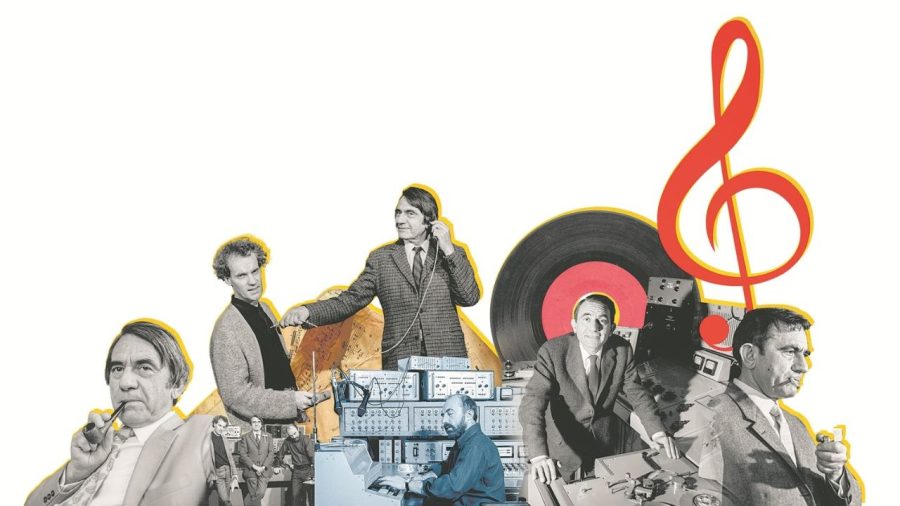
The mastermind behind this genre is Pierre Schaeffer. In 1942, he began his exploration of radiophony along with Jacques Copeau and others. They founded the Studio d’Essai de la Radiodiffusion Nationale.
This studio originally functioned as a centre for the French Resistance, responsible for the first broadcasts in liberated Paris. A set of journals was created by Schaeffer through which he would create a ‘symphony using noise.’
Brian Kane, author of Sound Unseen: Acousmatic Sound in Theory and Practice, said that Schaeffer was driven by “a compositional desire to construct music from concrete objects – no matter how unsatisfactory the initial results.”
In 1949, these ‘results’ were first coined as acousmatic, and later rebranded as musique concrete. Two years later, the team, including Schaeffer, Copeau, and Poullin, won the official recognition of Groupe de Recerches de Musique Concrète.
Carlos Palombini, a music faculty member at the University of Sussex, in his research (Machine Songs V: Pierre Schaeffer – From Research into Noises to Experimental Music) used the opus magnum of Schaeffer in perspective.

The album, Étude aux chemins de fer, posed the problem of musically organising sounds produced by six locomotives at the Batignolles station. Schaeffer initially recorded the music and, using the tape loop method, created formations of the original sound.
By lowering and increasing the rotation of the tape, he was able to create variations of the sounds. Furthermore, he was able to loop certain parts and turn them into a unique portion by stretching (now known as Paulstretch).
The same concepts were used in other albums such as Ètude pour orchestra (where he used certain instruments found in an orchestra) and Ètude aux tourniquets (consisting of certain African musical instruments).
Gabriel Bolaños, an assistant professor of music composition at Arizona State University, studied the methods of Schaeffer’s analogue musique concrète, and gave us certain examples from a digital perspective.
According to him, Schaeffer would use 5 methods to create musique concrète: looping, stretching, pitch shifting, reversing, and splitting. Each method (or filter) would give a different vibration of the body, thus putting an effect aligned with the rhythm.
This does not mean that a body is going to vibrate physically. It is the vibration of the mind which enables the release of hormones fit for the situation (i.e. serotonin, dopamine etc.).
Pitch shifting would alter the vibration (increase or decrease as per the shift), which would make the listener imagine a scenario. The low shifts would resemble a scenario of something approaching, while high shifts would resemble an action taking place.



Stretching (also known as Paulstretching in digital music production) can provide a listener with the climax and think about how long this climax will last.
This has to be noted that the climax is crucial in any part of music, as it provides the essence of the story (often portrayed by the album cover, song title, and lyrics).
Now, I would like to focus on the philosophy that musique concrète applies to the listeners. First of all, Schaeffer used the philosophy of raw and natural sounds as the essence of music.
As mentioned before, his album Étude aux chemins de fer focused on the sounds of locomotives arriving and departing at Batignolle station. But it is not just trains that made up the composition.
The sounds included people chattering, announcements of sorts, and whatever was there in between. By using all of these sounds and techniques, he created a masterpiece that would provide listeners with the feeling of being in a train station.
In simple terms, hearing the sounds without seeing the sources of the sounds. The same goes for the other albums as well. By using certain instruments played in an orchestra, Ètude pour orchestra focused on giving the simulation of being present in an orchestra. The same goes for Ètude aux tourniquets (giving the African vibe).
The second philosophy that I would like to touch upon is ignoring all the musical theories and relying on the ear.
One of Schaeffer’s manifestos stated that the rules and limits of music depend entirely on human hearing and perception, urging composers to listen deeply to sound itself rather than relying on theoretical rules.
The main concept of musique concrète is to use the unique ability of hearing and use the various tones that hit the spot to turn typical sounds into a masterpiece.
Finally, the third philosophy would be the feeling. We listen to a specific genre of music depending on our mood. The feeling found in musique concrète is more like being in a place without being in the place.
I would like to rephrase the sentence I mentioned a couple of paragraphs prior: Hearing the sounds without seeing the source of the sounds. This may sound confusing at first since modern music is more straightforward.
Musique concrète is not backdated or anything. It is the perspective that plays a role.
Taking the three philosophies of musique concrète, let’s connect them to modern music. As I am an avid fan of metal music, I will use it as the prime example. The lyrical themes of certain extreme metal genres tend to give a sense of what the lyrics are trying to say.
Non-metal fans consider metal as just random noise. But on closer inspection, every string stroke and every drumbeat has a philosophy behind it. Power metal has the rhythm that makes the listener think that he/she is taking an adventure towards a battle.
Doom metal gives the vibe of being part of an occult society and understanding the underlying meaning of life.
If we look outside of metal (and me stepping outside of my comfort zone), we can find certain genres that rose from musique concrète. Some artists used rhythmic beats, which gave birth to industrial music.
Rhythmic beats (at a faster speed) gave birth to speedcore. Introducing a talking method of singing (now known as rapping) gave birth to the wide variety of hip-hop, RnB, and rap music. The list goes on and on and on.
It is all nothing more than an evolution of sorts. Adding, deducting, and modifying – the three elements of influence in modern society.
Something interesting has to be pointed out here. We have seen how the philosophies of musique concrète have given birth to modern music genres. But some acts have taken musique concrète too literally into their works.
The greatest example would be the song Revolution 9 by The Beatles. This song is more of a collage consisting of experimental, avant-garde, musique concrete, noise, and psychedelic music.
John Lennon said the following regarding the track and the production: “Revolution 9 was an unconscious picture of what I actually think will happen when it happens. I had about 30 loops going and fed them onto one basic track. I would cut up the part where an engineer uttered the words number nine. Nine turned out to be my birthday and lucky number, without me realising it.”
In conclusion, I would like to say that experimental music has its share of giving birth to the genres we love today.
As the name suggests, it is experimental; other artists have either included an element or cut out an element to make something different. But it is philosophy that is more important.
The very monotonous philosophy of musique concrète split into various colours; just like how a single beam of light produced the VIBGYOR spectrum when passed through a prism.
Author is a Sub-Editor of Daily TIMES of Bangladesh.