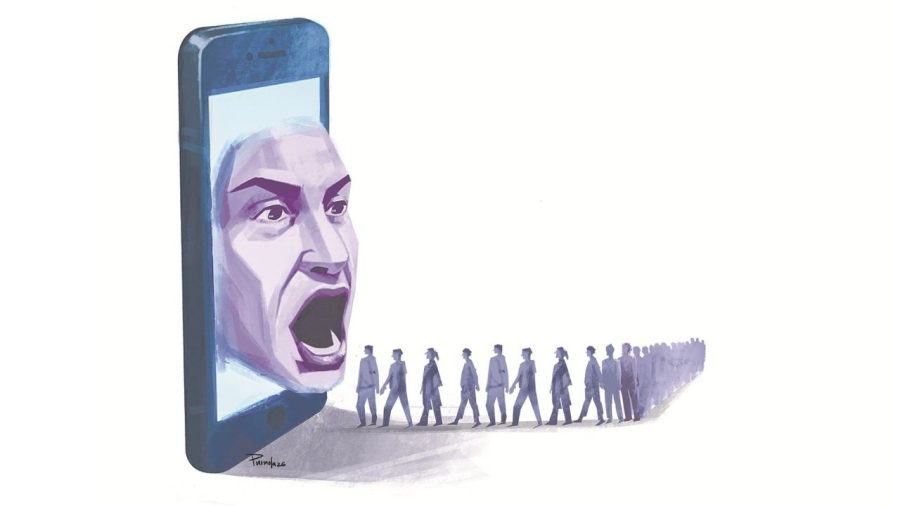



Think about the small gaps in your day. You are waiting for a friend at a café, standing for a bus, or sitting through a few empty minutes before a meeting. Almost automatically, the phone comes out.
Facebook, Instagram, TikTok or YouTube opens, and one reel leads to another. You may intend to spend five minutes, but novelty, speed and cliffhangers can keep you there much longer.
That habit tells us something larger about entertainment. Books became e-books, long articles became summaries, and now films and television dramas are being compressed into short, mobile-first episodes.
Vertical content and micro-drama are products of the attention economy, where the competition is no longer only about who tells the best story, but who captures the viewer fastest and keeps that viewer scrolling.
As a filmmaker, this is where my concern begins. The problem is not that short-form content exists, or that artificial intelligence is entering filmmaking. The problem is that Bangladesh may be arriving at this new market after the rules have already been written elsewhere.
The global shift is happening at remarkable speed. Sensor Tower says short-drama apps crossed 850 million downloads in the first quarter of 2026 and generated about $750 million in in-app purchases.
Omdia estimates the wider micro-drama business could reach $14 billion this year.
These figures cover short drama generally, not only AI productions, but generative AI is rapidly reducing the cost and time needed to create characters, locations, effects and fictional worlds.
Bangladesh has begun experimenting. ‘Silver Sadia’, promoted as the country’s first micro-drama series, was an important attempt to tell stories in a vertical, episodic format.

But human-made micro-drama has barely had time to develop into an industry here before AI-assisted production began changing the economics of the format. We risk skipping an entire stage of creative development.
Traditional Bangladeshi drama still depends on actors, locations, cameras, crews, shooting schedules and an economic model shaped by television and YouTube.
In parts of the industry, star fees consume a disproportionate share of already limited budgets, while writers, directors, technicians and independent creators struggle to build sustainable careers.
AI changes that equation. It does not make human creativity unnecessary, but it can reduce physical production costs and dramatically increase output. In an algorithmic market, frequency itself becomes an advantage.
This is why the creative-economy proposals in the 2026-27 budget deserve both applause and scrutiny. The government has proposed Tk300 crore directly for the creative economy and another Tk500 crore to be mobilised through Bangladesh Bank’s CSR channel.
It also aims to raise the sector’s contribution to GDP to 1.5 percent and create 500,000 jobs. These are ambitious goals. But the real question is not only how much money is announced. It is who can actually reach it.




That question becomes sharper when Tk 500 crore depends on CSR mobilisation. Bangladesh Bank’s Financial Stability Report says the banking sector ended 2025 with a gross non-performing loan ratio of 30.6 percent.
In that environment, assuming that large amounts of discretionary funding will easily flow into small creative ventures may be optimistic.
Many writers, independent producers and young creators also operate informally and may not have the balance sheets, collateral or institutional structure that conventional banks prefer.
There is a similar question around infrastructure. The government’s plan includes a proposed 160-acre Central Creative Hub in Purbachal and regional hubs across the country. Modern studios and shared facilities can help.
But Bangladesh should resist measuring creative development mainly in acres and buildings.
A beautiful studio is of limited value if a writer cannot protect a script, a producer cannot finance a pilot, or an artist receives no royalty when work is repeatedly exploited.
The more urgent infrastructure may be less visible: copyright enforcement, royalty systems, affordable production finance, cloud computing, GPU access, AI tools, training and global distribution.
The government’s film-grant system shows the policy gap clearly. Even in the 2025-26 cycle, official grants are structured around full-length and short films. There is still no dedicated category for vertical serials, digital-first fiction or AI-assisted micro-drama.
That should change. A new ‘Digital and Vertical Content’ category could be added to the grant framework, with smaller, competitive grants available to a wider pool of creators.
Funding should support not only cameras and locations, but also cloud services, AI rendering, post-production, subtitling, dubbing and international distribution.
Performance-based support could reward projects that build audiences, generate export revenue or create valuable Bangla intellectual property.
The National Film Policy 2017 also needs to be read alongside Bangladesh’s emerging AI framework.
The draft National AI Policy 2026-2030 proposes an AI Innovation Fund of Tk200 to 250 crore and a government-led national Bangla language model intended partly to preserve linguistic and cultural resources.
That is significant. But technology policy cannot treat AI only as software and data while cultural policy treats film mainly as a traditional art form. The next generation of screen production sits precisely between the two.
A joint creative-technology programme could support human-led, AI-assisted Bangla storytelling. ‘Human-led’ matters. Public support for AI content should not become a subsidy for replacing writers, actors or artists.
AI can reduce rendering time, generate backgrounds or make ambitious visual ideas affordable, while Bangladeshi creators remain responsible for story, character, cultural nuance and editorial judgment.
Copyright must be part of the same strategy. Bangladesh will not build a creative economy if creators cannot reliably earn from their intellectual property.
Stronger digital enforcement, transparent royalty collection and eventually a central royalty-management system would do more for sustainable creativity than another empty building. Rules are also needed for AI-generated voices, performer likenesses, training data and disclosure.
Other Asian markets are already treating this transition as an ecosystem.
At InnoAsia 2026, part of the Asian Contents & Film Market in Busan this October, companies including AWS, Kling AI, Google DeepMind and Alibaba will meet content firms and startups around AI production, investment and new storytelling technologies.
They are not waiting to decide whether cinema and technology should meet. They are building the infrastructure for that meeting.
Bangladesh should do the same, but in its own language and cultural context. The answer is not to block foreign AI dramas or demand that algorithms protect us. Algorithms distribute what holds attention. Our task is to make Bangla stories competitive enough to earn that attention.
The same platforms that can fill our feeds with foreign synthetic content can carry Bangladeshi stories to millions at home and abroad. But that will require more than a budget announcement.
It will require financing that reaches creators, copyright that protects them, technology they can afford, and policies that understand the screen people actually watch. Otherwise, we may discover too late that while we were building creative hubs, someone else had already captured the audience.
Writer: Abu Shahed Emon(Filmmaker)