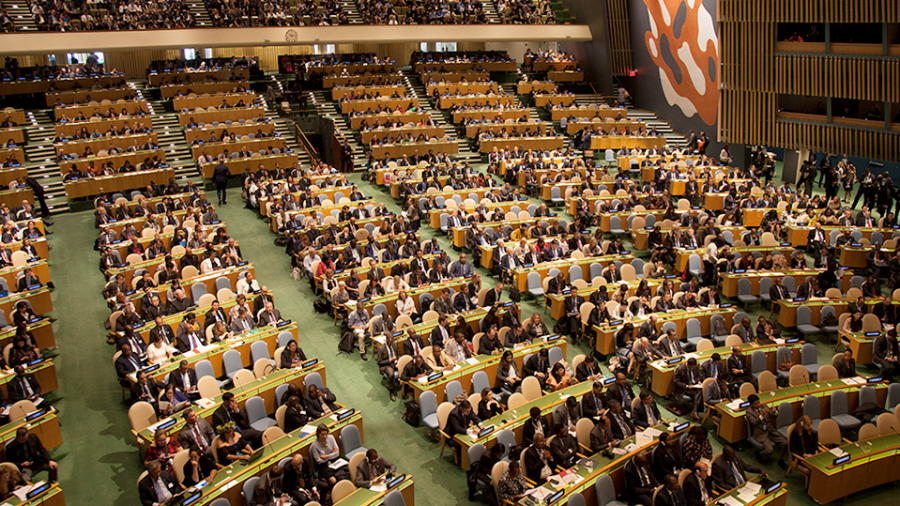



For a long time, the United Nations General Assembly has been one of the most prominent manifestations of multilateral diplomacy. Leaders from around the world meet here every September to set priorities and rally the international community to address global challenges and find collective solutions. However, ahead of the 81st session of the United Nations General Assembly (UNGA 81), the question is: Is multilateralism losing some of its political appeal?
Partly because a remarkable number of leaders this year didn’t make the General Debate. Xi Jinping, Vladimir Putin, Narendra Modi, Friedrich Merz, Minister Giorgia Meloni and Mahmoud Abbas are among the more than 50 heads of state and government missing in New York. Meanwhile, big names, including Donald Trump, Recep Tayyip Erdogan and Emmanuel Macron, are in attendance.
But the picture isn’t as simple as a UN decline. Nearly 130 heads of state and government are in New York for the high-level week, and the General Assembly continues to take a one-member, one-vote approach to all 193 member states. The real question is not where multilateralism has gone, but whether changing national priorities and a more complex international landscape are undermining traditional multilateralism.
Absences can’t be explained in one way. Domestic political pressures are an important factor. Friedrich Merz, for instance, was not involved in the past couple state elections and helped keep Berlin out of the political heat at home. In recent years, Indian Prime Minister Narendra Modi has also been a rare presence at the UN General Assembly, where the foreign minister has regularly replaced him.
Cost-cutting and government priorities have also affected decisions on international travel and delegation size in some governments. Others have mentioned health concerns, scheduling or personal reasons. Russia’s Foreign Minister, Sergei Lavrov, is representing Russia, which its leader, Vladimir Putin, has again boycotted. In the Palestinian situation, Mahmoud Abbas’ absence is not due to a denied diplomatic visa, but to his absence in person; the Trump administration denied him once again.

Meanwhile, leaders’ presence carries political and symbolic significance. The General Assembly is no ordinary international conference. The forum is the most comprehensive one in the world and is where governments can present their cases before almost the entire international community. The UN declares the General Assembly as a special platform for a multilateral discussion and the central policy-making body of the UN. The theme for this year, ‘Restoring trust, managing transformation: A United Nations that delivers for all,’ is especially attuned to issues of the multilateral system.
Even if major powers have other diplomatic priorities, the message can still matter. For instance, China’s President Xi Jinping is not in New York and is also promoting high-level diplomacy in Washington. This comparison has raised suspicions that China is adopting a more self-reliant foreign policy than one based on multilateral diplomacy under the auspices of the United Nations.
Patterns of cooperation are more overlapping in the modern international system. States have retained a presence at the UN, and they also rely on various other organisations and mechanisms, such as the G20, BRICS, ASEAN, the Shanghai Cooperation Organisation, the European Union, BIMSTEC and ad hoc coalitions. Bilateral diplomacy has also gained importance. Sometimes, parlay is the preferred way to handle sensitive issues such as trade or security concerns, or technology or strategic rivalry with other great powers. These talks may sometimes lead to faster results than comprehensive multilateral talks that include nearly 200 countries.



Bilateralism, of course, has a problem: global problems can’t be solved bilaterally. The threats and challenges of climate change, pandemic influenza, artificial intelligence, nuclear proliferation, refugee movement, ocean governance and sustainable development transcend national boundaries, and the threats of cyber-attacks and international terrorism exist beyond borders as well.
The real challenge multilateralism faces, however, is not just its lack of in-person presence. It has lost trust in international institutions’ ability to deliver results. Repeated diplomatic appeals have gone unheeded, and there are continuing wars and humanitarian crises. The Security Council is deeply divided among the great powers. A criticism of global institutions in developing nations is that they do not reflect the existing population, economic and political power configuration. At the same time, geopolitical competition is increasing the challenges of reaching agreement.
However, the alternative is not always more effective. In a splintered international system, dominant states may threaten global governance through competing groupings. If economic or military strength supplants international rules, there is much to lose.
Multilateralism is important for countries like Bangladesh. Bangladesh has neither the economic nor military might of the great powers. Smaller states have room to speak to institutions where states are equal and sovereign, based on international law and collective decision-making. The current discussion should thus focus on supporting the current multilateral system, not only in defence, but on strengthening it to be more representative, responsive and effective. The United Nations has a task to show that co-operation among several nations can be helpful. It’s a broad challenge that covers issues such as Security Council reform, development financing, international economic governance, climate change and global health.
A key aspect of multilateralism’s legitimacy is that states believe international institutions reflect the current world order. A world dominated by mid-20th-century politics is destined to provoke questions in a modern world of new economic powers, technological change and new geopolitical influence.
The UN’s importance as a diplomatic forum was highlighted by the presence of nearly 130 heads of state and government at the summit. The absence of over 50 national leaders, including some international power-holders, underscores the growing urgency for governments to balance their UN and domestic agendas, as well as bilateral relations and other international gatherings. This could result in a more complex form of multilateralism. States can pursue bilateral diplomacy to achieve their immediate objectives and multilateral diplomacy through regional and multilateral organisations. The task is to ensure that all these levels of diplomacy complement one another and do not interfere with one another.
The fact that none of them participated in UNGA 81 doesn’t mean multilateralism is over. Most UN member states remain relevant in international affairs, and the nearly 130 heads of state and government play an important role during the high-level week.
The form of multilateralism that is evolving is state multilateralism. Bilateral summit-level conferences have become part of great powers’ diplomacy, alongside the UN and small-scale strategic coalitions. Domestic politics increasingly shapes international participation. Governments are not looking for any ordinary institutions – they are looking for institutions that work and are representative. So, the issue isn’t just about a waning interest in multilateralism. It’s whether multilateralism can evolve in a new world.
The United Nations can regain relevance if it rebuilds members’ trust, increases its effectiveness, gives developing nations more power, and responds better to modern crises. One cannot choose between multilateralism and national interest when the world is plagued by issues that no one nation can address alone. The issue is how to harmonise these national interests and global responsibilities in a multilateral system.
The views expressed in this article are those of the author
The writer is a Professor, Department of International Relations, University of Chittagong, Bangladesh. Director, Hong Kong Research Center for Asian Studies-Bangladesh Center (RCASBC). Email: [email protected]