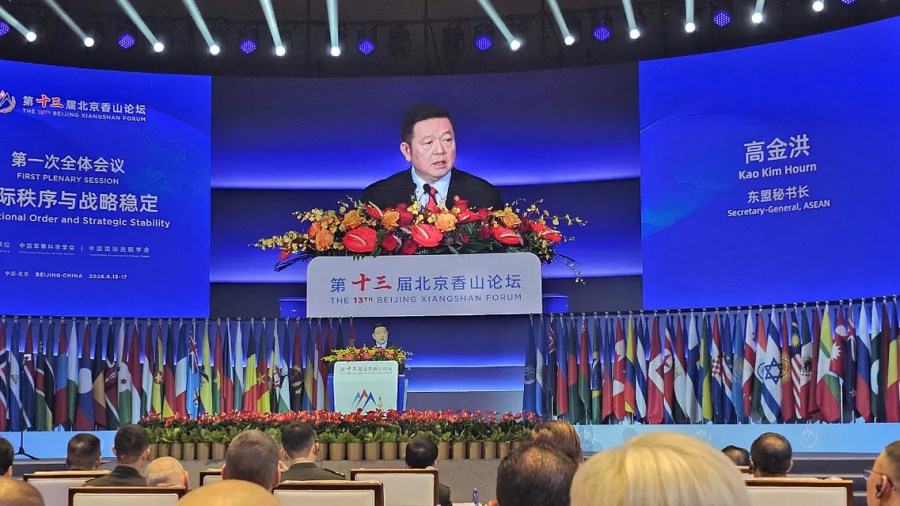



The 13th Beijing Xiangshan Forum was successfully held, bringing together representatives from over 100 countries and international organisations to discuss security cooperation. This once again proves that the more turbulent the situation, the more necessary dialogue becomes; the more contradictions there are, the more imperative cooperation is. Dialogue and cooperation are a proven effective approach to upholding world peace, while sanctions and confrontation only create turmoil. At present, the global security landscape is at a fragile juncture, marked by frequent multi-point disturbances and localised unrest, with a persistently large deficit in global security governance. Traditional governance paradigms such as zero-sum game, arms race, military alliance and armed strike are gradually losing their efficacy, and a new security governance paradigm is urgently needed.
As an international forum focused on security cooperation and governance, the Beijing Xiangshan Forum has long advocated dialogue and cooperation, pursued world peace and gradually developed an ‘Asian model’ for security governance. Rooted in the valuable experience of Asian security governance, this model is a fruitful outcome of applying Asian wisdom to global security governance. For a long time, Asia has been a relatively vulnerable segment in the global security architecture. In particular, the Middle East issue ranks at the top of various global security risk lists.
In recent years, crises on the Cambodia-Thailand and Myanmar borders have also emerged as new focal points in the Asian security domain. These elevated security risks have compelled Asian countries to explore crisis solutions, providing abundant practical scenarios for Asian security governance and giving rise to an Asian security governance model distinct from the West’s. One core element of the Asian model is dialogue. At this year’s Beijing Xiangshan Forum, experts from Russia and Ukraine, the parties involved in the crisis, sat at the same table for discussion; representatives from Iran and the United States spoke in the same hall. Such scenes vividly embodied the forum’s openness and inclusiveness.

There is an old Chinese saying: “Truth becomes clear through debate.” Only by putting disagreements on the table and explaining positions clearly can misjudgments be reduced and mutual understanding become possible. This is also important as the Asian model has gained recognition among participants from other parts of the world. A second core element of the Asian model is cooperation. Dialogue aims to promote and institutionalise cooperation so risks are kept under control and crises are de-escalated. China’s Global Security Initiative and Global Governance Initiative are efforts to institutionalise security cooperation through dialogue. China has also called on member states of the Shanghai Cooperation Organization and BRICS to actively implement the Global Security Initiative and the Global Governance Initiative, helping safeguard peace and stability across the Global South. In regional practice, the security cooperation advocated by the Asian model is producing tangible results in narrowing differences and reducing tensions.
In Southeast Asia, China led by initiating a trilateral foreign ministers’ meeting among China, Cambodia and Thailand, playing a constructive role in easing the Cambodia–Thailand border crisis. On the international stage, China has consistently worked to uphold the United Nations’ central role in responding to global and regional crises and has supported multilateralism as a coordinating mechanism for resolving disputes and managing crises. In the recent Middle East crisis, China has not only advocated a significant role for the United Nations, but has also supported regional countries in strengthening themselves through cooperation and pursuing greater security autonomy, drawing strong recognition from the United Nations and countries in the region.




A third core element of the Asian model is peace – the model’s ultimate objective. Dialogue may involve disagreement, and cooperation may encounter setbacks, but peace remains the central thread. In its agenda setting, this year’s forum directly confronted crises while seeking peace: it neither avoided the difficult questions posed by localised conflicts nor stopped searching for solutions. During the forum, experts frequently disagreed, yet those differences did not turn the forum into another ‘battlefield.’ Instead, they reinforced expectations that the forum can make an increasingly meaningful contribution to world peace and stability.
Finally, the ‘Asian Model’ in global security governance dialogue prioritises mutual respect, non-intervention, consensus building and development-oriented cooperation. It is not meant to replace existing international governance institutions, but may contribute to more inclusive, representative and responsive international security governance that addresses the concerns of the Global South. It remains, however, based on the principles of national sovereignty and collective responsibility and the spirit of cooperation with respect to peace, stability and sustainable development in the region.
As Asia’s influence expands, the Asian Model offers a more practical diplomacy, common interests and peaceful coexistence to enhance global security governance.
The views expressed in this article are solely those of the author
The writer is the Director, Hong Kong Research Center for Asian Studies, China