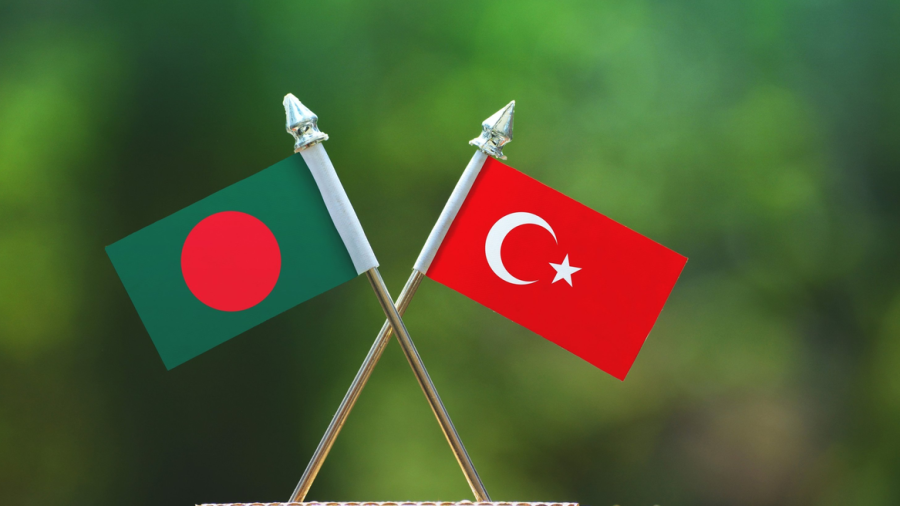



The growing proximity between Bangladesh and Türkiye is largely a story of cultural exchange. This is also a part of Ankara’s broader strategic ambition to expand its presence in Asia. Türkiye has established a significant soft power in Bangladesh via TV dramas, educational programmes, scholarships and humanitarian initiatives. That influence is now expressed in an institutionalised way. There’s a bigger diplomatic angle to that appeal, though.
The concept of ‘Neo-Ottomanism’ has been the agenda of Türkiye’s foreign policy for many years. The slogan is often associated with Ankara’s aspiration to extend its historical and cultural heritage to other regions. This concept is still not settled, but it is not difficult to imagine that Türkiye has been interested in expanding its regional presence. The ‘Asia Anew’ initiative is one such example. Established in 2019, it was intended to increase the scope of Türkiye’s economic, diplomatic, technological and cultural relations in Asia. The initiative is open and welcomes trade, investment, industries, education, culture and infrastructure. Also, the fact that Türkiye has also been an active member in platforms such as the D-8 demonstrates Ankara’s interest in strengthening relations with Muslim-majority and developing countries.
Türkiye is a very crucial defence partner of Bangladesh in recent years. Additionally, Ankara is looking for markets for rocket systems, armoured vehicles and other military hardware. Bangladesh, being a strategic location and undergoing ongoing defence modernisation, is a promising market. It is not only a question of what Bangladesh can purchase from Türkiye, but what Ankara is looking for. Türkiye’s increasing defence cooperation with Bangladesh is happening concurrently with trade, investment, defence industries, education and technology. In the fourth iteration of political consultations in October 2025, the two governments shared satisfaction on the increasing cooperation in defence industries, procurement, training and capacity building. They also spoke on the issue of trade diversification, investment, joint ventures, etc.
Politically important events have also taken place apart from the official government communication. Following the nation’s last general election, Turkish President Recep Tayyip Erdoğan’s son, Necmettin Bilal Erdoğan, was said to have travelled to Dhaka on a private plane along with German international World Cup winner Mesut Özil. The visit was one of the unusual and unpublicised visits. Such instances always raise questions regarding how Ankara is gaining influence in Bangladesh through informal networks.

This new equation also has a political component. Türkiye has tried to be seen as an independent voice in the Muslim world under Erdoğan’s leadership. It has also pushed for strategic independence and multilateral alliances. Some of this political rhetoric could fit in the post-2024 political context of Bangladesh that has been re-emphasising sovereignty, national interest, identity and foreign-policy autonomy. However, don’t confuse similarities in politics with an alliance of ideas. The relationship must be evaluated from the perspective of real cooperation in policy and the long-term national interest of Bangladesh.
The history of Bangladesh-Türkiye relations is far from simple. The war crimes trials in Bangladesh saw a serious strain in relations between 2012 and 2016. Türkiye called off its Ambassador to Ankara for consultations after the death sentence of Jamaat-e-Islami chief Motiur Rahman Nizami in May 2016. The relationship slowly grew during the rest of that year. The thaw in Bangladesh’s relationship with Türkiye was partly due to the country’s stance following the attempted coup. Türkiye later recalled its ambassador from Dhaka. It demonstrates that Ankara’s relationship with Bangladesh has always been more than just economic and cultural.
Rebuilding ties began to be more apparent in 2025. The two sides discussed trade, defence, political and other matters during Turkish Deputy Foreign Minister A. Berris Ekinci’s visit to Dhaka. The other sectors that were proposed for more cooperation included education, health care and technology. Both are interested in taking the bilateral security partnership beyond its narrow security focus. They are considering trade and investment, technology, human resources and development cooperation. However, the geopolitical implications warrant further consideration. As the relationship between the defence ties deepens, Bangladesh will have to reflect on the regional aspects more carefully. Dhaka already has significant economic, strategic and security ties with China. The presence of a stronger Turkey in that complicated picture is another factor.



The closeness of defence relationship with Pakistan is also applicable to Türkiye. It puts into perspective the emerging significance of Ankara’s involvement in Bangladesh in South Asia. It is important for Bangladesh not to join any new grouping of powers. It has to have partnerships that are issue-based and based on national interests. This is where the term ‘strategic partnership’ gets put to the test. Defence cooperation can be a very public relationship. It can’t do it alone to ensure that relationship. Trade, investment, technology, education and people-to-people ties will be important for long-term stability.
With a few countries, including Türkiye, Bangladesh is currently engaging in trade negotiations and market access to cope with the problems of LDC graduation. Dhaka is working with several countries on such arrangements. Thus, the Bangladesh/Türkiye FTA process should be considered more as a process, rather than an agreement that is already in effect. It’s more a reflection of Türkiye’s rising ambitions in Asia. Ankara does not seem to consider Bangladesh as only another trading partner. Bangladesh provides a strategic location, a huge market, access to the Bay of Bengal and a gateway to South Asia. Therefore, Türkiye can engage in deeper cooperation with Dhaka through an all-encompassing economic, diplomatic and strategic approach.
However, Bangladesh needs to mind the cost of such alliances. Ankara’s growing power does not warrant political reliance. Nor should cultural affinity replace hard headed diplomacy. Türkiye has strategic interests in South Asia as well. Bangladesh should take that into account, clearly.
The connection is thus going into a new phase. It’s going beyond friendship, trade and cultural exchange. Diplomacy, investment, technology, defence and education are taking on increasing importance. This diversification may open up new diplomatic and economic opportunities for Bangladesh. Bangladesh is another key forum for Türkiye to strengthen its presence in South Asia.
To see if Ankara’s political engagement translates into economic gains for Bangladesh is the real challenge. It will also be based on whether Turkish investment involves technology transfer and capacity building locally with sustainable employment. In defence, the central concern should be whether cooperation builds the ability of Bangladesh’s industry and technology to build, or merely raises the dependence on foreign systems. Thus, Bangladesh-Türkiye relations are worthy of attention. The expansion of Ankara’s reach is evident. What is welcome in Dhaka is useful cooperation; otherwise, it is Turkish soft power and Turkish altruism, which are different things.
The relationship is more conducive to the interests of Bangladesh if it is based on reciprocity, transparency, and strategic autonomy. Türkiye could become a growing partner to the EU. It bears no less than its own interests, however. The same should be the main thrust of Bangladesh’s policy toward Ankara.
The views expressed in this article are solely those of the author
The writer is an Associate Professor, Department of Communication and Journalism, University of Chittagong. Email: [email protected]