Speakers at the Bangladesh Journalism Conference 2026 stressed the need for strong editorial institutions to ensure independent and accountable journalism amid growing political pressure, ethical challenges and institutional weaknesses in the media sector.
They also highlighted the rising cost of investigative reporting as a major challenge for journalism in Bangladesh.
The remarks came during the first plenary session of the conference held in Dhaka on the current state, challenges and prospects of investigative journalism in Bangladesh. The session focused on the scope, quality and institutional support for investigative reporting alongside international experiences in the field.
Former BBC journalist Shakil Anwar moderated the session.

Transparency International Bangladesh Director of Outreach and Communication Tauhidul Islam presented the keynote paper.
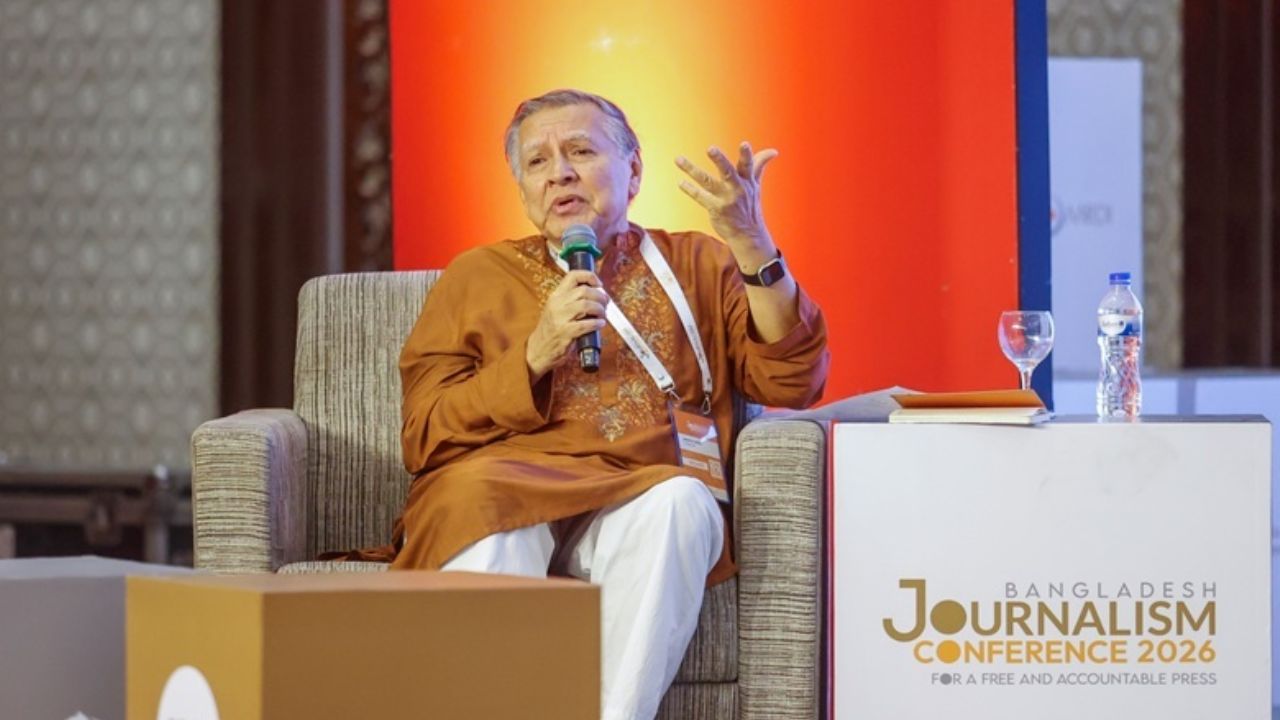
Editorial independence under threat
Mahfuz Anam, Editor and Publisher of The Daily Star, told the session that the development of investigative journalism depends primarily on the emergence of strong editorial institutions. He noted that investigative work is impossible without independent journalism, where the editor’s role is paramount in ensuring that freedom.
However, Anam raised concerns regarding the current state of leadership within the industry. “Many editors are now turning into spokespeople or PR agents for the owners,” he said, stressing the need for a clear distinction between the roles of the owner and the editor.




He further remarked that while Bangladesh once held a tradition of strong editorial leadership, this has been weakened by the politicisation of the media. Consequently, professional accountability and the ethical standing of journalists have been compromised. According to Anam, investigative journalism rests on three pillars: the independent role of the editor, the ethical standards of the institution, and the commitment of journalists to the profession.

International and local successes
Former Editor of the Toronto Star, Michael Cooke, highlighted the global impact of investigative reporting with several examples. He cited a case in Nigeria where an investigation revealed that bodies sent to a medical college as unidentified corpses bore bullet wounds, with a large portion suspected to be victims of law enforcement.
In Spain, Cooke noted, a journalist exposed the fake Master’s degree of an influential politician, leading to a major political scandal and the politician’s eventual resignation.
Closer to home, Cooke pointed to the case of Bangladeshi Member of Parliament Tamanna Nusrat, where a television investigation exposed that others were sitting for examinations on her behalf. He described this as a powerful example of accountable journalism.
He also referenced a Mexican investigation into a luxury home owned by the President and his wife, which was held by a government contractor who had received major state projects.
“Such investigative journalism brings corruption, conflicts of interest, and the abuse of power to the forefront,” Cooke added.
The economic crisis
Fahim Ahmed, Chief Executive Officer of Jamuna TV, observed that while direct intimidation of journalists has decreased slightly, a major crisis has emerged regarding economic capacity. He acknowledged that while investigative journalism is expensive, it is what sets a news organisation apart from its peers.
Ahmed concluded that investigative reports play a vital role in unearthing corruption, ensuring accountability, facilitating law reforms, and protecting the rights of the general public.