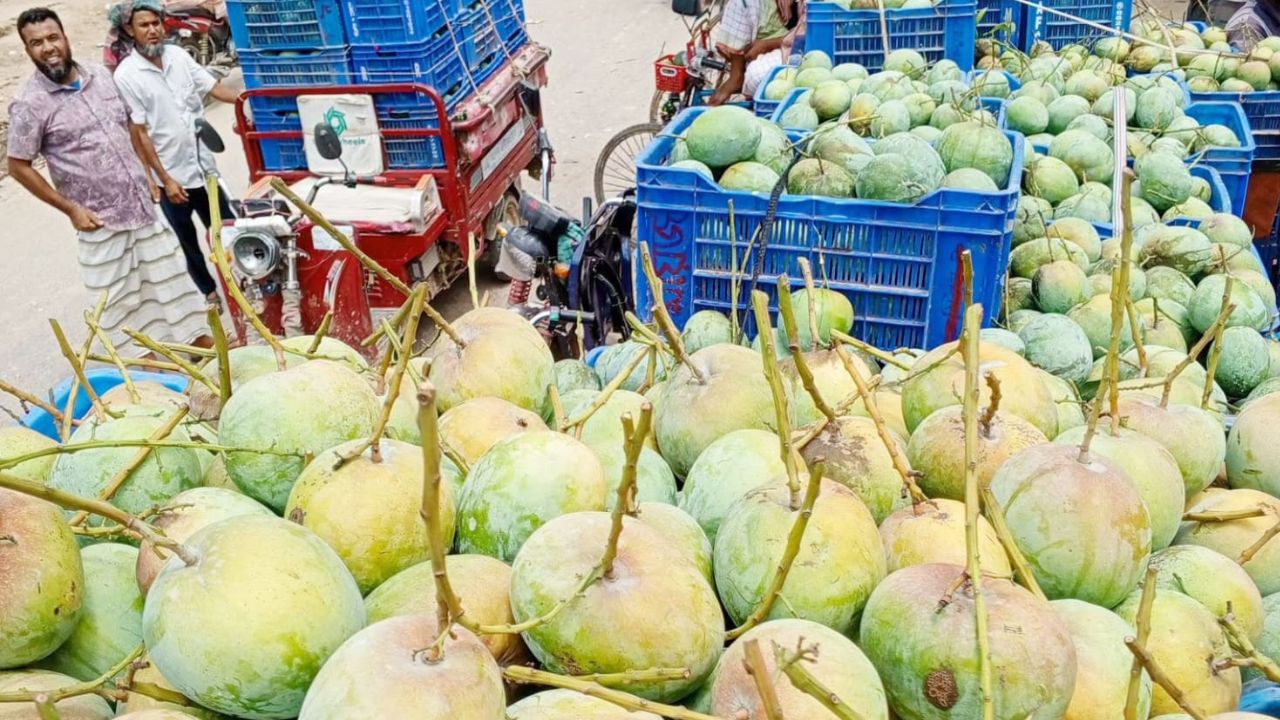



Although the mango season is drawing to a close, trading remains brisk at the traditional mango market in Sapahar, Naogaon, where dwindling supplies have driven prices sharply higher.
Market stakeholders said the wholesale market is currently handling mango sales worth around Tk5 crore to Tk7 crore a day, as buyers compete for the limited volume of late-season fruit still arriving from orchards.
A visit to the market found growers arriving from across the district from early morning with crates of mangoes on battery-powered vans and shallow-engine vehicles. However, with supplies falling towards the end of the season, intense bargaining has surrounded almost every consignment.
The market is now dominated by Banana Mango, Ashwina, Gourmati, Katimon, Bari-4 and small quantities of Amrapali, which remains the most sought-after variety.

Depending on quality, Amrapali is selling for Tk20,000-Tk25,000 per maund, while Banana Mango fetches Tk10,000-Tk15,000. Bari-4 is selling for Tk4,000-Tk8,000, Ashwina for Tk2,000-Tk3,000, and Gourmati and Katimon for Tk3,000-Tk5,000 per maund.
Growers said unusually high temperatures early in the season caused much of the crop to ripen ahead of schedule, flooding the market with fruit and depressing prices. Many farmers struggled to recover production costs during the peak harvest period.
Now, however, reduced supplies have strengthened prices, allowing growers with late-season fruit to secure better returns.



Farmer Jamal Hossain said many growers incurred losses because prices remained below expectations at the start of the season.
“Prices have improved towards the end, but the increase has not fully offset the losses suffered earlier,” he said.
Another grower, Latif Hossain, who cultivates several mango varieties on two and a half bighas of land, said he had received disappointing prices for Amrapali earlier in the season but was now earning satisfactory returns from Bari-4 mangoes.
Imam Hossain Rifat, general secretary of the Sapahar Mango Traders’ Cooperative Society, said Naogaon and Chapainawabganj were now among the few districts still supplying mangoes.
“If supplies fall further, prices are likely to rise again, benefiting growers with fruit still available for sale,” he said.
Naogaon Department of Agricultural Extension Deputy Director Md Monjur Rahman said the distinctive soil of the Barind region gave Naogaon’s mangoes their unique taste and quality.
He said the department was encouraging farmers to cultivate late-maturing varieties through regular training so they could continue selling fruit at profitable prices towards the end of the season.
According to the Department of Agricultural Extension, mangoes have been cultivated on 30,310 hectares of land in Naogaon this season, with production targeted at 387,235 tonnes. Officials expect the district’s mango trade to generate around Tk4,000 crore this year.