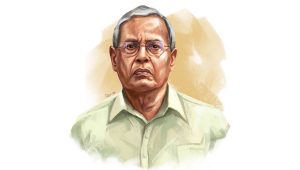
Long before the words “women’s empowerment” entered everyday conversation, Kamini Roy was quietly reshaping history with nothing more than a pen, a classroom and an unshakable belief that women deserved the same opportunities as men.
Born in 1864 in Basanda, now in Bangladesh’s Jhalakati district, Kamini Roy grew up in a progressive household where books were treasured and education was encouraged. At a time when most girls were expected to remain within the walls of their homes, she chose a different path.
In 1886, she became the first woman in British India to graduate with honours, earning a degree in Sanskrit from Bethune College in Calcutta. That marked an achievement that challenged the conventions of an entire era.
But Kamini Roy never regarded education as a personal victory. She saw it as a responsibility. As a teacher and poet, she believed that educating women was essential not merely for producing better mothers or wives, but for creating independent human beings capable of shaping society.

In an age when such ideas were considered radical, her words carried quiet defiance rather than loud rebellion.
Her literary journey began with “Alo O Chhaya”, published in 1889, and was followed by collections including “Nirmalya”, “Malya O Nirmalya”, “Dip O Dhup” and “Jiban Pathey”.




Her poetry explored love, grief, nature, spirituality, and the inner lives of women with remarkable sensitivity. While influenced by Sanskrit literature and the emerging Bengali literary renaissance, her voice remained distinctly her own, gentle, reflective and deeply humane.
Life tested her resilience. The death of her husband in 1909 plunged her into profound sorrow, a pain that found expression in some of her most poignant verses. Yet personal tragedy did not silence her. Instead, it strengthened her resolve to work for women beyond the pages of poetry.
Kamini Roy became an active campaigner for women’s rights, joining movements that demanded education, social reform and, eventually, voting rights for women. She played a leading role in the Bangiya Nari Samaj and served on the Female Labour Investigation Commission, advocating for the dignity and welfare of working women. Her activism reflected the same conviction that shaped her literature: Equality was not a privilege, but a birthright.
She also nurtured younger generations of writers, including the celebrated Bangladeshi poet Sufia Kamal, ensuring that the torch of women’s literary expression would continue to burn brightly.
In recognition of her contribution to Bengali literature, the University of Calcutta awarded her the prestigious Jagattarini Gold Medal in 1929.
Kamini Roy died in 1933, but her legacy has only grown stronger with time. Today, she is remembered not only as one of Bengal’s finest poets but also as a pioneer who proved that intellect has no gender and that literature can be a powerful instrument of social change.
Her greatest poem, perhaps, was not written on paper. It was the life she lived, one that opened doors for generations of women who followed.