

- Bangladesh’s tobacco taxation system still depends on a complex multi-tiered, ad valorem structure that creates major market distortions and weakens policy effectiveness.
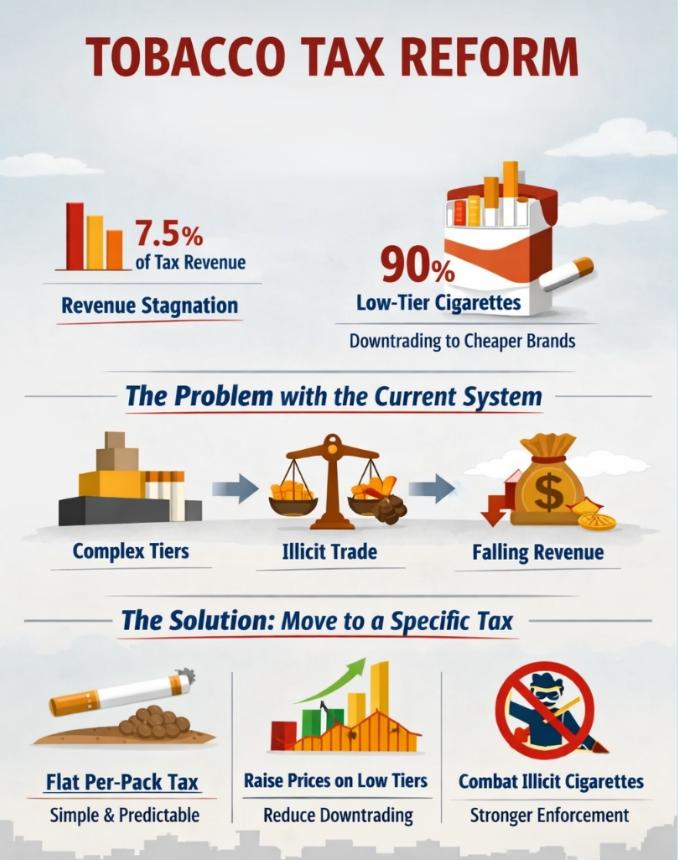
- Cigarettes contribute nearly 7.5 per cent of total tax revenue, creating high fiscal dependence on a structurally weak system.
- Nearly 90 per cent of cigarette consumption is concentrated in the two lowest price tiers due to persistent downtrading.
- Consumers are shifting to cheaper cigarette tiers instead of quitting, reducing the effectiveness of tax increases.
- Large price gaps are encouraging the expansion of illicit products, leading to revenue leakage and weakening formal market regulation.
Bangladesh is set to announce the national budget under the leadership of the new politically led government in early June.
However, as the government navigates the challenges of rising inflation and international pressures to increase revenue collection, tobacco taxation presents a familiar but increasingly urgent paradox. One of the most heavily taxed sectors in the country is no longer delivering consistent real revenue growth.
Cigarettes account for roughly 7.5 per cent of total tax revenue, a strikingly high dependence for a single product category in a country with a relatively narrow tax base.
Yet despite repeated aggressive tax increases over the past decade, real revenue gains have slowed in recent years and, in some periods, have even reversed.
This is not a question of whether tobacco is taxed sufficiently.
By any comparative standard, it already is.
The more fundamental issue is whether the current structure of taxation is capable of delivering stable fiscal and regulatory outcomes.
Increasingly, the evidence suggests that it is not.
At the core of the problem is the design of the system itself.
Bangladesh continues to rely on a complex, multi-tiered structure combined with an ad valorem approach, where taxes are levied as a percentage of price.
While such systems can function in earlier stages of market development, they tend to generate structural distortions as consumption patterns and income levels evolve.

In Bangladesh, the interaction between tiered pricing and percentage-based taxation has produced strong incentives for consumers to adjust behaviour in ways that undermine the intended policy outcomes.
Downtrading, revenue pressure and market distortions
The most visible manifestation of this is persistent downtrading.
As price differentials widen across tiers, consumers shift toward cheaper products rather than reducing overall consumption.
Over time, this response has become embedded in the market structure.
Today, nearly 90 per cent of cigarette consumption is concentrated in the two lowest price tiers.
This reflects not only consumer preference but also the way the tax system shapes relative prices and incentives.
The result is a market where the bulk of volume sits in low-yield segments, limiting the effectiveness of incremental tax increases.




This concentration has direct implications for revenue performance.
When consumption is heavily skewed toward lower-taxed segments, across-the-board tax increases produce diminishing returns.
The system effectively channels volume into parts of the market where additional taxation has limited marginal impact.
Over time, this weakens the responsiveness of revenue to policy adjustments and reduces the fiscal effectiveness of the tax base.
This is why the structure of the lower tiers is central to any serious reform discussion.
If most consumption is concentrated at the bottom of the market, then the system’s performance is determined primarily by how that segment is designed.
A more effective approach would involve rationalising minimum prices in the lower tiers more decisively than in the upper tiers.
The objective is not abrupt adjustment, but correction of a structural imbalance that has accumulated over time.
Reducing the gaps would weaken incentives for downtrading and improve the average tax yield across the market.
Price sensitivity and the rise of illicit trade
Policy design also needs to account for behavioural sensitivity to price changes.
Recent experience suggests that the market is highly responsive to sudden adjustments.
The sharp increase in early 2025, for instance, was followed by a significant contraction in legal sales, indicating that price changes which exceed short-term absorption capacity can trigger shifts in purchasing channels rather than gradual consumption adjustments.
This underscores a key policy constraint.
Effectiveness depends not only on the magnitude of tax changes but also on their sequencing and predictability.
This dynamic is closely linked to the expansion of illicit trade.
Unregulated cigarettes, whether smuggled or produced outside the formal tax system, are becoming more visible in the market.
While enforcement gaps are part of the explanation, the structure of taxation plays a reinforcing role.
Large and abrupt price increases widen the gap between legal and illegal products, increasing the incentive for substitution.
Illicit supply then expands in response to this price signal, creating a feedback loop in which revenue gains are partially offset by leakage from the formal system.
The case for a specific excise tax system
The current reliance on a multi-tiered, ad valorem framework has created persistent distortions, particularly through widening price gaps that encourage downtrading and concentration of consumption in lower tiers.
A specific tax structure would reduce these distortions by shifting taxation to a per-unit basis, improving transparency and strengthening the stability of revenue outcomes over time.
This shift should be accompanied by price increases, with particular emphasis on the lower tiers, where weak or uneven adjustments have allowed consumption to concentrate and shift across segments rather than decline.
A specific tax framework also reduces reliance on price-based valuation and limits scope for tier manipulation and arbitrage, both of which currently weaken the responsiveness of the tax system.
Price adjustments across tiers are necessary to avoid sharp behavioural responses, particularly in a market that has shown high sensitivity to sudden price changes.
Lower-tier pricing dynamics are especially important, given the heavy concentration of consumption at the bottom of the market and its disproportionate influence on overall revenue performance.
In this context, tax reform must also be supported by stronger monitoring of illicit trade, including smuggled and untaxed products that tend to expand when price gaps between legal and illegal cigarettes widen.
Such monitoring is essential to detect shifts in consumption patterns early and to prevent erosion of the tax base during periods of adjustment.
Strengthening oversight in this area is therefore not an auxiliary measure but a necessary condition for ensuring that structural reform translates into sustained fiscal gains.
Policy Research Institute of Bangladesh (PRI) Director Dr Bazlul Haque Khondker, PRI Economists Dr Masudul Haque Prodhan, Munia Khan and PRI Senior Research Associate Hasan Al Banna co-wrote the article. Views expressed in the article are solely those of the authors.