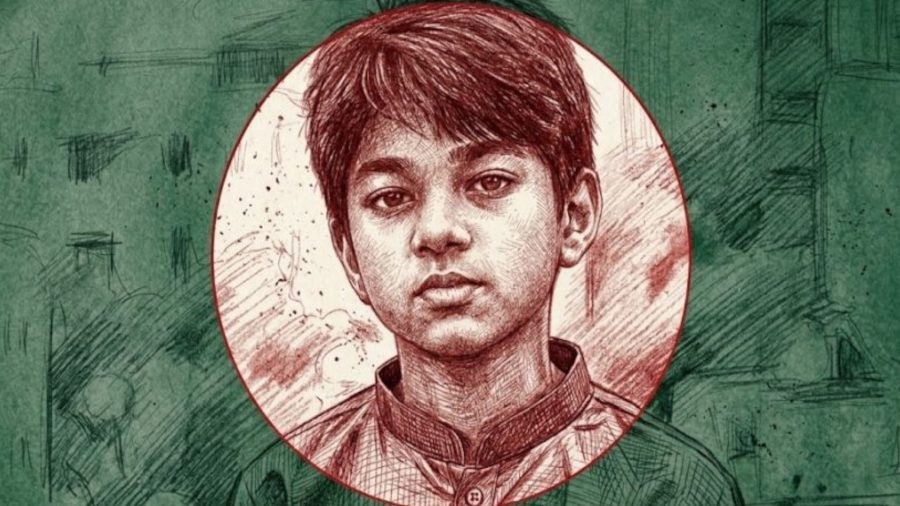

The murder of 13-year-old Aprotim was tragic enough on its own. But what happened after his death raised another set of uncomfortable questions about us as a society, about journalism, and about the way social media now responds to tragedy. After his body was recovered, cameras seemed to follow his parents everywhere. His mother’s crying, his father’s broken words, scenes from the burial and deeply private moments of grief were all pushed into the public space. We often forget that a parent who has just lost a child is not speaking from a normal emotional state. A grieving mother may say something in anger, despair or shock that she would never say under ordinary circumstances. Yet one such emotional statement from Aprotim’s mother quickly travelled across social media and was judged almost like a political position. Journalism has a duty to report the truth, but it also has a duty to protect dignity. Grief should not automatically become public property simply because a camera is present.
Then something even more disturbing happened. The discussion slowly moved from Aprotim’s death to Aprotim himself. Old videos from his social media accounts surfaced. In some, he was seen riding a motorcycle. In others, he appeared with friends who seemed older than him. Questions followed. Why did his parents give him an expensive phone? Why did they not know where he was going or who he was spending time with? These are not entirely unreasonable questions in a broader discussion about parenting. But timing and context matter. When a child has been murdered, going through his past behaviour in a way that quietly suggests he may somehow have contributed to what happened becomes a form of victim blaming.
A 13-year-old is supposed to make mistakes. Teenagers hide things from their parents, choose the wrong friends, take unnecessary risks and sometimes do things they later regret. This is precisely why society distinguishes between a child and an adult. We do not expect a 13-year-old to have the judgement of a 40-year-old. A child grows by making mistakes, facing consequences, learning and moving on. The cruellest part in Aprotim’s case is that he will never get that chance. He will never explain why he went somewhere, why he trusted someone or which decisions he himself might later have considered foolish. He will never come home after making a mistake and get scolded by his parents. He will never grow up and laugh at some of the things he did at 13. His life stopped there. Yet adults who are still alive are going through his old videos and judging his character.

This is also where the media has to examine its own role. Journalism does not simply provide information. It shapes perception. The picture we publish, the video we repeat, the words we put in a headline, and the people we identify all contribute to the story the audience begins to believe. Being seen with Aprotim in CCTV footage does not make someone a murderer. Being questioned by investigators does not make someone guilty. But today the distance between suspicion and conviction can disappear within hours. A name appears, a clip circulates, and thousands begin passing judgement. Some claim someone was released because money changed hands. Others declare a person guilty before an investigation is complete. When the same assumption is repeated thousands of times, it begins to sound like fact. The job of an investigation is to test suspicion. The job of journalism is not to turn suspicion into a verdict.
Aprotim’s death also exposed how deeply polarised our social conversation has become. His mother’s past political and social role became part of the debate. People questioned who visited the family, which political figures spoke to them and why. Some attacked her over her past position. Others asked why those defending her had remained silent about previous killings. Very quickly, the murder of a child was no longer just the murder of a child. It became another space for political camps to fight each other. Surely there should be moments when a grieving mother can simply be seen as a grieving mother, regardless of her politics. If even the death of a 13-year-old cannot briefly take us beyond political identity, then we have to ask what has happened to our capacity for empathy.




I wrote earlier in Daily TIMES of Bangladesh that one of the most valuable resources of the creative economy is our collective attention. Millions of people spending hours watching, reacting, sharing and commenting create an enormous social and economic force. But that raises a simple question: what are we doing with that attention? If grief, violence, humiliation and outrage are repeatedly pushed because they bring more engagement, we are no longer simply competing for attention. We are turning human vulnerability into a product. The treatment of Aprotim’s death makes that question painfully relevant again.
There is another part of this conversation we cannot ignore. What kind of world are our teenagers growing up in? A phone now gives a child access to films, dramas, short videos, influencers, violent imagery, gang culture and endless displays of power and aggression. Showing violence in a story is not the same as glorifying violence. Telling a crime story is not the same as making the criminal’s language, style, aggression or dominance look desirable. Yet those lines are often blurred. If adults sometimes struggle to make that distinction, how do we expect a 13-year-old to do it alone? We expect children to somehow understand what is performance, what is dangerous, what should not be copied and what is being repeatedly shown to them simply because an algorithm has learned that it keeps them watching.
It is also too easy to place all responsibility on parents. In many urban families today, both parents work. Rent, education, healthcare, transport and daily expenses keep families under constant pressure. Extended families are less common than before. A child may physically be at home while socially and emotionally living somewhere else through a phone. Parents may not know what their child is watching, who is influencing him or what kind of behaviour he is beginning to see as normal. This does not remove parental responsibility, but it means the problem is larger than parenting alone. We need a broader conversation about age-appropriate content, media literacy in schools, parental controls, clearer warnings around harmful material and the responsibility of platforms for what they repeatedly place in front of young users.
In the end, Aprotim’s death asks something uncomfortable of all of us. If we could examine every reaction posted when news of his death spread, we might see a disturbing picture of our collective state of mind. Who expressed grief? Who searched for his mother’s political identity? Who blamed his parents? Who judged a dead child from an old video? Who declared someone guilty without evidence? Journalism should not place another torch in the hands of an angry crowd. Sometimes its responsibility is to say that we do not yet know. A suspect is not automatically a criminal. A child’s mistake is not an explanation for his murder. A mother’s grief is not content. And sometimes the most ethical thing a journalist can do is simply lower the camera. Aprotim will not come back, but other children like him are still growing up around us. They will make mistakes, choose the wrong friends, ignore their parents and take risks. Our responsibility is not to put them on trial after they die. It is to build a society where they can make mistakes, learn from them, grow up and, most importantly, stay alive.
The views expressed in this article are solely those of the author