
Pakistan’s armed forces shot down eight drones launched by the Afghan Taliban on Wednesday after they crossed into Pakistani airspace near the Torkham border and the city of Kohat, security sources said.
The drones were intercepted by air defence systems described by the sources as “active and vigilant,” with four brought down in areas adjacent to Torkham and the remaining four near Kohat, reports DAWN.
Security sources said the armed forces and the Pakistan Air Force’s “Shaheens” had “professionally thwarted the Afghan Taliban regime’s cowardly attempt to target public areas.”
Earlier in the day, two “rudimentary” drones had reportedly been downed using “soft skill” methods roughly seven kilometres from Kohat city, with officials saying air defence systems remained on round-the-clock alert against “all threats from Kharjistan.”
Sources described the incursion as “yet another proof of the Afghan Taliban regime’s direct support and patronage of terrorists.”

The drone incursion comes two days after Pakistan carried out “calibrated” airstrikes against terrorist hideouts and safe havens along the border region with Afghanistan, in response to recent attacks in Khyber Pakhtunkhwa.
According to a statement from the information ministry on Monday, more than 28 terrorists were killed in the strikes, with the ministry warning that “Afghanistan continues to remain a hub of terrorism” and that the “threat to Pakistan emanates from Afghanistan.”
The ministry said the strikes followed a “well-planned intelligence-based ground operation” conducted on September 20 in Kohat and Hangu districts, in which nine terrorists were killed.


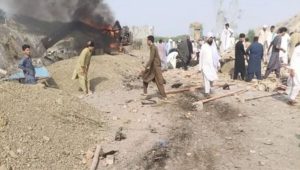
The airstrikes were also preceded by a major attack on the old Police Lines in Kohat that claimed 23 lives and injured around 100 others, prompting an overnight clearance operation in which eight terrorists were killed.
Separately, the military’s media wing said two officers and four others were martyred on September 20 during an exchange of fire between a security forces convoy and armed combatants in Hangu, during which eight terrorists were also killed.
This is not the first cross-border drone incident this year.


In July, the Afghan Taliban launched four rudimentary drones into Balochistan, which were shot down by Pakistani forces, while two further drones were downed in June in the Qila Abdullah and Chagai districts.
Relations between Islamabad and Kabul have remained strained, marked by repeated cross-border clashes over the past year.
Pakistan has consistently urged the Taliban administration to dismantle terrorist sanctuaries on Afghan soil, particularly those linked to the banned Tehreek-i-Taliban Pakistan (TTP), which it says are used to plan attacks inside Pakistan — appeals officials say have gone unanswered.
A day earlier, Deputy Prime Minister and Foreign Minister Ishaq Dar told a meeting of the Organisation of Islamic Cooperation that “seriously concerned” Pakistan wanted concrete and verifiable action to prevent Afghan soil being used for terrorism against any neighbouring state, citing the presence of more than two dozen terrorist groups in Afghanistan.
Last week, Pakistan informed the UN Security Council that it would respond to terrorist threats from Afghanistan in self-defence, in line with international law, whenever necessary.
Earlier this month, the Foreign Office said meaningful progress in ties with Kabul depended on the Taliban taking verifiable action against the TTP and other groups operating from Afghan territory, adding that while it welcomed China’s continued engagement on the issue, such facilitation could not replace direct action by Kabul.
A UN Security Council-mandated monitoring report covering December 16, 2025 to June 9, 2026 found that continued Afghan Taliban support for the TTP had contributed to a rise in the frequency and lethality of attacks in Pakistan, even as Kabul had taken some initial steps to restrain the group.
The report also highlighted growing operational and logistical links between the TTP, Al Qaeda, Islamic State-Khorasan (ISIL-K) and the Baloch Liberation Army (BLA).