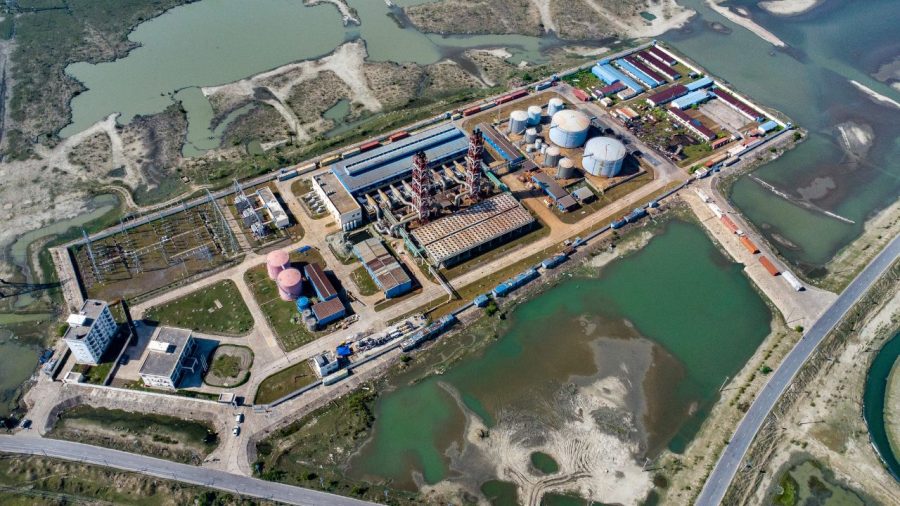



A string of thefts and robbery at factories and facilities in Mirsarai’s National Special Economic Zone is raising security concerns among investors, as growing industrial activity brings more machinery, construction materials and other valuable goods into the sprawling hub.
Three incidents since April – an attempted theft, an organised robbery at an under-construction factory and the theft of electrical cables – have prompted investors to seek stronger surveillance, tighter entry controls and more law-enforcement patrols.
The latest occurred on the night of 24 September, when 25 metres of electrical cable worth around Tk4 lakh was stolen from an under-construction Investor Club in the Bangladesh Economic Zones Authority (BEZA) zone.
Zorarganj police recovered the cables within about three hours of being informed, though the suspected thieves escaped.
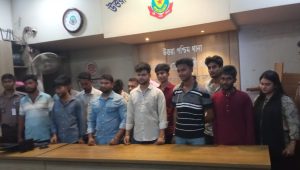
About a month and a half earlier, on 8 August, a group of around 10 to 15 people allegedly entered the under-construction factory of Bangladesh Auto Industries at night, intimidated security guards and took three mobile phones, around 250 metres of electrical wire and other valuables.
Police arrested seven people and recovered the stolen wire after an operation lasting around 32 hours.
The first of the three incidents occurred around 3:30am on 14 April, when five to six people allegedly scaled the boundary wall of Health Care Life Science and entered its premises. They confronted security guards before fleeing when other guards and employees arrived. The company later filed a written complaint with Zorarganj Police Station.

Investors push for tighter security
The incidents are putting security alongside infrastructure, utilities and logistics as a concern for investors as construction and movement of equipment and materials increase across the economic zone.
Bangladesh Auto Industries Project Manager Abdus Samad said the government and BEZA should take primary responsibility for overall security and preventing unauthorised entry.
“This is a vast area spanning around 30,000 acres. BEZA needs to establish its own well-organised security system here. Surveillance and checking at every entry point should also be strengthened,” he told TIMES.
Individual factories, particularly those under construction, do not have enough personnel to confront organised groups of thieves or robbers, Samad said.
“Investors are putting large amounts of money into the country’s economic development. We cannot operate our businesses while constantly remaining worried about robbery or theft,” he said.




Investors have already raised the issue with senior BEZA officials and the project director and plan to press for stronger security at an upcoming coordination meeting, according to Samad.
A senior official at a factory in the Bangladesh Export Processing Zones Authority (BEPZA) Economic Zone, speaking on condition of anonymity, said several establishments had experienced thefts of electrical connection cables, heavy transformer cables and other materials brought in for factory installation.
The official said the size of the industrial zone made security difficult, particularly because the number of police and Industrial Police personnel was inadequate for the area.
Additional private security guards or volunteers should be deployed, particularly at night, until adequate government security arrangements are in place, the official said, also calling for more law-enforcement patrols.
Security expansion planned
The BEPZA Economic Zone occupies 1,138.55 acres within the larger National Special Economic Zone.
Abdullah Al Mahbub, executive director of BEPZA Economic Zone-1, said security in Zones 1 and 2 was being prioritised.
“We have recently appointed a new security officer. Around 100 additional security guards will join within the next month. Currently, we have 50 in-house security personnel and 30 Ansar members,” he said.
The existing boundary wall is six feet high, and a proposal has been submitted to raise it to 13 feet and install barbed wire on top. Work is expected to begin within the next two to three months, Mahbub said.
Industrial Police also identified the zone’s size and incomplete perimeter security as major challenges.
Mahmuda Begum, superintendent of Chattogram Industrial Police-3, said the area was not yet fully enclosed by boundary walls or controlled gates, leaving opportunities for unauthorised entry.
Industrial Police-3 currently deploys around 50 personnel in the area under an inspector.
A proposal has been submitted to establish a separate 160-member Industrial Police-9 unit for Mirsarai, while discussions are under way to select a permanent site for its camp and office, Begum said.
“In such a vast area, when police are patrolling one section, miscreants may try to exploit another. Industrial police and district police are working jointly to maintain security,” she said.
Police, however, say security shortcomings also exist within individual establishments.
Md Abdul Halim, officer-in-charge of Zorarganj Police Station, said inadequate boundary walls, closed-circuit television cameras, lighting and security personnel at many establishments were contributing to theft incidents.
Police recovered the cables stolen on 24 September shortly after receiving the complaint and had also arrested suspects and recovered stolen goods following the earlier robbery, he said.
“Many establishments within the industrial area do not have the minimum security measures required for their protection. Several lack boundary walls and CCTV cameras, while lighting is also inadequate at night,” Halim said.
He urged investors and factory authorities not to panic but to strengthen basic security at their establishments.
Attempts to reach Md Tayebur Rahman, deputy director for planning and investment at the Mirsarai 2B Economic Zone, for comment were unsuccessful as his phone was switched off.