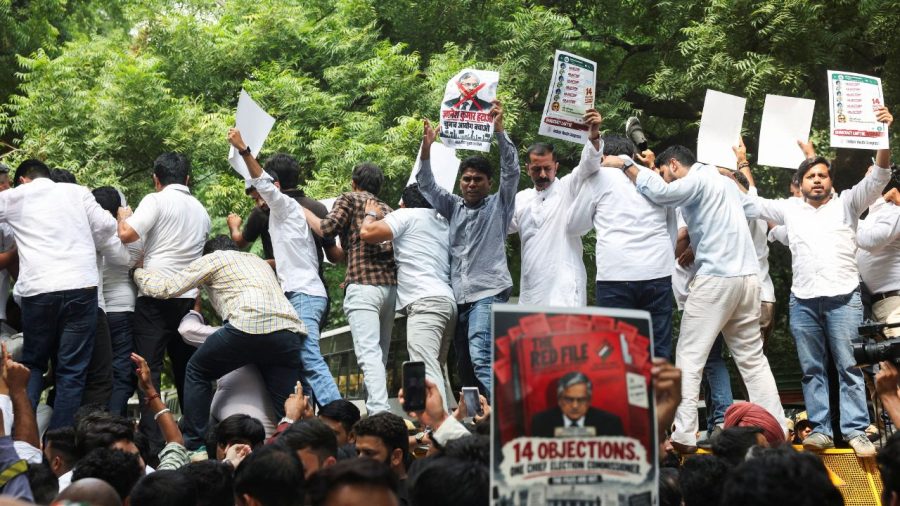



Indian police fired tear gas and water cannon on Friday to break up nationwide demonstrations by Congress party supporters demanding the resignation of the country’s chief election commissioner, whom they accuse of manipulating electoral rolls to favour Prime Minister Narendra Modi’s ruling party, reports Reuters.
Officers used water cannon in at least two cities, including Chandigarh in the northwest, after demonstrators scaled buses and barricades, while similar scenes of unrest unfolded in more than a dozen of India’s 28 states.
In the capital, hundreds of protesters clambered over barricades and jeered at a man wearing a mask depicting the election chief.
The unrest represents a fresh political headache for Modi, whose government appointed Gyanesh Kumar, 62, a former civil servant, to lead the ostensibly independent Election Commission of India.
Congress and allied opposition parties allege the commission has worked in tandem with Modi’s Bharatiya Janata Party (BJP) to skew voter lists and tilt the outcome of recent state elections — accusations both the commission and the BJP reject.

Kumar has not personally responded to the claims.
The protests were sparked by a report in the Indian Express on Wednesday, which said Kumar’s own deputies had challenged him internally over amendments made to voter rolls that opposition figures claim disproportionately benefit the BJP.
Senior Congress figure Rahul Gandhi seized on the report, accusing Kumar of treason and demanding his immediate resignation, saying he had spent three years highlighting what he called vote theft, and that election commissioners were now themselves acknowledging the problem.




In Chandigarh, local Congress leader Amarinder Singh Raja told supporters that theft of votes was taking place right across the country.
Demonstrators in numerous states shouted slogans against Kumar and brandished placards calling for his arrest; in one location, an effigy depicting both Kumar and Modi was set alight.
Behind the unrest lies the “cockroach” youth movement, a loosely organised but influential campaign that claims millions of supporters and was credited with forcing India’s education minister from office in July.
The group has warned it will stage fresh nationwide protests on 2 October unless Kumar steps down by Saturday. Other opposition parties have thrown their weight behind the campaign, widening its political reach beyond Congress alone.
The Election Commission, for its part, has sought to play down the reported rift among its officers, saying differences of opinion were normal within any institution and insisting all its actions had been lawful.
The BJP dismissed the newspaper report outright, characterising it as a smear campaign by opposition parties struggling to accept that the ruling party’s popularity was the real reason behind its electoral successes.
The row comes at a sensitive moment politically. State elections are due next year in several key battlegrounds, including Uttar Pradesh, India’s most populous state, and Gujarat, Modi’s home state — both currently governed by the BJP.
Those contests are widely seen as a barometer of public sentiment ahead of national parliamentary elections scheduled for 2029, raising the stakes around any perception that the polling process itself is being manipulated.
The Election Commission of India, established under the constitution, is formally tasked with overseeing free and fair elections and has long been regarded as a pillar of the country’s democratic institutions.
Opposition allegations of bias against the body are not new, but the reported internal dissent among commissioners marks an unusual escalation, lending fresh momentum to calls for greater scrutiny of how India’s vast electoral machinery — which serves close to a billion eligible voters — is run and overseen.