The 1960s, Bangladesh was under the authoritarian rule of Ayub Khan, who sought to impose the state’s ideology on culture itself. Rabindra Sangeet faced censorship, and there were even calls to purge ‘Hindu traces’ from the Bengali alphabet. At that turbulent time, Zahir Raihan rose in defense of the Bengali language and culture. In 1966, he made Behula—a film that transcended folklore to become a declaration of Bengali cultural identity. On October 28, the film marked its 59th anniversary. In the history of Bengali cinema, it stands not just as a classic but as a cultural document.
From Folk Myth to National Consciousness
Behula draws its story from the immortal epic of Bengali literature, Manasamangal—a tale where human struggle, love, and defiance against destiny are woven through myth. The goddess Manasa demands worship; merchant Chand Saudagar refuses, provoking her wrath and the death of his sons. Ultimately, the newlywed Behula embarks on a perilous journey by raft to the realm of the gods to restore her husband’s life.
Zahir Raihan turned this mythical tale into a profoundly human epic. His camera doesn’t dwell on divine miracles—it illuminates human courage and love. Behula here is not a goddess; she’s a woman who refuses to bow before fate, who does not remain silent in the face of injustice.
The film begins with a simple but powerful line: “The Padma Purana is a poem of real people.” That single sentence encapsulates the film’s philosophy—its focus is on humanity, not divinity.
The Language of Cultural Resistance

At that time, Dhaka’s film industry was dominated by Urdu-language productions aimed at the West Pakistani market. In that context, Zahir Raihan made a film entirely in Bengali—its dialogue, songs, and imagery steeped in the soil of this land.
With music composed by Altaf Mahmud, Behula became a living archive of Bengali folk traditions—panchali, kirtan, wedding songs, and elegies blending seamlessly to form a complete expression of Bengali culture. Through this very choice, Zahir Raihan seemed to declare: our strength lies in our own stories, our own myths.
When the state sought to erase Bengali identity, basing a film on Manasamangal—a “Hindu myth”—was itself a quiet act of cultural defiance.
Characters and Symbols



Behula stands as the symbol of feminine power. She is not the passive, devoted wife of tradition; she is a woman of resistance. In the words of Rajganak:
“She is Saraswati in knowledge, Draupadi in intellect, Savitri in virtue, and Durga in action.”
But the film’s most defining moment comes when Behula asks,
“If a husband cannot trust his wife, what meaning does chastity have?”
That single line crystallizes the entire film’s feminist vision.
Behula’s journey by raft becomes the metaphorical journey of a nation—from subjugation to freedom. The revival of the dead Lakhindar symbolizes the rebirth of Bengali cultural and political consciousness.
Manasa, Chand Saudagar, Bishu, and Komli—each character reflects layers of human society, faith, and irony. The dialogue between Bishu and Komli carries humour, but beneath it runs a subtle critique of patriarchy and social inequality.
Acting and Direction
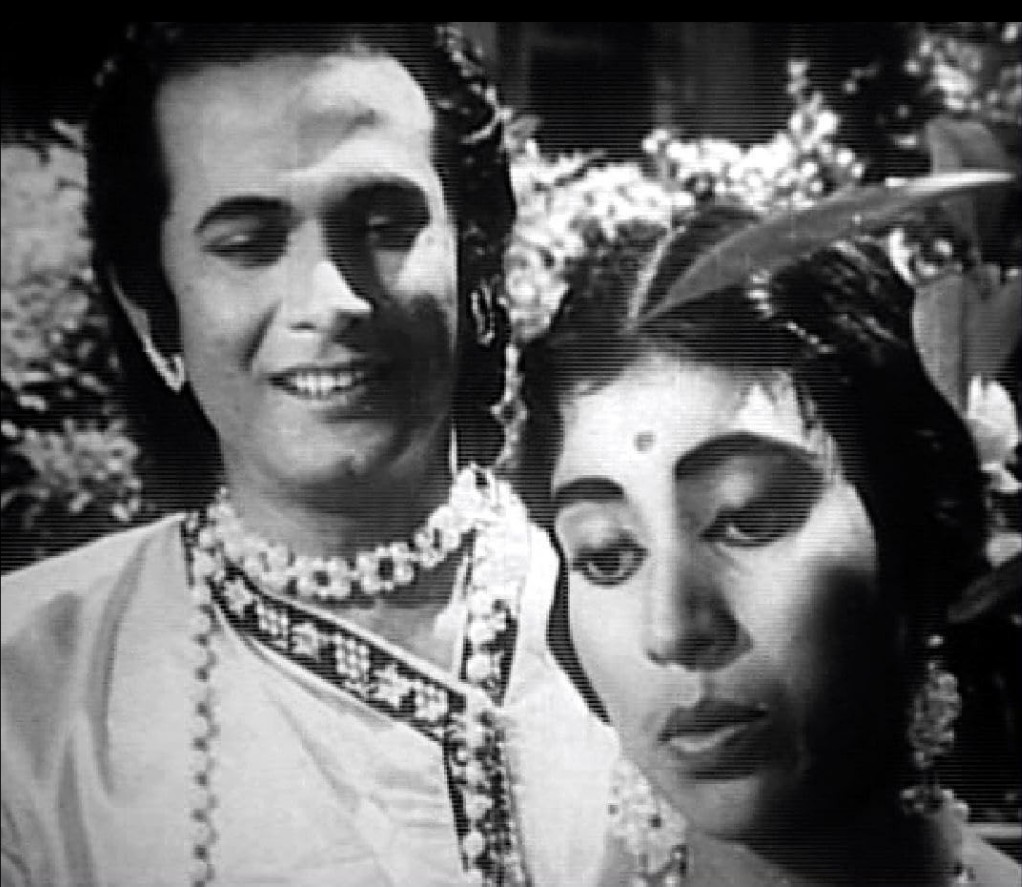
The soul of the film was Suchanda. Through the expressiveness of her eyes, the firmness of her voice, and the sorrow etched on her face, she turned Behula from a mythic figure into a flesh-and-blood woman of struggle. As Lakhindar, Razzak was restrained and composed embodying, in a way, the silent presence of patriarchy. Sumita Devi as Manasa, Fateh Lohani as Chand Saudagar, and Mohammad Zakaria as Shahi Saudagar—all delivered performances that gave the film its depth and balance.
Zahir Raihan’s direction was nothing short of extraordinary. Despite limited technology, he captured the river journeys, the raft sequences, and the celestial court of Indra with such artistry that every frame remains a lesson in cinematic aesthetics.
Music and Aesthetic Depth
Altaf Mahmud’s music was the soul of Behula. He rooted the score in the rhythms and ragas of Bengali folk traditions, blending them with the emotional current of the story. The voices of Shahnaz Begum, Neena Khan, Jharna Bandopadhyay, Moushumi Kabir, Nazmul Huda, and Mahmudunnabi carried the songs beyond their time—they still resonate today.
The Roots of Nationalism
In 1966, as Bangabandhu Sheikh Mujibur Rahman’s Six-Point Movement ignited political awakening, Behula became its cultural echo. If the Six Points were the manifesto of political freedom, Behula was its artistic proclamation.
Behula’s endurance, her relentless voyage stood as symbols of the Bengali people’s struggle for dignity and identity.
Zahir Raihan’s Behula is, therefore, far more than a myth-based film—it is the cinematic chronicle of a nation’s awakening.