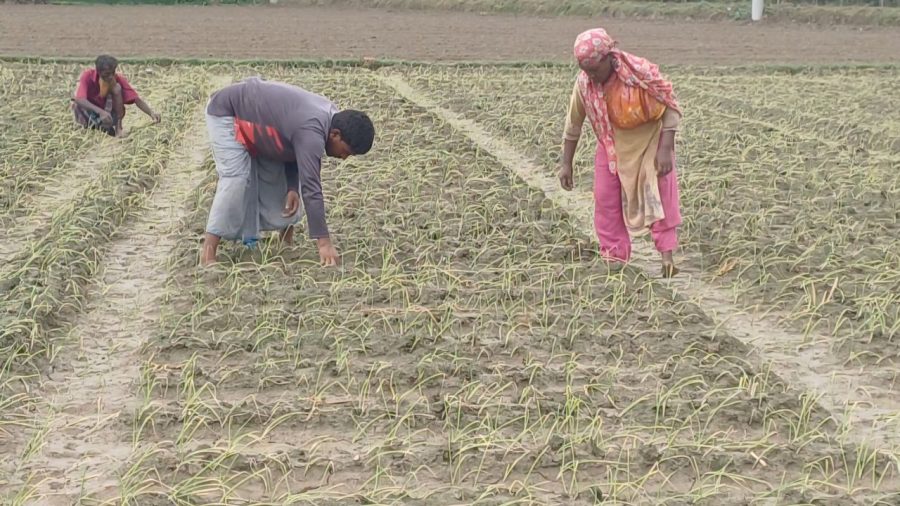



Farmers in Meherpur are struggling with fertiliser shortages and rising production costs as they tend Aman paddy fields and prepare for winter vegetable cultivation, raising concerns over crop yields and profitability.
Agriculture Department figures show that allocations of urea, triple superphosphate (TSP), diammonium phosphate (DAP) and muriate of potash (MOP) have all fallen below demand for the October-February period.
Farmers say they are spending hours queuing for fertiliser, buying supplies at higher prices or reducing cultivation.
Rising diesel, seed and pesticide costs, coupled with uncertain crop prices, have added to their worries.
Across the district, farmers are tending Aman fields and preparing land for onions, cabbages, cauliflowers and other winter vegetables, hoping early harvests will fetch better prices.

Babul Sheikh of Sheikhpara in Meherpur town usually grows onions on 12 to 15 bighas but has reduced cultivation to eight bighas this season because of inadequate fertiliser supplies.
“Without sufficient fertiliser at the right time, we cannot achieve the expected yield,” he said, urging the authorities to ensure adequate supplies.
Another Sheikhpara farmer, Mega Khan, grows Aman paddy on three bighas, requiring irrigation around three times a week alongside fertiliser and pesticide applications.
“We have to visit one dealer after another. Often, we cannot get fertiliser on time or in sufficient quantities,” he said.




He said higher diesel prices had increased land preparation and irrigation costs, making farming increasingly difficult without fair crop prices.
In Anandabas village of Mujibnagar upazila, vegetable grower Sohan Hossain said rising prices of seeds, fertilisers and pesticides had sharply increased cultivation expenses.
“If we do not get good prices in the market, we will suffer losses,” he said, adding that higher transport charges were further squeezing profits.
Abul Kalam, a farmer from Gangni upazila, said Meherpur supplies vegetables and onions to several districts, yet fertiliser allocations remain inadequate.
“We sometimes wait from morning until afternoon for one sack of fertiliser and still receive only half the quantity we need,” he said.
He urged the authorities to reduce input prices and ensure fair returns, warning that farmers could eventually abandon cultivation.
According to the Department of Agricultural Extension (DAE), Aman paddy covers 26,930 hectares this season, while the target for winter vegetable cultivation is 4,525 hectares.
For October-February, the district received allocations of 20,819 tonnes of urea against demand for 22,082 tonnes and 8,878 tonnes of TSP against 11,044 tonnes.
DAP allocations stood at 10,995 tonnes against demand for 11,802 tonnes, while MOP allocations totalled 7,493 tonnes against 7,785 tonnes.
Kazi Shahnewaz, deputy director of the DAE in Meherpur, said the department had submitted fertiliser requirements to the relevant authorities and was working to ensure fair distribution of available allocations.
He said officials were monitoring distribution and would investigate any irregularities.
Farmers were also being advised to adopt modern cultivation methods and cooperative transport arrangements to reduce expenses, he added.