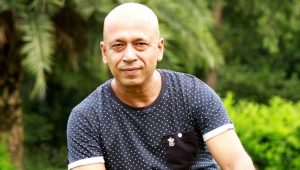
Anwar Hossain remains a celebrated figure in Bangladeshi cinema. Audiences affectionately called him the ‘Nawab,’ a title he carried throughout his career. To them, he was forever the crownless Nawab.
He was known for his versatility and reliability, performing in over five hundred films across a range of roles. His distinctive voice remains instantly recognizable to audiences today.
Born on November 6, 1931, in Murulia village of Jamalpur, Anwar was the son of AKM Nazir Hossain, a sub-registrar. From his school days, he had a keen interest in acting. His first deep connection with performance came through a stage role in Askar Ibn Shaikh’s play Padakkhep. Soon after, his journey flowed from stage to radio, and eventually to film.

He debuted in 1961 as a villain in Mohiuddin’s Tomar Amar and soon after played the lead in Salahuddin’s Surjosnan. Within five years, he appeared in 18 films, establishing himself as a dedicated actor. His breakthrough came in 1967 with Khan Ataur Rahman’s Nawab Sirajuddaula, where his performance earned him the enduring title of the ‘Nawab’ of Bangla cinema.



Anwar Hossain’s talent extended beyond historical roles. He excelled in political dramas, literary adaptations, children’s films, folklore, fantasy, social narratives, family melodramas, and message-driven cinema. He collaborated with nearly every major director of his era, and his performances in films such as Jibon Theke Neya, Arunoday-er Agnishakkhi, Lathial, Golapi Ekhon Traine, Bhat De, Boro Bhalo Lok Chhilo, and Dhire Bohay Meghna remain highly regarded.
Recognition came in many forms. He won the Nigar Award, and in 1975, he received the very first National Film Award for Best Actor for Lathial. He was again honored as Best Supporting Actor for Golapi Ekhon Traine. In 1985, he received the Ekushey Padak, and in 2010, the Lifetime Achievement Award at the National Film Awards.
Toward the end of his life, his body betrayed him. Long illness forced him away from acting. His last role was in Kazi Morshed’s Ghanee in 2006. When asked if he carried any regrets, he replied, “I have only one sorrow—that I can no longer act because of physical weakness.” That single line revealed the truth of the man: he could not imagine himself without acting.
On August 18, 2013, he was admitted to the hospital. He passed away on September 13 at the age of 82. His passing marked the loss of a dedicated artist who contributed over five decades to Bangladeshi cinema.