
Somewhere on the highway between Dhaka and Chattogram tonight, a 16-tonne truck is rattling back to its depot with nothing in the back. It dropped off its load hours ago. Its driver is not hauling anything on the return leg, not because there is nothing to haul, but because nobody told him what was waiting three kilometres away.
Multiply that truck by roughly a third of every truck trip in the country, and you start to understand why Bangladesh’s logistics bill looks the way it does.
This is not a story about potholes, though there are plenty of those. It is a story about a country that became extraordinarily good at moving one kind of cargo, the garments that make up 84 per cent of everything it exports, while quietly leaving everything else to fend for itself.
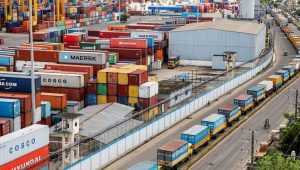
Almost everything Bangladesh sells abroad funnels through Chattogram, which handles over 90 per cent of the country’s trade and close to 98 per cent of its container traffic.
For decades, when someone decided where the next berth, highway or customs upgrade should go, there was really only one customer in mind: the container of shirts heading to a ship. It worked. It built a genuine export engine.

But it also meant that everything else — a sack of rice going to a wholesale market, a phone case on its way to Rangpur, a truck trying to find a paying load on its way home — was left to ride on infrastructure that was never built with it in mind.
The reflex answer is always “build more roads”. Sometimes that is true. Only a quarter of Bangladesh’s road network is paved, against a South Asian average of 57 per cent, and less than half the rural population has all-weather road access.
No app fixes a road that does not exist. But a road is a thing you build once. A truck’s route is a decision made fresh every morning, with whatever scraps of information its driver’s employer happens to have.




Two rival companies can send empty trucks down the same highway on the same afternoon and never know it. That is not a concrete problem. It is an information problem, and it happens to be the cheaper one to fix.
A shared tracking standard starts paying for itself almost immediately; a new highway takes a decade and hundreds of millions of dollars.
The World Bank found Bangladeshi trucks run empty roughly 35 per cent of the time, with utilisation around 70 per cent against Vietnam’s 80 per cent. Moving a tonne of goods here costs nearly three times what it costs in India or Pakistan. Fix the congestion and idle capacity, and the same report suggests logistics costs could fall by more than a third while exports climb 20 per cent.
Then there is the human end of this failure. Around 90 per cent of online orders in Bangladesh are still paid cash on delivery, not out of preference, but because nobody trusts the system enough to pay first.
Of buyers who report delivery problems, roughly two-thirds say their item arrived damaged, and more than half say it arrived badly late. Complaints to the national consumer-rights body jumped from about 12,000 in 2023 to nearly 80,000 by 2024–25, almost sevenfold in two years.
Evaly, once the country’s most talked-about e-commerce platform, took in hundreds of crores from customers and merchants while holding a fraction of that in real assets; its founders were finally sentenced in 2025, and most of the people still owed money have not seen a taka of it.
The empty truck and the customer who will not pay online are the same failure wearing different clothes: nobody holds a shared, current picture of where demand is and where the roads actually go.
Every courier, Steadfast, Pathao, RedX, Paperfly and the rest, has its own partial map and no reason to share it, because handing over that data gives a rival a competitive edge, while the benefit of a smarter national network gets split with everyone, including competitors.
That is not bad management. It is a textbook case of nobody privately building something everyone needs.
The writer is a data analyst at CartUp
Views expressed are solely those of the author