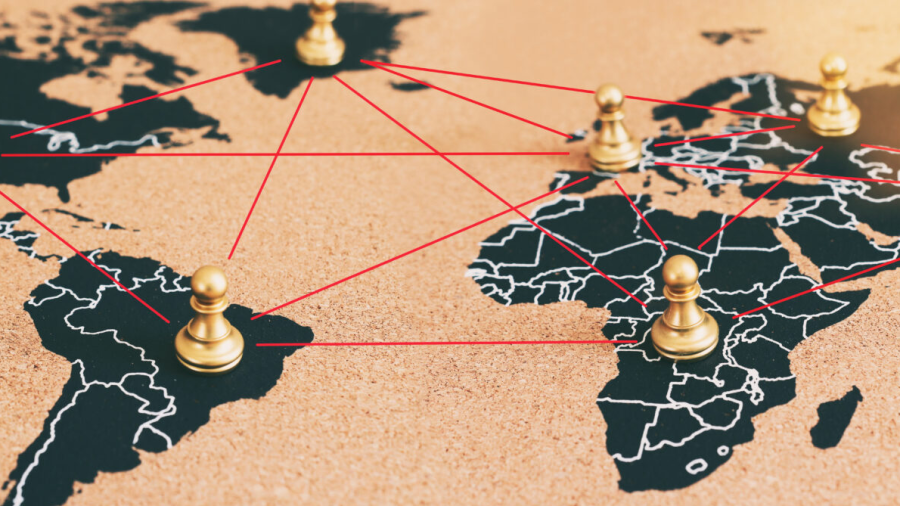

Born from the ashes of the Soviet Union in late 1991, America’s unipolar moment has quietly drawn to a close. Lasting roughly until 2017, that epoch of unparalleled American global dominance has been eclipsed by the rise of other powers, pushing the international system toward multipolarity. Today, major powers are increasingly asserting their autonomy and seeking an order in which the United States is one of several poles rather than the undisputed hegemon. This seismic structural shift is not a temporary departure from the post-Cold War order; it reflects a deeper redistribution of global power. That raises the question: What is the lure of a multipolar order?
The great-power rivalry between the United States and the former Soviet Union – rooted in security competition and the ideological divide between democracy and communism – forced the two nations into a Cold War shortly after World War II, creating a bipolar order. Because global events tended to unfold in predictable ways, this era was less raucous than previous periods of history. But it was not without volatile flashpoints; the most salient was the Cuban Missile Crisis in 1962. The threat of Soviet nuclear deployment petrified the world and brought it to the brink of war. Ultimately, prudence prevailed. President Kennedy and Premier Khrushchev de-escalated the threat, settling their differences through astute back-channel diplomacy and hard-fought negotiations. When the Cold War ended, the bipolar order disappeared, and the unipolar order took over.
A unipolar order was an exceptional phenomenon. It lasted barely three decades. Yet it served as an unintended catalyst for the future shift in world order. The sole hegemon, the U.S., assessed that the end of the Soviet Union meant no other country could remotely challenge its global supremacy. Warned by realists, inspired by liberal ideals, and driven by hubris, the U.S. made promoting democracy across the globe a core tenet of its foreign policy. Democratic peace theory – the idea that democracies don’t fight each other – was treated as a prescriptive panacea for the U.S. expansionist campaigns. Washington failed to realise, though, that lone power is greatly vilified and constantly challenged by those who aspire to a slice of that power pie.

Power has no inherent fidelity; it is retained only through proper mechanisms. More importantly, a state must know how to wield power wisely. During the unipolar moment, the U.S. was deeply engaged in conflicts and nation-building missions. China viewed the period as an opportunity to build a strong economy and leverage it to modernise a formidable military; the goal was to assert its primacy in its backyard – the East and South China Seas – and to reduce U.S. hegemony in the region. While the U.S. squandered its resources abroad on unnecessary wars, China quietly consolidated its own; this transformation considerably contributed to the emergence of the current order: multipolarity.
A multipolar order is one in which power is distributed among multiple influential states rather than a single dominant power. The allure of a multipolar order is its ideological neutrality. For example, Kyrgyzstan recently hosted the Shanghai Cooperation Organisation (SCO) summit, where leaders such as Xi, Putin, Modi, Pezeshkian, Sharif, and Erdoğan mingled and outlined a vision for a new global governance framework. These leaders come from diverse political backgrounds, where democracy, autocracy, theocracy, and monarchy converge around shared aspirations. As a result, forums like the SCO are gaining traction quickly in the Global South.




BRICS is another significant product of a multipolar order. It is an alliance of major emerging economies seeking to build alternative ways to conduct global business. BRICS membership is expanding, and many countries have already expressed interest in joining. For some, it is a hedging platform; they want an insurance policy in case relations with the U.S. go sour. India, for example, is one of the major powers that does so.
However, both the SCO and BRICS pose an enthralling puzzle: China and India remain locked in rigid border disputes, yet both are highly active in these groups. What brings them together? It is not an idealistic pursuit of peace but raw pragmatism. While they share a structural interest in revamping Western-centric trade and payment rules, New Delhi’s buoyant participation also serves a defensive purpose – ensuring Beijing cannot leverage these expanding blocs to establish uncontested hegemony over the Global South. Thus, multipolarity has its own subluminal tensions, too.
China has already risen. As a great power, it plays a pivotal role in the multipolar system. China is the only country capable of eroding U.S. power across several sectors, chief among them trade and commerce, machinery, connectivity, artificial intelligence, renewable energy, and infrastructure development. Each of these sectors is drawing the Global South closer to the Chinese camp rather than to the U.S. The Belt and Road Initiative’s astronomical growth, already adopted in over 140 countries, confirms that Chinese influence is spreading widely. Furthermore, China is the largest oil importer from Iran amid U.S. oil sanctions. The China-Russia friendship is described as a ‘friendship with no limits.’ Accordingly, these calculated Chinese moves create a wall of resistance to U.S. geopolitical strategies.
Geopolitical analysts are deeply divided on whether a multipolar order is prone to conflict. More countries than ever have retaliatory nuclear strike capabilities, a grave menace to the world. Russia is at war with Ukraine, which is arguably a war against the West and the U.S. Iran is fighting a war against the U.S. and Israel. India and Pakistan, both nuclear-armed countries, had a military confrontation not so long ago. North Korea is also a nuclear power and a close ally of both Russia and China. These countries are armed to the teeth. Even a modicum of flare-up between them can destabilise global security. Multipolarity is far from perfect; however, it is a pragmatic order that reflects the world’s true structure. The sooner the U.S. and the West internalise it, the better. Chinese President Xi Jinping recently reminded them, “The trend toward a multipolar world is irreversible.” Therefore, it is the ‘end of other history.’
The views expressed in this article are solely those of the author
The writer is a Doctoral Researcher, International Relations, Universiti Sains Malaysia (USM)