


On April 4, 2025, as the stock markets fell after his tariff announcement, the President of the United States posted five words in capital letters on Truth Social: “ONLY THE WEAK WILL FAIL!”
He was saying what politicians, executives, and so-called self-made men say all the time -the aggressive deserve to dominate, the vulnerable deserve to be discarded, and this is simply nature’s law. Even people who do not believe in evolution do not hesitate to claim Darwin here. Deregulation, budget cuts, and indifference to suffering are presented not as choices but as hard facts of life – survival of the fittest. It is not only a profitable belief for the people on top but also an intellectual fraud.
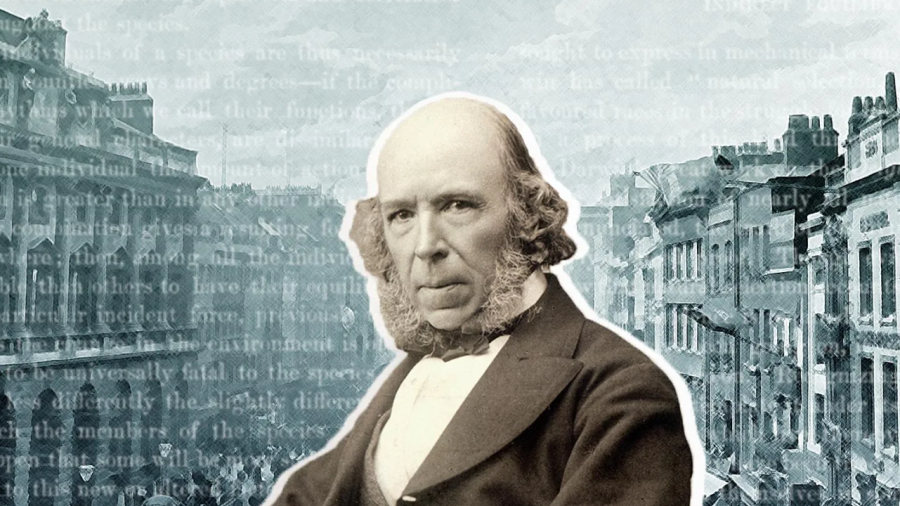
English philosopher Herbert Spencer, not Charles Darwin, initially coined the phrase ‘survival of the fittest.’ He held the ideology long before Darwin published anything. In his first book, Social Statics (1851), he was already arguing that the weak should be left to fail. The phrase told the wealthy that their wealth was natural and the poverty around them was deserved.
So let us be clear. Survival of the fittest is not a law of nature. It is a hyper-capitalist slogan hiding behind Darwin. Darwin himself did not use the phrase until 1869, in the fifth edition of On the Origin of Species. He took it up on the advice of his co-discoverer, Alfred Russel Wallace. Critics kept insisting that ‘natural selection’ implied a divine hand doing the selecting, and Wallace thought Spencer’s phrase would put that to rest. And what Darwin meant by ‘fittest’ was never brute force, ruthlessness, or the crushing of rivals. He meant the organism that best fits its environment and leaves the most offspring. That is the entire definition. Nothing about strength. Nothing about dominance.

‘Survival of the fittest,’ as people use it, makes two claims about nature. The first is that the strong crush the weak. The second is that every creature is on its own, and any creature that helps another is a fool. Elon Musk said it plainly on The Joe Rogan Experience in February 2025: “The fundamental weakness of Western civilisation is empathy.” Both claims are false, and they fail for different reasons. Nature is full of competition, but competition is not combat. In the wild, muscles cost food and aggression costs blood. An animal wounded in a pointless fight usually dies of infection. Natural selection, again and again, favours the creature that avoids the fight altogether.
Few creatures demonstrate this better than the Giant Australian Cuttlefish, studied for years by marine biologist Roger Hanlon and his team at the Marine Biological Laboratory in Massachusetts. During the breeding season, the massive bull males exhaust themselves in combat, flashing zebra stripes and spreading their arms wide to guard the females. The smaller males cannot win against their giant opponents, so they don’t even fight. They pose as females. They tuck in their arms, shift their skin to the soft mottled pattern of a female, and swim straight past the guarding bull. He lets them through. He even gets an ego boost, thinking he now has two women in his life. Meanwhile, under the rock, the small male in his disguise gets the girl and impregnates her. He has beaten his bigger, stronger opponent without breaking a sweat.




Now let’s talk about the second claim, Musk’s claim, that empathy is a weakness. It fails all the way down to the cell. In 1967, the evolutionary biologist Lynn Margulis published a paper her colleagues found absurd. The mitochondria inside our cells, the tiny engines that power every heartbeat and every thought, were once bacteria living on their own. Billions of years ago, one cell swallowed another and, instead of digesting it, kept it. The two entered a permanent symbiosis, each one living off what the other provided. The guest made energy. The host gave shelter and food. Biologists call this mutualism. Her paper was rejected by more than a dozen journals. It is now textbook biology, and it happened more than once. The chloroplasts that let plants turn sunlight into food were once bacteria too. Every complex organism on Earth, every animal, plant, and fungus, is descended from that merger. There was no victor. Complex life did not begin with one cell conquering another. It began with two cells agreeing to live together. As Margulis put it, life did not take over the globe by combat, but by networking.
Physically, humans are fragile primates with no claws, no fur, blunt teeth, and offspring requiring years of intense investment. What set us apart was cooperation, raising one another’s children, sharing food, defending the group together, and passing on what we learned. Darwin understood this. In The Descent of Man (1871), he explicitly rejected the idea that a society thrives by leaving the weak behind. He observed that tribes with the greatest number of sympathetic and faithful members would prevail over others, and wrote that we could not check our sympathy for the helpless ‘without deterioration in the noblest part of our nature.’
So, both claims fail. The strong do not always crush the weak, and the creatures that cooperate are not fools. But even if nature were as brutal as the slogan claims, it would prove nothing about how we should treat one another. Cholera is natural. So is infant mortality. We fight both, and no one calls the doctor a fool for it.
Humans are a tribal species. The instinct that kept us alive turns suicidal when it is deliberately turned against the wrong people. The question has never been whether we will have a tribe. The question is how many people we are willing to count as ours. The boundaries we are told to defend are manufactured. Race, religion, class, national borders, partisan camps. In the tree of life, there is only Homo sapiens. Take skin colour. It is not a sign of different kinds of humans. It is what the sun did to our ancestors. Dark skin protects against too much sunlight near the equator. Light skin lets in enough of it to make vitamin D in the north. Our complexion is a record of where our ancestors lived. Nothing more.

If our species is to survive, our tribal instinct cannot remain trapped inside these small boundaries. What evolution demands now is that we expand the tribe until it holds the whole of humanity, and the living world that sustains us. Nature does not worship the bully. But it will ruthlessly discard any species foolish enough to destroy the network that keeps it alive.
The views expressed in this article are solely those of the author
The writer is a filmmaker