


In October 2024, the Italian navy picked up a group of men in the Mediterranean and took them to Albania. Among them were Bangladeshis. Because Rome lists Bangladesh as a safe country, officials examined their asylum claims within days and rejected them. Then the story turned. A Rome court refused to detain twelve men from the group and ordered them back to Italy. Later, a specialised tribunal reversed the rejection of two Bangladeshis, accepting that what they suffered in Libya, from torture to forced labour, deserved protection. Europe’s top court added that any safe-country label must face scrutiny.
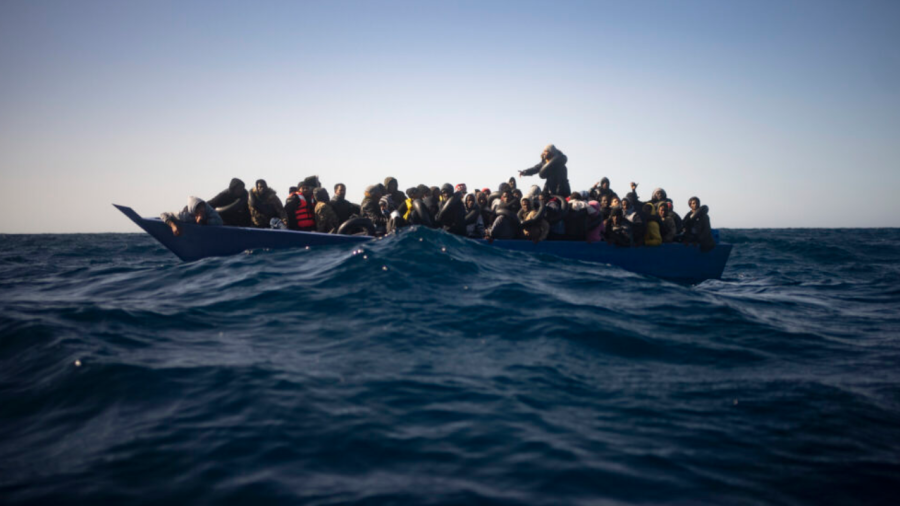
That is a rare happy ending. For many others, the journey ends in the sea. So how do they get there, and what awaits those who survive?
Nobody lands on a rubber boat off Libya by accident. IOM researchers estimate that about 14,000 Bangladeshis reached Italy by sea in 2024 and roughly 20,000 in 2025, making them the leading nationality on the route. By August this year, they made up 26.7 percent of Italy’s sea arrivals. Behind those numbers sits a large business. One study puts the smuggling economy at up to $190 million a year. Families pay brokers Tk10 to 14 lakhs, often for a job in Italy that does not exist. BRAC research found that 89 percent of those trafficked never found work. Many face Libyan detention until relatives pay again. Those who make it ashore usually ask for asylum. Italy registered 28,365 Bangladeshi applicants in 2025, its largest national group. In 2023, it had received 58 percent of all Bangladeshi claims in Europe.
Most are turned down, however. Of 29,595 first-instance decisions on Bangladeshis in 2025, only 380 granted refugee status and 155 subsidiary protections. Another 2,820 received ‘special protection’, a narrower national status. In short, about 11 percent were protected in some form, but 1.3 percent as refugees.

Why, then, do so many apply? Many surely seek asylum to legalise their stay, but that is not the whole truth. EUAA’s country report describes democratic backsliding that puts politicians, journalists and activists at risk, so some fears are real. Yet genuine applicants now risk disbelief because authorities assume Bangladeshi claims are fabricated.
If asylum is the back door, why not use the front door? The answer is that it has been stuck for years. Labour migration to Italy restarted under a bilateral agreement after a long freeze, yet only 1,164 Bangladeshi workers went in 2024, because Italy suspended older permits over forged documents. By August 2025, about 40,000 applications were pending, and only 8,000 had been cleared. Nearly 60,000 work-visa applications remain stuck at the Italian embassy in Dhaka. Italy plans 164,850 entries in 2026, but applicants from Bangladesh, Pakistan, Morocco and Sri Lanka face extra police and labour-inspectorate checks, with no approval by default.
Italy has good reason to fight forgery. Still, a state cannot lecture people about boats while its legal route works like a waiting room. Those 60,000 applicants deserve a deadline and a public answer from both capitals. Meanwhile, the border has narrowed further. Italy added Bangladesh to its national safe-country list in May 2024, and the EU followed. Parliament approved a common list by 408 votes to 184, and the Council gave final approval on 23 February 2026. Dhaka had yet to respond formally in 2025. Since then, its public line has been zero tolerance for irregular migration.

The logic is easy to follow. Italy rejected nearly nine in ten Bangladeshi claims. Yet ‘safe’ is a statistical judgment, while asylum is a personal one. The Euro-Med Monitor calls the label misleading and dangerous, but the European Union answers that individual assessment remains mandatory. The real question is whether the new timetable leaves room for it.
That timetable arrived in June. The EU Pact on Migration and Asylum became applicable in every member state on 12 June, and Italy’s Decree-Law 100/2026 made border procedures routine for defined groups, within a first-year ceiling of 16,032 cases. Those procedures can now run for twelve weeks. An appeal must be filed within five days and does not automatically stop removal. Moreover, the European Parliament has backed return hubs and centres outside the EU for rejected applicants.
Now consider what five days means for a man who survived a Libyan camp, owes relatives a heavy loan and has no lawyer. Evidence of torture takes weeks to gather. Because a Bangladeshi passport will now likely start the fast clock, he may run out of time before his story is heard.
Even those who avoid the fast track must wait. At the end of 2025, about 37,130 Bangladeshi cases sat pending in Italy. Italy’s overall backlog reached 237,485 by February 2026, though Eurostat marks the figure as unreliable. And those who do win a status often get the weakest one. Special protection permits run for two years, and since 2023 the right to convert them into work permits has been sharply restricted for new applicants. A Palermo tribunal granted special protection in 2025 to a Bangladeshi because of his roots and work in Italy, but nobody publishes how many Bangladeshis turn such permits into jobs.

Is there hope, then? Some. The Albania cases show judges will overturn hasty rejections when evidence exists, and Europe’s top court wants safe-country labels open to challenge. Legal quotas could make a boat pointless if they actually work. Dhaka and Rome have pledged to enhance legal pathways, and the CID has begun arresting brokers tied to deadly crossings. Hope, however, needs action. Dhaka should publish what it knows about who recruits, from which districts and through which networks. It should prosecute brokers instead of only warning families, and press Rome to clear the 60,000-file backlog and give genuine claimants proper legal help. Rome, for its part, should treat ‘safe country’ as a starting presumption, not a verdict.
Ultimately, the ray of hope is shrinking for Bangladeshis seeking asylum.
The views expressed in this article are solely those of the authors
Both the authors are Adjunct Faculty, Department of Media Studies and Journalism (MSJ), University of Liberal Arts Bangladesh (ULAB)