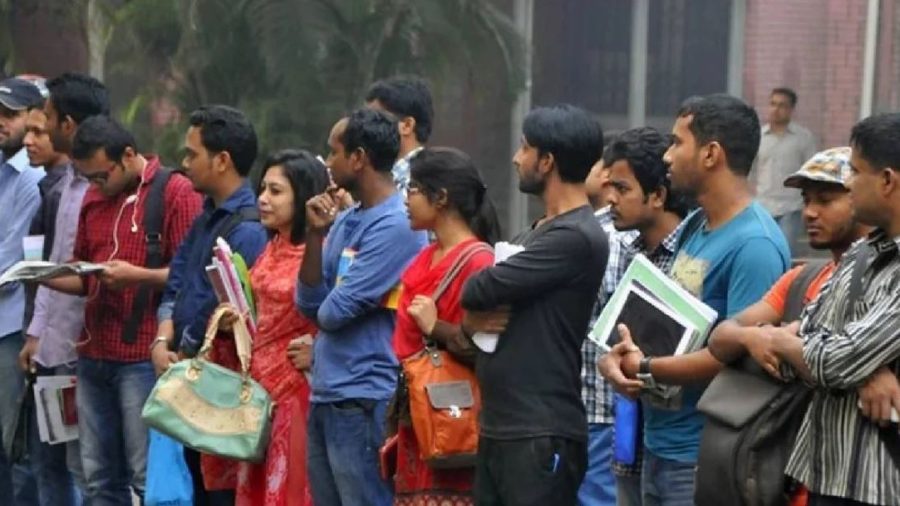



A graduation photo marks a family’s pride. This picture rarely highlights the sacrifices behind that achievement, including paying tuition fees with borrowed money, postponing the mother’s treatment, and adding extra years of work for the father. However, when a graduate spends many months filling out job-out-of-job applications without receiving any responses, unemployment is no longer just a statistic. Bangladesh should restore the broken promise of education and employment opportunities. The country has already done well in increasing access to education, but the certificate itself does not guarantee prosperity.
The Bangladesh Bureau of Statistics’ Final Labor Force Survey 2024 report indicates an unemployment rate of 13.5 percent among tertiary-educated people, and around 885,000 graduates are without jobs. This statistic reveals the uncertainty hidden behind the euphoria about educational advancement. However, pointing to a lack of skills among graduates is not the full diagnosis. Employers and job seekers both need each other. In March 2026, according to a study by the International Labour Organization, Bangladesh has had very little link between economic growth and employment, making job creation a necessary objective.
Thus, this problem has two aspects: increasing readiness for work and creating meaningful employment. Training cannot compensate for underinvestment, insufficient industrial diversification, and the neglect of merit in recruitment. The statistics on unemployment should also be read carefully. A graduate working odd hours in an irrelevant, low-paid job is still considered employed. National policy should consider wages, job stability, and skill utilisation alongside the employment rate.
University studies should foster independent thinking, good judgment, and citizenship while also giving learners the skill to apply what they learn. These are all interrelated. It is required of all graduates to research the problem, evaluate the information, communicate effectively, cooperate professionally, and apply appropriate technology. Artificial intelligence has added the need to validate results, secure information, and judge rather than delegate work to computers.
All these skills must be demonstrated during assessment. Thus, a future business student can examine a local company’s distribution system; a journalism student can investigate and verify it with multimedia; and an engineering student can diagnose technical problems.

Career preparation must start from the very beginning of studies. Students need information about career choices, workplace expectations, application procedures, and interview skills. Universities must monitor their graduates’ experiences and draw necessary conclusions.
Bangladesh should abandon the belief that higher education equals success and technical education equals failure. An economy can prosper only if it has technicians, electricians, machinists, health care assistants, mechanics, and similar skilled personnel. Technical education can instill self-confidence if it has good teachers, efficient infrastructure, certified degrees, a safe environment, and good earnings prospects. Publicity cannot compensate for a lack of substance.
Opportunities need to be available as well. Technical school graduates need to be able to attain higher degrees through accredited transfers and bridge courses. Mature students should be allowed to demonstrate what they already know and receive credit without repeating courses. The school counseling programme must clearly explain the implications, prerequisites, and job prospects of different choices. Students must decide whether to enter fields that do not match their abilities or potential. Apprenticeships can address an old dilemma: employers demand experience, yet young applicants often lack a first opportunity to get it.




Even Bangladesh has made some impressive progress on this front. As the World Bank reported in April 2025, more than 17,200 young people completed apprenticeships through its RAISE programme; over 90% were employed or running micro-enterprises afterward. While these results seem encouraging, one should not take them for granted as national results.
Growing programs should retain high standards. Every apprenticeship should comprise an individualised learning plan, qualified mentoring, adequate remuneration, workplace protection, and independent certification. Apprentices must learn transferable skills instead of becoming a continuous supply of cheap labour. Small firms might have to share training facilities and mentoring services. Public funding should encourage real learning and continued employment without risking the replacement of workers through such apprenticeships.
An agreement signed in a ceremony offers little benefit if it does not improve students’ learning or job prospects. Universities and employers should cooperate to identify needs, analyze curricula, arrange supervised work, and develop projects that help solve organizational problems. Attaching faculty members to the industry can help to rejuvenate classroom teaching, whereas practitioners can provide specialised teaching.
The partnership will require local businesses outside Dhaka. Businesses in sectors such as food processing, logistics, tourism, manufacturing, and ICT services can collaborate with regional organisations based on demand. For MBAs, a company assignment will let them combine finance, management, communication, and operations in a single assignment. The employer will receive a valuable analysis, while the student will learn to support their conclusions and identify weaknesses. Academic freedom should remain an overriding theme throughout the process. The employer should provide information without making education too career oriented.
Skills reform must be paired with policies that encourage productive investment, reliable infrastructure, competitive enterprises, and transparent recruitment. Entrepreneurship can expand opportunity, but it requires customers, mentoring, finance, and manageable business conditions.
Access is important as well. Placements should address transportation expenses, accessibility for disabled, sexual harassment at work, and obstacles to accessing education for women and disadvantaged students. Unpaid internships may bar exactly those youth who need this kind of opportunity. Government, institutions, and employers must provide comparable data on completion, placements, salary level, employment, and employer satisfaction. Resources can account for performance improvements.

Young people in Bangladesh have put in great effort to prepare for their future. Bangladesh needs to create stronger links between its youth and its future. Degrees should reflect practical knowledge; vocational programmes should reflect dignity; and apprenticeships should reflect decent job opportunities. If education builds capability and capability meets opportunity, then graduation begins to be good on the promise.
For Bangladesh, overcoming the skill-job mismatch is both an economic problem and a matter of maintaining citizens’ confidence. Parents can no longer afford to finance their qualified offspring without any promise of a future. Young people should not have to choose between becoming dependent on life or leaving their country to become somebody. They deserve to be treated in ways that match their dreams: universities that teach them in practice, respected colleges of vocational education, companies that want to employ them, and a government that cares about good employment.
This obligation is collective, but the cost of inaction would be borne mostly by the youth. Each year that goes by without getting one’s first job costs time, money, and confidence, and deprives the country of its creative force. The success of education in Bangladesh should be measured by its impact on its graduates’ lives, and the success of the economy by the opportunities it provides them.
The views expressed in this article are solely those of the author
The writer is a Professor and Former Chair, Department of Journalism and Mass Communications, Savannah State University. E-mail: [email protected]