
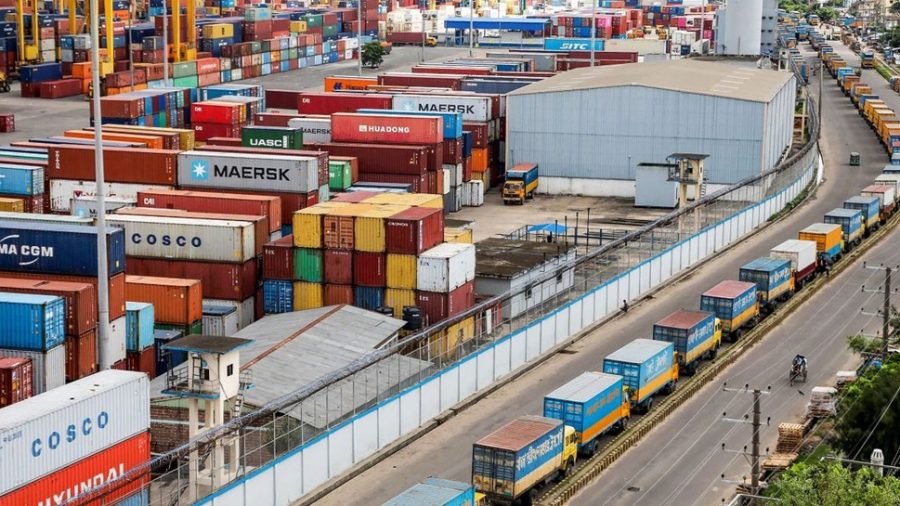

Bangladesh ended FY2025–26 with a merchandise trade deficit of about $27.3 billion. Imports increased by 10.5 percent while exports remained virtually stagnant. Analysing the latest Bangladesh Bank data, economist Abdur Razzaque has also pointed to an important qualification: the import recovery should not automatically be interpreted as evidence of an investment boom, as capital machinery and industrial raw-material imports remain weak. His analysis of the FY26 balance of payments provides an important economic backdrop to the widening trade gap. But there is another way to look at Bangladesh’s trade imbalance: ‘through a logistics lens’.
A trade deficit appears in economic statistics as dollars. Once those imports and exports enter the physical economy, however, they become tonnes of cargo, containers, vessels, trucks, trains, warehouses and terminal movements. The structure of trade therefore has consequences extending far beyond the balance of payments.
For the logistics sector, the important questions are different: What are we importing and exporting? Where do those cargoes originate and terminate? Through which gateways do they move? What transport and handling do they require? And is our logistics system organised efficiently around those flows?
Bangladesh’s merchandise export economy remains overwhelmingly concentrated in ready-made garments. The World Bank says RMG accounts for about 82 percent of Bangladesh’s exports, while leather goods, footwear, light engineering, plastics and other sectors still have considerable untapped potential. Imports are physically much more diverse. They include petroleum, food grains, clinker and other bulk commodities as well as cotton, chemicals, machinery, industrial materials and containerised goods.
Some imports arrive as liquid bulk, others as dry bulk, breakbulk or containers. Different commodities require different terminals, storage facilities, transport modes and supply chains. Even within containerised trade, equipment requirements vary by container size, type, location, shipping service and timing. This is where a macroeconomic imbalance begins to acquire a physical logistics dimension.
According to Chattogram Port Authority statistics, the port handled a record 3.52 million TEUs in FY2025–26, up 6.76 percent from the previous fiscal year. Total cargo throughput reached 137.74 million tonnes, another record. These are impressive numbers. But logistics performance cannot be judged by throughput alone.

Every tonne or container entering a port is only one part of a longer journey. Import cargo has to move from vessel to terminal, Customs clearance, warehouse, factory or consumer. Export cargo moves in the opposite direction through its own chain of collection, consolidation, documentation, inland transport, terminal handling and shipping.
Bangladesh’s logistics debate has traditionally focused on physical capacity: ports, terminals, highways, bridges, railways, ICDs and economic zones. All are necessary. But infrastructure and logistics are not synonymous. A wider highway does not necessarily produce an efficient supply chain if trucks spend excessive time waiting or return empty. A railway connection does not automatically attract freight if schedules and commercial arrangements do not meet shippers’ requirements. An inland terminal does not become successful merely because cranes and yards are available. And expanding a seaport does not solve logistics inefficiency if cargo continues to encounter delays elsewhere in the chain.
Bangladesh has spent decades debating how to reduce its dependence on garments. Pharmaceuticals, leather and footwear, agro-processing, light engineering, plastics, electronics and other industries regularly appear on lists of promising sectors. But producing an exportable product is only the beginning.
Garments benefit from a logistics ecosystem that developed over several decades: bonded warehousing, freight forwarding, inland container depots, consolidation, Customs procedures, shipping connectivity and buyer-driven supply chains. Other sectors need logistics systems appropriate to their own characteristics.




Perishable agricultural exports may depend on cold chains and airfreight. Pharmaceuticals require highly controlled handling and regulatory compliance. Engineering products may need different packaging, consolidation and shipping arrangements. Regional exports may depend more heavily on land ports, rail or inland waterways than traditional apparel exports destined for Europe and North America.
The World Bank’s recent work on export diversification demonstrates that non-RMG sectors can expand when firms receive the support needed to meet international standards and enter global value chains. Nearly 180,000 jobs were created across targeted firms under its Export Competitiveness for Jobs initiative.
The approval of the National Logistics Policy 2025 is therefore important. The policy explicitly seeks to modernise transport and trade infrastructure, improve export competitiveness and develop a more integrated logistics environment. But a policy becomes valuable only through implementation.
Bangladesh now has an opportunity to shift the logistics conversation from individual projects towards an integrated national freight system. That means asking how Chattogram, Mongla, Payra, land ports, airports, ICDs, roads, railways and inland waterways can complement one another rather than being planned largely as separate assets. It also means examining Customs, documentation, digital systems, warehousing and private logistics services as parts of the same cargo journey.
There is another consequence of Bangladesh’s trading structure that receives much less attention. Imports and exports do not necessarily generate matching transport demand.
The cargo arriving at a gateway today may not produce an equivalent outbound movement tomorrow. Import and export origins may differ geographically. Transport equipment required by one commodity may not suit another. Peaks in import demand may not coincide with export seasons.
This asymmetry can leave trucks, wagons, vessels, warehouse space or containers underutilised in one direction while capacity is constrained in another. In other words, trade imbalance can become logistics imbalance. One current example is the growing debate over empty-container management around Chattogram. Business groups and port stakeholders are seeking greater flexibility over where empty containers can be positioned and stored as existing facilities face pressure.
But that issue deserves more than a passing discussion about storage space. It raises deeper questions about how Bangladesh manages transport equipment, regulatory boundaries and the physical consequences of its trade structure.
Digitalisation can eventually make much of this visible. But visibility must lead to coordination and better decisions. Bangladesh’s $27.3 billion trade deficit is primarily an economic issue. It should be analysed by economists in terms of investment, foreign exchange, savings, consumption and the balance of payments.
From a logistics perspective, however, it tells another story. Trade is not ultimately moved in dollars. It is moved in ‘tonnes, TEUs, trucks, wagons, vessels and aircraft’.
The challenge is therefore not simply to balance the monetary value of imports and exports. It is to build a logistics system capable of managing the physical flows generated by a changing economy – efficiently, predictably and at competitive cost. And sometimes the consequences of imbalance become remarkably visible.
At Chattogram, they can be seen in something that appears to carry nothing at all: an empty container. That is where the next part of this discussion should begin.
The views expressed in this article are solely those of the author
The writer is a Maritime, Logistics and Supply Chain Policy Analyst | Former Head of ICD Kamalapur & Pangaon ICT