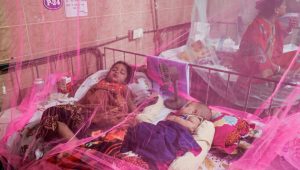
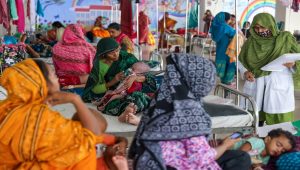
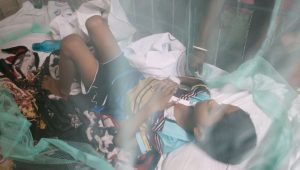
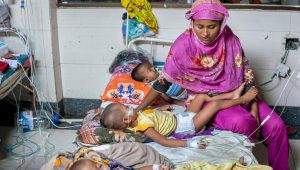
A 23-day-old infant, Abu Hurayra, is battling measles and related complications in the neonatal intensive care unit (NICU) of Bangladesh Neonatal Hospital in Narayanganj, as his mother remains by his side, holding onto hope through a difficult and emotional ordeal.
The baby’s father, who is working in Saudi Arabia, has not yet been able to hold his child. Meanwhile, his mother, alone beside the incubator, faces this struggle with unwavering determination.
Medical professionals have said that cases like Abu Hurayra’s – a 23-day-old baby with measles – are extremely rare worldwide.
“According to global infectious disease literature, measles in a baby this young is a rare event,” Professor Mozibur Rahman, chief consultant of the hospital, told TIMES of Bangladesh.
He said the infant shows classic symptoms, including fever, conjunctivitis, pneumonia and a characteristic rash that began near the ears and spread across the body.

Newborns usually receive protective antibodies from their mothers, which can provide immunity for six to nine months, and sometimes up to a year in well-nourished populations, he added.
Meanwhile, nine children died from measles and related symptoms in the 24 hours leading up to Saturday, bringing the total number of fatalities to 352. Additionally, 1,435 new suspected cases were reported nationwide.
Medical records show the infant, Abu Hurayra, born on 16 April, was admitted at the hospital on 8 May, at 8:10pm. Mozibur Rahman said the baby’s samples have been sent to a reference laboratory for confirmation, though clinical signs strongly indicate measles.


Mother Asma Akhter said the baby fell ill on Thursday after suddenly developing symptoms. She mentioned that there were no known measles patients around him, and she is unsure how her son contracted measles-like symptoms.
She said a doctor at a hospital in Narayanganj first examined the child and suspected measles. “The doctor said it looked like measles and told us to admit the baby,” she said.
She added that she initially did not understand the severity of the condition and moved between facilities before the child was finally admitted to the neonatal hospital.
Professor Mozibur Rahman said in countries like Bangladesh, where many mothers suffer from malnutrition, anemia and iron deficiency, babies may not receive sufficient antibodies.
He added that the ongoing outbreak has increased exposure risk even among very young infants.
Former Principal Scientific Officer of the Institute of Epidemiology, Disease Control and Research, Mohammad Mushtuq Husain, told TIMES that measles is spreading widely in Bangladesh and declining immunity is being observed not only among vulnerable groups but also in middle-income families.
He said when a virus spreads widely in the community, it becomes more powerful due to increased transmission.
He added that malnutrition and maternal health remain key risk factors, as children born to undernourished mothers may have weaker immunity and face higher risk of severe infection.
Mushtuq Husain said that no major change has been observed in the virus itself. He said the situation reflects gaps in child health, maternal health and the health system’s capacity to control outbreaks and called for stronger intervention to protect affected infants.
Health Secretary Md Quamruzzaman Chowdhury said on Saturday that an investigation is underway to determine the causes behind the ongoing measles outbreak, child deaths and reported gaps in health administration.
“The incidents of child deaths from measles are being investigated. Once the investigation report is prepared, it will be made public,” he said.