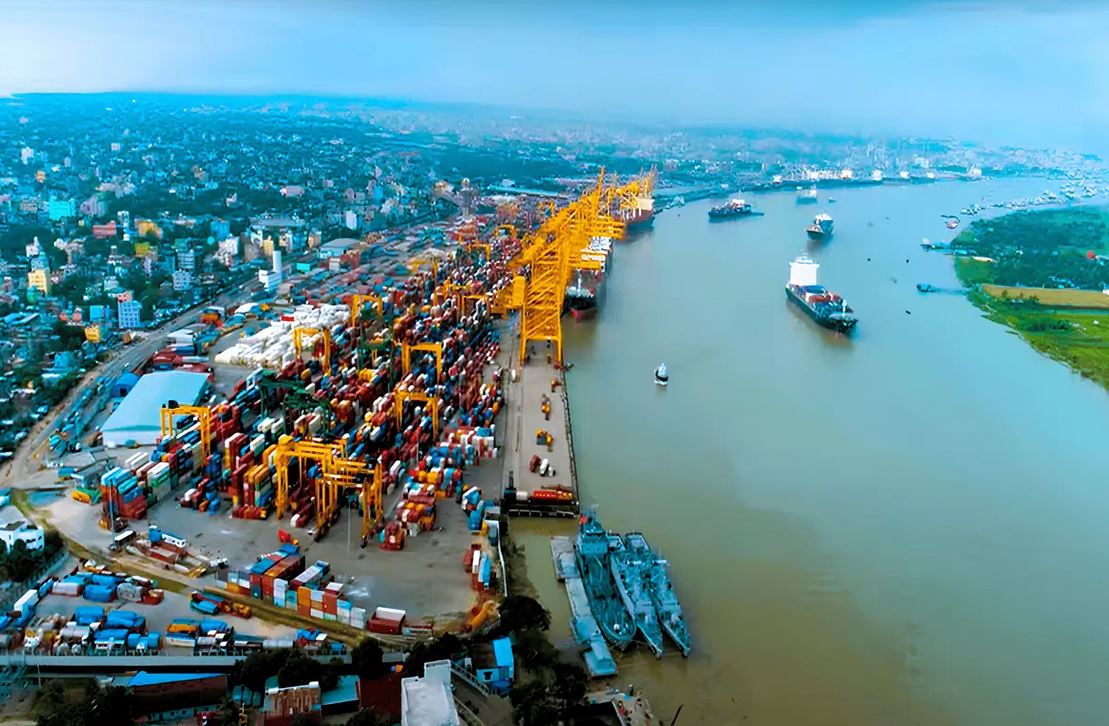

Bangladesh’s logistics sector is entering a period of major transformation. Terminal concessions, growing private participation, multimodal transport expansion, and increasing integration into regional and global supply chains are reshaping the country’s logistics landscape.
Discussions surrounding the proposed concession arrangements of both the New Mooring Container Terminal (NCT) and Chittagong Container Terminal (CCT) at Chattogram Port—alongside growing interest from global and domestic operators such as DP World, RSGT International, and MGH Group—have therefore triggered an important national conversation, not only about operators, but about governance itself.
The issue is not whether Bangladesh should welcome private investment or international expertise. In many respects, it must. Global operators can bring technology, investment, managerial capability, and operational efficiency that Bangladesh needs to modernise its logistics system and strengthen trade competitiveness.
At the same time, the participation of domestic logistics firms alongside major international companies also reflects the growing maturity of Bangladesh’s logistics sector. Diversified participation may encourage healthier competition and reduce excessive dependence on any single operator.
However, the more important question lies elsewhere. Who will oversee and regulate Bangladesh’s increasingly complex logistics ecosystem once operational control gradually shifts toward concession-driven and commercially integrated models?
This concern is becoming increasingly visible among exporters, importers, freight users, and business stakeholders themselves. Some fear that excessive dependence on a limited number of large operators could gradually weaken the bargaining position of cargo users, particularly regarding tariffs, service conditions, operational transparency, and dispute resolution.
Such concerns should not be interpreted as opposition to private participation. Rather, they reflect a broader governance challenge that Bangladesh must now address carefully.

Under traditional public port management, port authorities exercised direct operational control over terminals. Under concession arrangements, however, the role of port authorities gradually shifts from operator to landlord and regulator. While this model is widely practiced internationally, it also requires strong institutional safeguards.
At present, Bangladesh’s logistics governance structure remains fragmented across multiple agencies and legal frameworks. Chattogram Port Authority (CPA), Mongla Port Authority (MPA), and Payra Port Authority (PPA) operate independently under separate administrative structures. Customs administration functions under the National Board of Revenue (NBR), road transport under BRTA, inland waterways under BIWTA, while railway logistics and freight services follow separate institutional arrangements.
Each institution performs important sectoral responsibilities. But logistics efficiency is no longer determined by isolated institutional performance. It depends on how effectively the entire logistics ecosystem works together. That coordination gap is becoming increasingly costly.
When ports expand without synchronized rail connectivity, congestion shifts outside terminal gates. When customs systems evolve without interoperability across shipping agents, freight operators, and inland depots, delays continue despite digitalisation. Bottlenecks are relocated rather than eliminated.
Efficient logistics is not only a port issue. It affects export competitiveness, investment confidence, industrial productivity, consumer prices, and the overall cost of doing business. As Bangladesh’s logistics system becomes more complex, fragmented governance may ultimately become one of the country’s most expensive inefficiencies.




This is why Bangladesh may now need to move beyond coordination alone and establish a statutory National Logistics Commission (NLC).
The proposed Commission should not function merely as another coordination committee or administrative layer. Rather, it should become the central logistics governance institution responsible for integrating, monitoring, and regulating the country’s increasingly interconnected logistics ecosystem.
Most importantly, the National Logistics Commission should serve as the principal implementing authority for the recently adopted National Logistics Policy 2025. While the policy already provides strategic direction, successful implementation will require an empowered institution capable of translating policy objectives into coordinated actions across ports, customs, transport, multimodal logistics, and private-sector operations.
The Commission could therefore function as a logistics regulatory body, licensing and compliance authority, performance monitoring institution, tariff oversight mechanism, grievance redress platform, and strategic coordination body capable of integrating the country’s increasingly interconnected logistics ecosystem under a coherent national framework.
Under such a framework, major logistics actors—including terminal operators, berth operators, shipping lines, freight forwarders, NVOCCs, customs brokers, inland container depots, multimodal transport operators, and logistics service providers—could gradually be brought under a unified governance and compliance framework. This would help establish clearer accountability and more transparent market practices across the logistics sector.
The NLC could also introduce performance benchmarks covering vessel turnaround time, cargo dwell time, crane productivity, truck turnaround, digital efficiency, and service reliability. Transparent monitoring systems would help ensure that logistics efficiency remains aligned with national trade competitiveness rather than solely commercial objectives.
Equally important is the issue of tariff governance and user protection. As private participation expands, exporters, importers, and freight users increasingly require predictability and transparency regarding charges, surcharges, and service conditions. The objective would not be to discourage investment or interfere unnecessarily in commercial operations, but to ensure fair competition, balanced market conduct, and protection of users within strategic national infrastructure.
The Commission could also play an important role in dispute resolution and grievance management. At present, disputes across the logistics sector often become fragmented, slow, and institutionally unclear. Exporters, transport operators, freight users, and logistics service providers lack a dedicated sectoral platform for resolving operational and commercial grievances efficiently.
A specialized dispute resolution mechanism under the NLC could gradually help fill that gap through mediation, arbitration, complaint management, and quasi-judicial oversight.
In this regard, the proposed Commission may also include a dedicated Judicial Commissioner nominated through an appropriate judicial process, preferably from among retired judges of the High Court Division or individuals qualified to hold such office. The Judicial Commissioner could constitute adjudicatory benches together with technical commissioners depending on the nature of disputes, combining judicial neutrality with sector-specific expertise. Such an arrangement may strengthen institutional credibility and improve stakeholder confidence in logistics dispute resolution.
Digital integration would form another critical responsibility of the Commission. Bangladesh’s logistics digitalisation efforts remain fragmented across multiple systems and agencies. Ports, customs, shipping lines, freight operators, and inland depots often operate through disconnected digital platforms. The NLC could help coordinate interoperability standards, cargo visibility systems, and integrated logistics information platforms to improve transparency and efficiency.
International experience offers important lessons. Countries such as Singapore, Malaysia, and Vietnam strengthened logistics competitiveness not only through infrastructure investment, but through integrated governance systems capable of aligning operators, regulators, infrastructure agencies, and users within unified national strategies.
Bangladesh does not necessarily need to replicate any single regional model. The country’s logistics ecosystem, institutional realities, and emerging concession-driven transition are unique in many respects. The objective should therefore not be to imitate neighbouring frameworks mechanically, but to develop a governance structure that best serves Bangladesh’s long-term economic and trade interests. If designed effectively, such a model may itself become a useful reference for other emerging logistics economies in the region.
Bangladesh’s next logistics challenge is no longer building more ports and terminals. It is building the institutions that can govern an increasingly concession-driven logistics ecosystem with transparency, competition and accountability.
Bangladesh has already entered a new era of logistics transformation. The remaining question is whether its governance architecture is ready for it. A National Logistics Commission may therefore no longer be simply a policy idea. It may now deserve serious national consideration.
The views expressed in this article are solely those of the author
The writer is a Maritime, Logistics and Supply Chain Policy Analyst; Adjunct Faculty, Bangladesh Maritime University