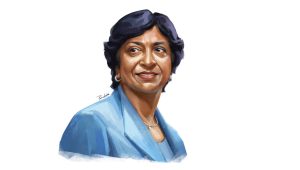
Some women build careers. Others build courage in a nation. Nilima Ibrahim did both.
Nilima was born in 1921 in Bagerhat and grew into one of Bangladesh’s most formidable intellectuals – an educationist, writer and social reformer whose life was intertwined with the cultural and political heartbeat of her country. But it was not titles or accolades that defined her. It was the way she stood steady when history turned violent.
Long before the Liberation War reshaped Bangladesh, Nilima was already a scholar of rare discipline. She completed her MA from the University of Calcutta in 1943 and later earned a PhD from the University of Dhaka in 1959, all while raising five children.

At a time when higher education for women was still a battle in itself, she quietly claimed space in lecture halls and academic circles. She began teaching in 1944 and eventually became a professor of Bengali at Dhaka University, later serving as Chair of the department, Director General of Bangla Academy and Provost of Rokeya Hall. Her leadership extended beyond academia into women’s organisations and social advocacy.
Then came 1971. While many fled, Nilima stayed. She sheltered student leaders, supported freedom fighters with money and medicine and faced the brutality of war head-on. After liberation, when the nation struggled to rebuild, she turned her attention to those who had endured a different kind of battlefield – the women who had been raped and tortured during the conflict.



These women were given the title Birangona, which means war heroines, yet society often met them with stigma and silence. Nilima refused that silence. At the request of Bangabandhu Sheikh Mujibur Rahman, she helped establish rehabilitation centres for survivors, contributing to the formation of the Nari Punorbashon Board. But she did more than organise support systems; she listened.
From those conversations emerged Ami Birangana Bolchi, a groundbreaking work that documented the first-person testimonies of seven survivors. By giving them space to speak, she challenged a society that preferred to look away. The book remains one of the most powerful feminist interventions in Bangladesh’s literary history, not just a record of trauma but an assertion of dignity.
Her scholarship was equally expansive – spanning literary criticism, fiction, drama, translation and autobiography. She received the Bangla Academy Literary Award, Begum Rokeya Padak, Ekushey Padak and numerous other honours – recognition of a lifetime dedicated to language, culture and women’s empowerment.
Yet beyond the accolades, there was also the woman – a mother who balanced scholarship with family life, a mentor who nurtured generations of students, and a leader who believed independence meant both self-reliance and compassion.
Nilima Ibrahim passed away in 2002, but her legacy continues to echo in classrooms, literature and in every conversation about justice for women. She reminds us that courage is not always loud. Sometimes it is the quiet act of listening, documenting and standing beside those the world would rather forget.
For women today, her life is more than history – it is a call to use our education, our voices and our positions, however big or small, to create space for others.