


Memes in Bangladesh operate a lot like cartoons used to. For a long time, newspapers used political cartoons to make powerful points about power, governance and societal paradoxes. Unmad, Bangladesh’s first satirical magazine based on cartoons, became immensely famous even before then by employing comedy and caricature to bring out social and political flaws. These cartoons propagated through the media and changed people’s opinions, just like memes do now, but only within the limitations of institutional distribution.
Tokai, the well-known cartoon character created by artist Rafiqun Nabi, is a highly notable example. Tokai wasn’t just a made-up guy; he stood for something important in society. This street child character talked about class inequalities, corruption and the hypocrisy of city life in brief but cutting exchanges. Tokai shows how a simple-looking visual figure can become the centre of a wider social debate.
According to Limor Shifman, it is this conceptual standpoint of imitation that is critical in understanding the difference between the Dawkinsian meme and the internet meme. Not meme but rather enthymeme better captures the essence of internet memes as a digital phenomenon marked not by imitation but by the capacity to propose or counter a discursive argument through visual and often also verbal interplay; the emphasis here is on those internet memes that inhere a critical component of society.
In Bangladesh’s political history, the media has always been an important location for negotiating power, protesting and shaping public opinion. Along with print and electronic media, social networking sites, have recently become key locations for political discourse. Political memes are a popular but contentious method to communicate in this digital age. Memes have a big effect on how people think and feel about things, and they use simple pictures, satire and connections to other texts to do this.
Political memes in Bangladesh have become more popular since 2013. Especially after events like the Shahbag, the national elections that followed, the quota reform, the Road Safety Movement and more recent rallies conducted by students and citizens. These events led to a lot of talk and activity on social media. In a media world where mainstream channels sometimes hold back because of political, legal or institutional demands, memes have become an alternative way to communicate that allows for criticism, parody and dissent.

The Digital Security Act 23 and cases of online spying, arrests and legal harassment have made work in a fearful and unpredictable atmosphere. This makes the role of political memes even more important because authors have to balance expression with risk. They typically make political remarks by using coded jokes and indirect symbols.
Political memes are growing more popular in the US, Europe, India and the Middle East as a method for individuals to get involved in politics, share their opinions and challenge those in charge. These visual-discursive artifacts exist at the crossroads of humour, ideology and popular culture, allowing complicated political messages to spread quickly through digital networks.


During the presidential elections in 2016 and 2020, political memes became very popular in the US. They were employed as both new and old ways to run political campaigns. Memes that made fun of politicians converted abstract political ideas into simple, visually attractive, and emotionally charged stories. This approach worked well to get younger people involved since memes were a popular and accessible way for them to discuss politics.
Political memes in Europe have been linked to immigration, nationalism and Euroscepticism. During the Brexit referendum in the UK, memes not only highlighted how split the public was on the topic, but they also circulated misleading information and made political arguments too simple. They show that the internet public realm is increasingly tense and susceptible, where emotional resonance frequently surpasses factual intricacy.
In India, political memes are a big component of Hindu nationalist talk, online trolling and elections. Memes have two main uses here: getting people to support political causes and nationalist feelings, and are regularly used to bully religious minorities, journalists and individuals who disagree with them online.
Political memes and visual satire were also essential in displaying resistance to authoritarian governments during the Arab Spring upheavals in the Middle East. These digital manifestations enabled people around the world to notice local protests and made it easier for people from other nations to voice their support on social media. In this setting, memes functioned as symbolic instruments that challenged state-controlled narratives and expanded the forum for dissenting voices.
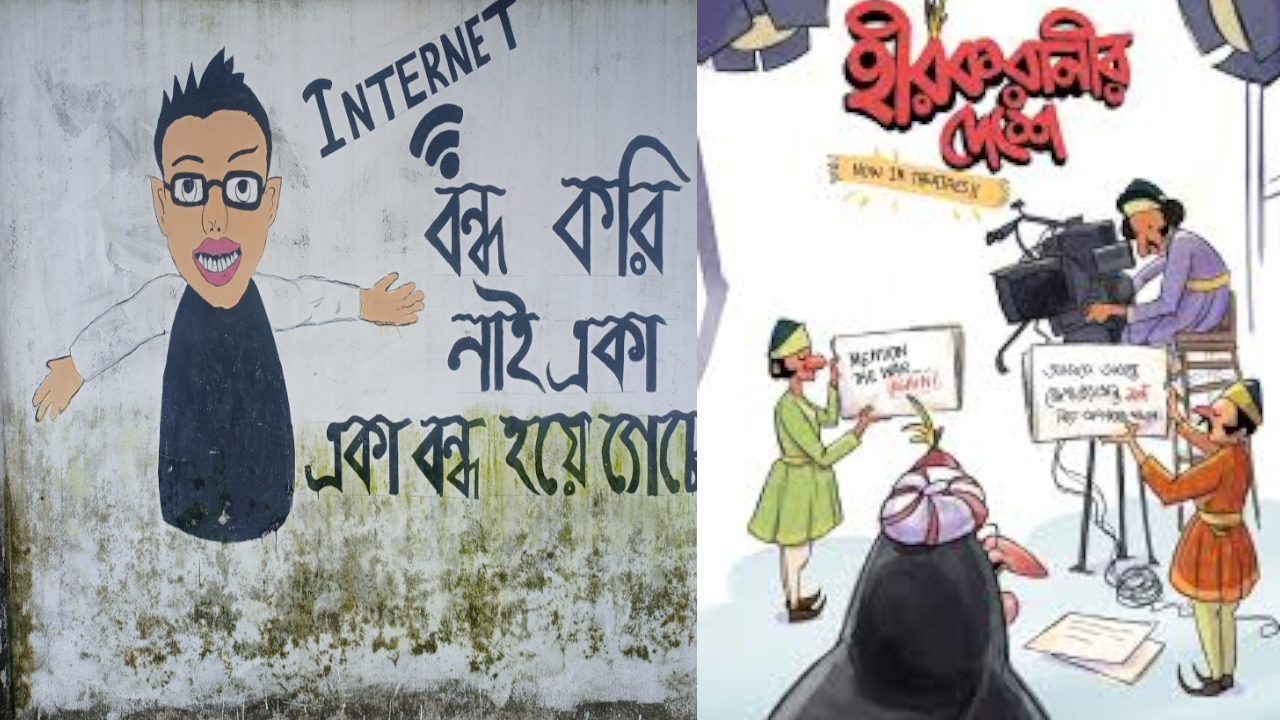
‘Internet বন্ধ করি নাই, একা একা চলে গেছে reads the text in Bengali. (We didn’t shut down the internet, it shut down on its own.) Given that internet shutdowns in Bangladesh in July 2024 are frequently under state control, the word suggests irony. The issue of internet filtering is furthered by the WiFi emblem. A criticism of internet shutdowns enforced by the government, frequently with political or security justifications. ‘হিরক রাজার দেশে (In the Land of Diamond King). Meaning of this meme: A critique of political regimes that exploit historical occurrences, like the Liberation War, to stay in power.
During civic movements like the Road Safety Movement and the Quota Reform Movement, political memes became more prominent as strategies to protest and show support. When mainstream news didn’t cover what protesters wanted or what they were going through very well, memes showed what activists went through, how the government reacted and how regular people were suffering in ways that were easy to understand and emotionally powerful.
These visual stories propagated on media, which helped online support networks flourish and kept the protests visible even when they weren’t happening in person. Their rapid dissemination among younger demographics contributed to the emergence of an alternative digital public sphere that contradicted mainstream political narratives. At the same time, legal actions and harassment aimed against meme pages focusing on Dhaka University Central Students’ Union (DACSU) sparked fresh conversations about freedom of speech and the Digital Security Act, showing that Bangladesh’s democracy has some limits. The (DUCSU) and its aftermath represent a particularly revealing period in this progression.
Political memes have also played a big role in national parliamentary elections. Both the ruling party and the opposition have utilised memes in smart ways during elections to promote their candidates, fight back against their opponents and change people’s minds. Many of these memes utilise insults against political opponents, emotive appeals and storylines that are too simple, which makes political polarisation worse. They also illustrate how voters experience suspicion, dread and dissatisfaction, which gives us an insight into the social psychology of elections in Bangladesh.
The views expressed in this article are solely those of the author
The writer is a Special correspondent, Jamuna TV