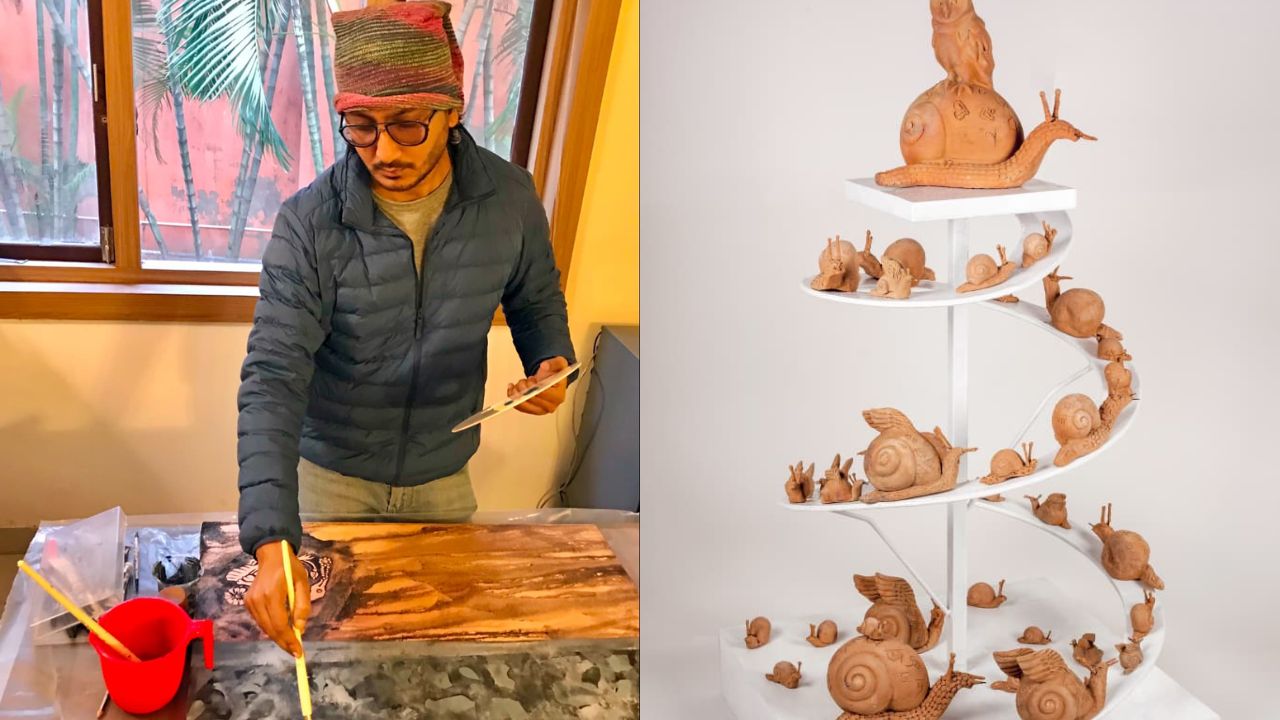



A Mughal emperor stands beside Tepa Putul. An owl shares the frame with the tiger from Gazir Pat. Centuries collapse into a single canvas in Sourav Chowdhury’s imagined universe, where prehistoric cave paintings, Egyptian traditions, Bengali folklore and contemporary life coexist. For the artist, it is a way of travelling through time.
A popular name among Bangladesh’s current generation of artists, Chowdhury has spent more than two decades building a visual language where history, mythology, folklore and fantasy meet in playful, intricate ways.
In an exclusive interview with the TIMES of Bangladesh, he spoke about his artistic journey, inspirations, travels and an evolving practice that refuses to stay within one medium.
Born in Rangpur and raised in Rajshahi, Chowdhury completed his undergraduate and postgraduate degrees in painting from the University of Development Alternative (UODA). Alongside his studies, he explored photography, design and direction, experiences that later enriched his visual practice.
“I am inherited from a beautiful family which adores, honors and promotes art and culture,” Sourav Chowdhury told ToB. “It helped me to embrace art as my way of living, and fortunately I always received moral support from my family.”

In 2012, he joined Gallery Cosmos and now serves as its Artistic Director. Nearly 15 years of working with artists and cultural initiatives in Bangladesh and abroad have shaped his understanding of the country’s art scene.
“My journey with Gallery Cosmos has been quite beautiful,” Chowdhury said. “Since Cosmos works to promote Bangladeshi art and culture nationally and internationally, I feel that through my work I can contribute, even in a small way, to our art and culture.”
His exhibition journey began with his first solo exhibition in 2016. The following year, he travelled to Russia for exhibitions and artistic programmes, spending around one and a half months there.



“I had two exhibitions there and had a wonderful time, and it remains one of the most significant experiences of my life,” Sourav Chowdhury told ToB.
Since then, he has travelled to India, Russia, China, Sri Lanka, Nepal, Bhutan, the Philippines, South Korea, Singapore and Indonesia, among others. For him, travel is a way of learning about cultures and collecting stories.
“I have always wanted to time travel,” he said. “Since there is no time machine, I do it through my artworks.”
That idea drives Eternal Existence, his long-running series developed over more than a decade. The works draw from prehistoric cave paintings, Egyptian visual traditions, Mughal history, Bengali folk culture, mythology and contemporary life.
In his imagined universe, owls, Tepa Putul, the tiger from Gazir Pat, Mughal emperors and other characters from different eras occupy the same visual space.
“I have always been fascinated by how people created such extraordinary things thousands of years ago,” he said. “How were the pyramids built? How were cave paintings created thousands of years ago without modern materials? I have always wanted to go back and experience those worlds.”
Yet Chowdhury refuses to be confined to one medium. Printmaking remains important, but he has also explored painting, sculpture and installation using metal, clay, ceramics and fibre.
“I don’t want to remain within a specific medium,” he said. “I want to establish myself simply as an artist and express my thoughts through whatever medium I need.”
Humour and optimism also define his visual language. Bright colours, lively characters and playful interpretations of Bengali idioms and proverbs turn darker aspects of human nature into something more joyful.
He remains hopeful about Bangladesh’s contemporary art scene, particularly its younger generation.
“Our master artists have already shown us a path, and the enthusiasm of the younger generation inspires me,” he said. “I believe Bangladesh can one day become one of the prominent countries in the world of art and culture.”
For Chowdhury, the past is never really past. Through folk characters, ancient images, mythical creatures and forgotten stories, centuries that once seemed distant can exist in the same world.