


Bangladesh could turn tannery solid waste into a new resource-based industry and replace around $100 million in annual imports of gelatin, glue, shoe soles and poultry-feed additives, according to a study presented at a policy dialogue in Dhaka on Monday.
The Savar Tannery Industrial Estate generates about 84,000 tonnes of solid waste a year, of which roughly 60-70 per cent consists of chrome-free beamhouse trimmings and fleshings that could be processed into gelatin, collagen, protein meal and tallow, Business Initiative Leading Development (BUILD) said.
BUILD CEO Ferdaus Ara Begum said fragmented policies, unclear waste classifications and the absence of source-level segregation leave much of that material underused or improperly dumped.
She said tannery solid waste should be treated as secondary industrial raw material rather than hazardous refuse.
The study outlined business models ranging from large commercial biorefineries to small and medium-sized tallow extraction units.

Industries Ministry Additional Secretary Smriti Karmakar said tannery waste could support new businesses, investment and green entrepreneurship while addressing pollution, resource efficiency, compliance and value addition.
She said the ministry was ready to work with BUILD and other stakeholders on practical policy measures.
BUILD Chairperson Abul Kasem Khan said the sector could support export diversification, attract foreign direct investment and generate revenue, but investors were facing shortages of suitable raw materials despite the volume of waste generated.



Participants identified weak coordination, poor segregation at source, unclear regulation, limited financing, inadequate traceability and environmental-compliance gaps as the main obstacles.
Several speakers called for a dedicated tannery solid waste policy, clearer standard operating procedures, digital tracking, easier environmental clearance and stronger coordination among government, industry and development partners.
University of Dhaka Development Studies Professor and Research and Policy Integration for Development Executive Director Mohammed Abu Eusuf called for a comprehensive approach, stronger coordination and compliance, along with better-organised slaughterhouses to improve raw-material quality.
Dhaka Tannery Industrial Estate Waste Treatment Plant Company Ltd Managing Director Md Golam Shahnewaz pointed to strong domestic demand for gelatin, including from Bangladesh’s capsule market.
Bangladesh Tanners Association General Secretary Mizanur Rahaman said dedicated processing plants could convert material now treated as waste into industrial inputs, while noting that no factory inside the Savar Tannery Industrial Estate currently held Leather Working Group certification.
Practical Action Country Director Ishrat Shabnam called for digital tracking, standardised waste segregation and more effective financing support, including incentives for women entrepreneurs.
Bangladesh Finished Leather, Leathergoods and Footwear Exporters Association President Tipu Sultan said weaknesses in the central effluent treatment plant remained a major obstacle to international compliance.
United Nations Industrial Development Organization Country Representative Alamgir Hossain said leather could become an important alternative growth engine as Bangladesh seeks to diversify its economy ahead of least-developed-country graduation.
Bangladesh Small and Cottage Industries Corporation Director for Promotion and Development Kazi Nazrul Islam proposed a master action plan and a coordination committee involving the Industries Ministry and other agencies.
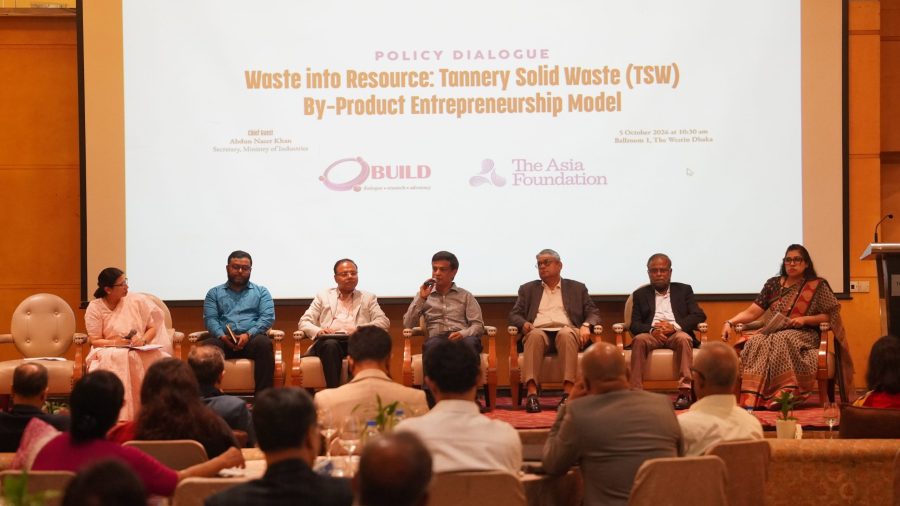
The policy dialogue, titled “Waste into Resource: Tannery Solid Waste Byproduct Entrepreneurship Model”, was jointly organised by BUILD and The Asia Foundation at The Westin Dhaka.
Representatives from Invest Bangladesh, Bangladesh Bank, the Commerce Ministry, Bangladesh Council of Scientific and Industrial Research, Export Promotion Bureau and private-sector businesses also took part.